 Breeds
Tibetan Mastiff: Imposing, Loyal Guardian
The Tibetan Mastiff isn't just an imposing-looking dog; his genetics hold the memory of centuries at extreme altitudes, as shown by the EPAS1 gene that lets him breathe at 4,000 metres. Understanding his legacy as a Himalayan guardian explains his demanding temperament and specific care needs, and why he isn't a breed for inexperienced owners.
History and origin of the Tibetan Mastiff
Few breeds have been what they are for as long as the Tibetan Mastiff. His ancestors guarded flocks and Buddhist monasteries on the steppes of Central Asia, standing up to wolves and snow leopards with nothing but his own instinct. Generations upon generations above 4,000 metres leave a mark, including in the DNA: high-altitude individuals share EPAS1 gene variants with Tibetan wolves, a transcription factor that helps the body function on little oxygen ‘EPAS1 variants in high altitude Tibetan wolves were selectively introgressed…’ (2017). Hence that massive build and that non-negotiable temperament.
In Europe he was an almost unknown breed until the mid-19th century, when the first dogs arrived as diplomatic gifts. Selective breeding outside Tibet took decades to get going. Today the FCI classifies him in Group 2 — Pinscher and Schnauzer type, Molossoid breeds, Swiss Mountain and Cattle Dogs — the same category as the Neapolitan Mastiff and other guard molossers. Tibet's geographic isolation gave him an unusual genetic purity, though it also favoured certain hereditary diseases that responsible breeders keep a close eye on. This dog was never intended for shows or the ring; what survived was whatever worked in a hostile environment.
All of this past changes how you need to relate to him. A Tibetan Mastiff has spent millennia solving situations on his own, with nobody telling him what to do at any given moment, and that autonomy comes as part of the package. As a territorial guardian, he has more in common with the Boerboel than with any conventional companion dog. With owners inexperienced in handling dogs, things can get complicated fast. And watch out for the bark: deep, powerful, designed to alert over long distances in the mountains of Tibet. In a housing development it can become a serious problem if the dog doesn't learn from puppyhood to tell a real threat apart from a passing cyclist.
Physical characteristics of the Tibetan Mastiff
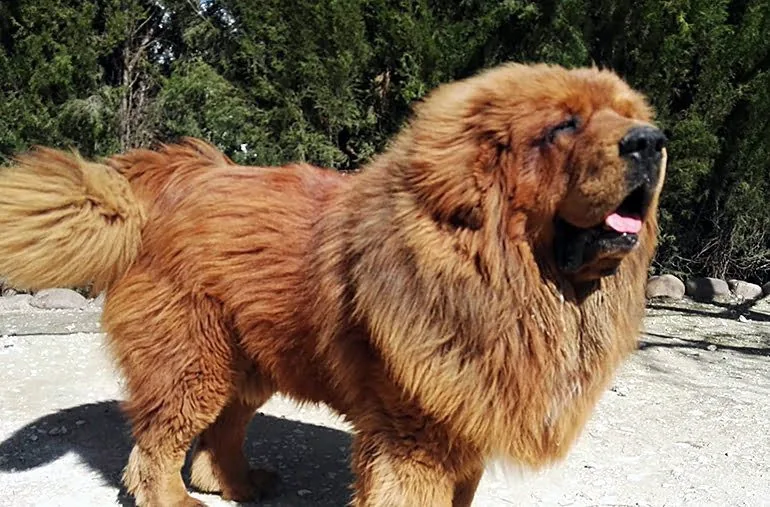
Seeing him for the first time is disorienting. The Tibetan Mastiff is an animal of genuine bulk, with dense bone structure and musculature that doesn't deceive. The double coat amplifies that sense of size even further. The inner layer is thick and woolly, built for insulation against cold; the outer one, coarser and thicker, builds up around the neck and shoulders into a mane that's especially pronounced in males. The most common colours are solid black, black and tan, and various shades of gold and fawn, often with white patches on the chest or paws.
Many people ask whether this is a dangerous breed. The serious gaze, the enormous body and that coolness toward strangers make the question understandable. But the answer is more nuanced. The Tibetan Mastiff has a very pronounced territorial instinct and is wary of the unfamiliar — that's undeniable — but that's a long way from pathological aggression. A well-socialised individual can tell perfectly well between someone who represents a real threat and someone who's come for coffee. With his family he's a calm, patient dog with plenty of affection underneath. When a Mastiff turns reactive, there's almost always a specific reason behind it — poor socialisation, insufficient mental stimulation or mishandling by the owner — not an innate predisposition of the breed. His first line of defence is rarely attack; he prefers to intimidate. His size and that deep, rumbling bark are usually enough to stop any attempted intrusion at exactly that — an attempt.
Size can be deceiving. This dog isn't built for sprinting; he's built to move for hours over difficult terrain, and that shows in his activity level. He needs several daily walks on lead and a fenced garden so he can do his rounds. In a small flat, he simply doesn't fit. The coat also needs attention, especially during the two annual sheds, when he loses undercoat in impressive amounts. Brushing him regularly during those periods nips tangles in the bud and keeps the skin in good condition; neglecting it has consequences with this breed, since these dogs are prone to skin conditions.
Tibetan Mastiff temperament and personality
The Tibetan Mastiff thinks for himself. Always. That's the first thing to accept before living with one. For centuries this dog made decisions with nobody beside him — no shepherd to point the way, no constant supervision — and that legacy still shapes how he operates today. Those who don't know him read that trait as stubbornness; but a stubborn dog refuses out of whim, and the Tibetan Mastiff does something different: he weighs, calibrates and acts. Sometimes that matches what we want. Sometimes it doesn't. With his family he builds a solid, protective bond, even if his displays of affection are understated for anyone expecting effusiveness. A long look, staying close during hard moments, or simply leaning his body weight against your leg are, to him, statements enough.
Night activates him. That throws off almost every first-time owner. This breed's historical job was watching while humans slept, and that tendency to switch to alert at nightfall hasn't gone away just because the dog now lives in a townhouse. Night-time barking is the first serious problem that shows up, and heading it off means starting from puppyhood. You need to work on environmental stimuli, build calm routines, and let the dog learn to tell what deserves attention from what doesn't. It's also worth knowing he responds well to calm authority and rules applied consistently every time. Shouting or physical punishment has the opposite effect: the dog loses trust in the person who should be guiding him and can become avoidant or, if the pressure continues, react defensively.
Indoors he can be a fairly calm dog, as long as his exercise and mental stimulation needs are covered. With the children in his family — the ones he's watched grow up — living together usually works well. His size alone justifies keeping an adult present during those interactions, and with children he doesn't know, the situation calls for even more attention. With other dogs, it all depends on how much socialisation work was done in the first months: puppies who had regular contact with other dogs usually get on without major tension as adults; those who grew up more isolated develop wariness, and between males that has a good chance of ending in conflict. He's not a dog with a short fuse — he tolerates quite a lot before reacting — but once he decides something deserves his intervention, he does it with a force few breeds can match.
Tibetan Mastiff puppies: healthy growth and preventing dysplasia
In giant breeds, the first months mortgage the future of the whole musculoskeletal system. The Tibetan Mastiff and the Spanish Mastiff grow at a brutal pace, and if that rate outstrips what the body can handle — from excess calories, miscalibrated calcium or phosphorus that doesn't keep pace — the joints end up paying for it. Hips and elbows suffer the most, and when dysplasia shows up, it usually stays for good. That's why kibble needs to be formulated for giant breeds from the start; a generic one with high energy density can do more harm than good. A puppy at his ideal weight has ribs you can feel by touch and a silhouette with nothing to spare. Looking a bit lean shouldn't cause concern; excess weight is what should. It's also not advisable for a Mastiff puppy to jump, climb stairs daily or run on hard surfaces: the skeleton is still maturing, and slips on floors with poor grip can cause damage that takes months to show up.
Beyond the orthopaedic side, there are hereditary conditions any Tibetan Mastiff buyer should know about before choosing a breeder. A recessively inherited hypertrophic neuropathy has been identified in the breed, presenting in puppies as generalised weakness and hyporeflexia as early as the first weeks after weaning, as documented in ‘Canine inherited hypertrophic neuropathy’ (1981). Uncommon, granted, but devastating when it shows up. That's exactly why choosing the right breeder matters so much. A responsible breeder runs genetic tests, knows their breeding stock's dysplasia history, and shares those results without anyone having to ask. Demanding transparency about the parents' health should be the starting point of any conversation, not something to be grateful for if the breeder happens to offer it.
Infectious diseases also deserve attention in these early months. Canine parvovirus type 2 (CPV-2) has been isolated in Tibetan Mastiffs, confirming this agent still causes parvoviral enteritis despite widespread vaccination — as documented in ‘First Isolation of New Canine Parvovirus 2a from Tibetan Mastiff and…’ (2014). Bloody diarrhoea, vomiting and a puppy who suddenly goes quiet are signs that call for a vet without delay. To reduce the risk, sticking rigidly to the vaccination schedule, maximising environmental hygiene and avoiding contact with dogs of unknown health status all matter. Early socialisation is key for the Mastiff's temperament to develop well, but it needs doing calmly: gradually, with trusted dogs and in environments where who he interacts with can be controlled, until the vaccination protocol is complete.
Feeding the adult Tibetan Mastiff
An adult Tibetan Mastiff needs a diet that supports his enormous body mass without encouraging excess weight, one of the biggest enemies of his joints. The base should be a high-end kibble formulated for giant breeds, with a moderate fat content (around 10-14%) and quality protein that maintains muscle mass without empty calories. Calcium and phosphorus need to be balanced in the right ratio, since imbalances in these minerals are linked to bone abnormalities. The daily ration is split into two or three meals to reduce the risk of gastric torsion, a potentially fatal emergency that deep-chested dogs like the Great Dane are especially prone to.
As a rough guide, a 60 kg adult male can consume an appropriate amount of dry kibble a day, split across the meals mentioned. Constant access to fresh, clean water is non-negotiable, and exercise should be kept at least an hour away from meals to aid digestion. Treats and snacks shouldn't exceed 10% of total calorie intake, and it's best to opt for natural, dehydrated options, avoiding products with excess grain or added sugar.
Some owners explore homemade or BARF diets, but in a breed with such specific needs, any change should have the supervision of a veterinary nutritionist. Micronutrient deficiencies or excesses can have serious long-term consequences. Indiscriminate supplementation with calcium, joint supplements or vitamins without a prior assessment is contraindicated. A dog fed a complete, balanced kibble doesn't need extras, and giving unjustified supplements can throw his system off balance and, paradoxically, favour the very conditions they were meant to prevent.
Tibetan Mastiff training and socialisation
A Tibetan Mastiff puppy with pedigree and health guarantees costs between €1,500 and €3,000 in Spain. Price varies depending on the breeder, the parents' health checks and current demand. But that's only the first cheque. Anyone who skimps on professional training afterward, or skips early socialisation, ends up living with an animal over 60 kg who does whatever he pleases, and fixing that in adulthood is a whole different challenge.
The Tibetan Mastiff learns fast, that much is true. He also has a fairly strong independence of judgement: he evaluates every command before complying, and if he doesn't see a clear benefit, he passes. Here's the trick with this breed: sessions need to be short, with rewards he genuinely cares about and enough variety that he doesn't get bored. Positive reinforcement, consistency and patience aren't the easy route — they're the only one that works. And socialisation — gradual exposure to different people, new environments, noises and other animals from two months of age — determines what that dog will be like as an adult. A Mastiff who grows up without those experiences can become fearful or reactive, and those problems are much harder to work with later.
During walks, especially in the countryside or areas with tall vegetation, ticks are a risk not to underestimate. There's a documented case of a Tibetan Mastiff puppy who developed tick paralysis and Babesia gibsoni infection — transmitted by the Haemaphysalis longicornis tick — and recovered with ivermectin therapy ‘Diagnosis and Curat of Tick Paralysis and Babesia gibsoni Infection of…’ (2011). Checking his coat after every trip to the countryside should be automatic, a habit with no exceptions. Sudden weakness, fever or unexplained lethargy are signs that call for a vet visit that same day. As for basic obedience — sit, stay, heel — with a dog this size it serves a very specific purpose: being able to hold him back or redirect him when a situation gets complicated, before something irreversible happens.
How much does a Tibetan Mastiff cost: price and lifetime expenses
Beyond the purchase price, keeping a Tibetan Mastiff involves a significant annual outlay that any prospective owner should calculate in advance. Quality food for a dog this size runs a monthly cost that can hover around €80-120, depending on the brand and diet type. On top of that come routine vet expenses: annual check-ups, vaccinations, internal and external deworming, and periodic bloodwork to catch joint or metabolic problems early. Liability and health insurance for a giant breed can add another €300-600 a year, and it's highly advisable given the potential for accidental damage a dog this size can cause.
Coat care shouldn't be underestimated. Although regular maintenance can be done at home with good brushes and rakes, many owners turn to specialist dog groomers during seasonal shedding, at a cost of €50 to €80 per session. Basic equipment — reinforced harnesses, safety leads, raised bowls to help prevent torsion, large orthopaedic beds — represents an upfront cost that easily exceeds €300. If the dog needs professional training for behavioural issues, each session with a qualified behaviourist or trainer runs between €40 and €70, and a full programme can stretch over several months.
Medical surprises are the hardest expense category to quantify, but also the most important. A hip surgery for advanced dysplasia, emergency surgery for gastric torsion, or cancer treatment can push the vet bill into several thousand euros. Having an emergency fund or insurance with good cover is a prudent decision. All told, the annual cost of keeping a Tibetan Mastiff falls, roughly speaking, between €1,500 and €2,500, not counting the price of the puppy. That figure reflects the responsibility of bringing into the family a dog who, given his biology and needs, allows no financial shortcuts.
How to choose a trustworthy Tibetan Mastiff breeder
Before talking about diet, training or vets, there's one decision that outweighs all the others. The breeder. A good breeder doesn't disappear once you sign the contract; they're still there a year later, five years later, whenever a question comes up or a health issue appears. To start, check they're affiliated with an official breed club and work to FCI standards, which require breeding stock to pass hip and elbow dysplasia tests with periodic checks. Ask for the original certificates and genetic tests for conditions like hypertrophic neuropathy. You have every right to ask for them, and any serious breeder will understand that.
Visit the breeder in person. Photos can deceive; smell and atmosphere can't. A clean facility, with calm adults and puppies raised amid household noise, visitors and activity, speaks well of the breeder's work. Pay attention too to the questions they ask you, because a serious breeder will want to know your experience with large dogs, what your home is like, and how much time you spend away. The Tibetan Mastiff isn't a breed for someone starting from zero, and a professional who knows that won't place a puppy without making sure the home is a good fit. If they won't show you the mother, offer puppies without a pedigree, or rush you to close the sale, walk away.
The contract matters too. It needs to include written health guarantees, a cooling-off period, and the clause — rarer than it should be — where the breeder commits to taking the dog back if the buyer's circumstances change. That point separates responsible breeders from opportunists. A Tibetan Mastiff will be part of your life for ten years or more, with everything that means in terms of space, time and temperament. This isn't a decision to make in an afternoon.
Visit several breeders before deciding. Ask everything you need to without hesitation. The more time you invest in this choice, the fewer surprises you'll have later. And once you're sure, prepare the house before the puppy arrives. The whole family needs to know how to handle this dog and what boundaries to set from day one.
IMPORTANT: This article is for informational purposes only and does not constitute veterinary, nutritional or behavioural advice. Every dog is different, and only your trusted vet can advise you on its specific needs.