 Breeds
Nova Scotia Duck Tolling Retriever: Complete Breed Guide
The Toller, formally known as the Nova Scotia Duck Tolling Retriever, has a trick up his sleeve few dogs can boast: he lures ducks in close by imitating a fox playing by the water. It's no accident. He was bred for exactly that.
Origin and history of the Nova Scotia Duck Tolling Retriever
In this article we trace where that very specific skill comes from, what's special about his physical build, and why his methodical temperament fits so well with people who respect the working instinct running in his blood.
The Toller carries the name of a Canadian peninsula few could point to on a map, and he came into the world in the 19th century for a very specific purpose: hunting in waters that cut to the bone in the depths of winter.
Yarmouth hunters needed something specific. A dog able to withstand the Atlantic cold, one that wouldn't tip over a small boat with his weight, and one that also mastered a skill no other retriever had honed to the same degree: luring ducks within shotgun range. The solution came from crossing retriever-type dogs — including the Flat-Coated Retriever — with spaniels and, according to records from the time, possibly farm collies. The animal that emerged from those crosses combined retrieving instinct, cold-water tolerance and a practical intelligence that made him hard to match.
Tolling is what gives the breed its name, and watching it in action is a bit disorienting. The dog darts through the reeds, jumps, changes direction with no apparent pattern, waves that bushy tail as if it were a lure. And the ducks come closer. That mix of curiosity and distraction brings them within the hunter's range. Afterward, the Toller goes into the water without a second thought — whatever the temperature — and brings back the birds with the soft mouth that marks a good retriever. That dual role ended up sculpting a very particular temperament: methodical, persistent, work-focused and genuinely cooperative.
The Canadian Kennel Club recognised the breed in 1945, though it took decades to reach Europe. It was during the 1980s that he started making his way across the Atlantic. Today he remains far less common than the Golden Retriever, but anyone who gets to know him well rarely looks elsewhere. He's a medium-sized dog, versatile and family-friendly — provided he's given work, movement and something to think about.
Physical characteristics of the Nova Scotia Duck Tolling Retriever
The Toller stands 45 to 51 centimetres at the withers if male, and 43 to 48 if female. As for weight, males run around 20-23 kilos and females 17-20. A medium-sized, compact dog, built for endurance, not to impress on a racetrack. He has enough muscle to spend hours swimming without losing efficiency, but without reaching the bulk of a Labrador Retriever, which in icy water or jumping from a boat would start being a liability rather than a tool.
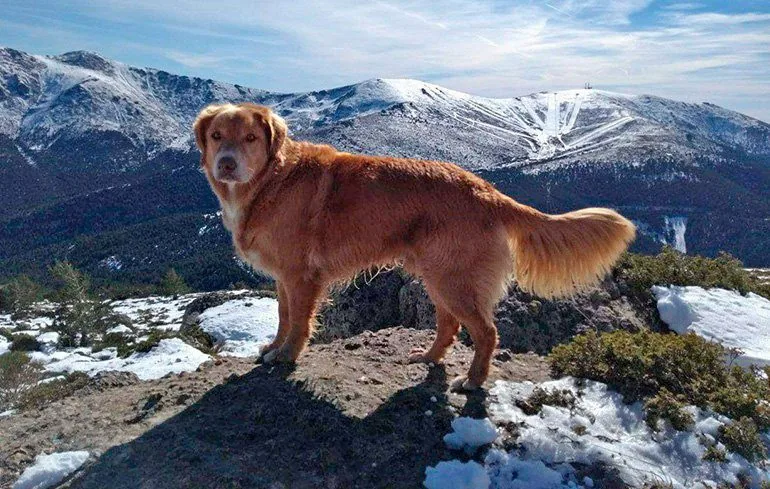
The coat ranges from deep gold to dark copper, always within that reddish range that makes him unmistakable. Underneath, a dense, woolly layer for insulation; on top, medium-length, straight hair that repels water. White markings on the tail tip, chest, feet and sometimes the forehead are common, though they should never take over the coat. The tail is set low, thickly coated, and works as a rudder in water and a visual lure on land. The ears, triangular and medium-sized, fall close to the cheeks. And that gaze — alert, direct, with a permanent hint of a question — already says a lot about the dog behind it.
The bone structure is solid without being coarse. The chest drops well and protects the organs during cold-water dives. The feet are webbed, an adaptation selective breeding refined over time that provides real propulsion while swimming. The trot is low and economical, the kind that covers a lot of ground without wasting energy. Every anatomical detail serves a function, and when one strays from the standard, it changes not just his looks but the dog's real performance.
The Toller's mind is always working. He isn't a dog for mechanical commands repeated over and over; he needs things to make sense, and once they do, he throws himself in with a focus that can border on obsession. That makes him exceptional at dog sports. It also makes him an animal who gets frustrated fast if training turns monotonous or if the challenges fall well below what he's capable of.
With his family he builds intense, fairly selective bonds. He watches strangers, sizes them up, and approaches only once he's made that decision himself. That reserve comes from generations of dogs working alone in the field, having to trust their own judgement, and shouldn't be mistaken for fear or aggression. When he does grant trust, he gives it fully. Tollers are also tremendously vocally expressive: they don't just bark, they also whine, growl softly and let out that peculiar high-pitched "scream" when excitement overwhelms them.
Living with other animals usually works well if socialisation in the first months was handled properly, though his prey drive can switch on around small animals outside his own group. With children he fits well as long as there's respect and games have some structure. Prolonged solitude and a lack of mental stimulation are his worst enemies; boredom almost always turns into non-stop barking or destruction. Watch out for this: anyone looking for a low-maintenance dog easy to ignore has picked the wrong breed in the Toller. Anyone who genuinely brings him into family life, with everything that entails, has a companion who gives back far more than he receives.
Essential care
Keeping a Toller in top condition means attending to his physical and emotional needs with the same dedication he puts into every task. High-quality food, adjusted to his activity level, is the first pillar. Being a dog prone to hyperactivity if not given enough exercise, calorie balance needs to be calculated precisely to avoid excess weight, which would worsen any joint predisposition. Daily rations, split into two meals, should be based on high-biological-value protein and essential fatty acids that maintain the health of his dense coat and joints.
Dental hygiene deserves special attention in this breed. Regular tooth brushing, ideally daily or at least three times a week, prevents tartar build-up and periodontal disease, which can have systemic consequences. Nails should be trimmed every three or four weeks, or sooner if you hear the characteristic clicking on the floor. His ears, being floppy and exposed to moisture given his love of water, need a weekly check and clean with specific products to prevent ear infections. With consistent care and preventive vet attention, the Nova Scotia Duck Tolling Retriever's life expectancy falls between 12 and 14 years.
The ideal environment for a Toller includes access to a safe outdoor space where he can move freely, but he isn't a dog who should live isolated in a garden. He needs to be part of the family unit, taking part in daily routines. Continued socialisation, even into adulthood, helps prevent excessive wariness from developing. Regular vet visits, with six-monthly check-ups from age seven onward, allow early detection of any change and let the care plan adjust to each life stage's shifting needs.
Double coat: how to care for it without ruining it
The Toller has a double coat that, well cared for, withstands cold and water like few others. For it to work, it needs brushing two or three times a week for most of the year. It's best to use a metal-pin comb combined with an undercoat rake that reaches the inner layer without damaging the outer one. This removes dead hair, prevents tangles and, along the way, spreads the natural oils through the whole coat, keeping that characteristic shine and reinforcing water resistance.
Things change in spring and autumn. Seasonal shedding sends hair loss up to levels that can be pretty dramatic, and you need to switch to daily brushing to control the loose undercoat before it ends up on the sofa and the rugs. An undercoat de-shedding tool helps a lot during these phases, always used gently to avoid irritating the skin. Bathing is best kept for when it's genuinely needed — visible dirt, bad smell — because bathing more than that strips the protective sebum and dries out the skin. When it's time, use a shampoo specific to double-coated dogs and dry thoroughly, without leaving moisture trapped in the inner wool, which is where most skin problems start.
Shaving the Toller in summer to keep him cooler seems logical, but it backfires. The double coat insulates both ways: against cold and against heat. Removing it leaves the skin exposed to sunburn and insect bites, and on top of that disrupts the hair growth cycle, which can take months to fully recover. If heat is a concern, the solution lies in shade, fresh water and taking the dog out during the least intense hours of the day.
Exercise and mental stimulation needs: sports and retrieving games
The Nova Scotia Duck Tolling Retriever isn't a dog who's satisfied with a short walk around the block. His minimum daily exercise requirement sits at 60 minutes of intense physical activity, but that figure should be read as a baseline, not a ceiling. During that time, the Toller needs to run, swim and, above all, use his brain. Plain physical movement with no mental component leaves him unsatisfied, because his genetics demand solving problems and actively cooperating with his handler. Exercise sessions should be split into two or three blocks across the day to keep his stimulation level consistent.
Retrieving games are the top activity for this breed. Throwing a dummy, a ball or a disc in a safe space and working on delivery, direction and obedience at a distance satisfies his deepest instincts. Water retrieving adds a boost of physical endurance and builds muscle with no joint impact. Beyond classic retrieving, Tollers excel at sports like agility, obedience, rally and, especially, nose work. Hiding objects with a specific scent and asking him to find them channels his scenting ability and persistence, offering a challenge that tires him mentally far more effectively than an aimless run.
Mental stimulation also needs building into home life. Interactive toys, snuffle mats, short training sessions with new commands or tricks, and even self-control games like waiting patiently before a meal, are tools that prevent boredom and strengthen the family bond. A Toller not given enough intellectual challenge will channel his energy into unwanted behaviours: digging, chewing furniture, persistent barking or developing obsessive patterns. The key is giving him a job, a mission that gives his day purpose, because for this dog, cooperating with humans isn't optional — it's a need.
Common health problems
Although the Toller is generally a healthy breed, certain conditions show up more often and every owner should know about them to act quickly. Hip dysplasia is one of the most common orthopaedic concerns. This malformation of the hip joint causes pain, lameness and, over time, arthritis. Weight control, low-impact exercise during growth and choosing a puppy whose parents are dysplasia-free are the best preventive strategies. Eye problems like progressive retinal atrophy and cataracts are also documented in the breed, which is why regular eye exams are essential.
One condition deserving special vigilance is hypoadrenocorticism, better known as Addison's disease. The Nova Scotia Duck Tolling Retriever has a higher risk of developing hypoadrenocorticism, a potentially fatal disorder with a hereditary component ‘Association of a dog leukocyte antigen class II haplotype with hypoadrenocorticism…’ (2010). This endocrine condition is characterised by insufficient hormone production from the adrenal glands, causing vague symptoms like lethargy, vomiting, diarrhoea and weakness that can be mistaken for other ailments. Diagnosis requires specific tests, and lifelong treatment relies on hormone supplementation. Early detection is vital, since an Addisonian crisis can be fatal without urgent veterinary intervention.
Other conditions to keep in mind include hypothyroidism, which affects metabolism and presents with weight gain, hair loss and lethargy, and certain skin allergies that may require dietary and environmental management. Autoimmune problems, though less common, also show up in some lines. Prevention comes down to regular vet follow-up, bloodwork when nonspecific symptoms appear, and open communication with the professional about any change in the dog's behaviour or physical condition.
Hereditary diseases in the Toller: what separates a serious breeder
Before talking about temperament or working drive, there's something any serious Toller breeder needs to put on the table: health tests. Hips and elbows, assessed through official X-rays signed off by specialists certifying that breeding stock doesn't carry dysplasia to a degree that compromises mobility. Annual eye exams to catch progressive retinal atrophy, hereditary cataracts and other visual abnormalities. And cardiac tests to rule out cardiomyopathies that could pass down to litters. Without this, the rest of the conversation is moot.
Genetics have been steadily closing in on the breed's most serious problems. The copy number of the FGF4L2 retrogene has been linked to intervertebral disc calcification and vertebral geometry in these dogs, according to ‘FGF4L2 retrogene copy number is associated with intervertebral disc calcification…’ (2023). Calcification like that opens the door to disc herniation and chronic pain; knowing it has a genetic basis changes the criteria used to select breeding stock. On the cardiac front, things are just as serious. Two 10-month-old Nova Scotia Duck Tolling Retriever puppies died acutely with dilated cardiomyopathy and myocardial fibrosis; analysis identified a frameshift mutation associated with the condition, as documented in ‘Naturally occurring canine laminopathy leading to a dilated and fibrosing…’ (2023). These are small-sample studies, but the warning stands. A young dog who tires early or has episodes of weakness deserves more attention than he's usually given.
A responsible breeder has the paperwork, yes, but also knows how to explain it. Parents listed as "healthy" by their own judgement isn't enough; results need to be registered with official bodies, and any buyer has the right to see them before deciding anything. Buying a Toller without those guarantees is an unnecessary risk that, on top of everything, feeds breeding lines that have been passing down the same problems for generations. A serious breeder doesn't mind being asked for the documents. If they do mind, you already know what that means.
Living with a Nova Scotia Duck Tolling Retriever means an active pace and real involvement. This dog has an intelligence that demands a response and a sensitivity that doesn't sit well with anyone treating him as mere home decor. For anyone considering this breed, the first step is finding a breeder able to prove, with verifiable documentation, that all relevant health tests have been completed and that the puppies have grown up with proper socialisation from their first weeks of life.
IMPORTANT: This article is for informational purposes only and does not constitute veterinary, nutritional or behavioural advice. Every dog is different, and only your trusted vet can advise you on its specific needs.