 Breeds
Flat Coated Retriever
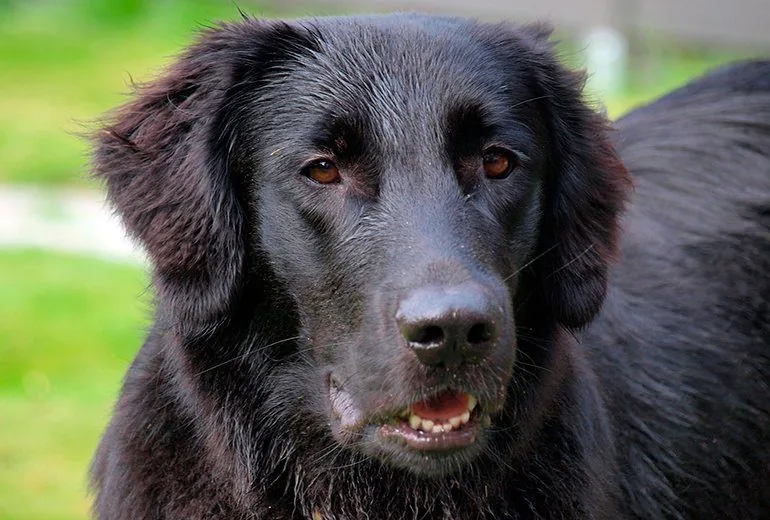
These dogs have one trait that gives them away instantly: a coat so glossy and sleek it looks varnished. That's no accident. Their origin in the icy waters of Newfoundland and their work retrieving from the water gave them a unique, almost oily protective coat that makes them practically waterproof. That's why, even though many mistake them for black Labradors or Irish Setters, the Flat Coated Retriever is a completely different creature: slimmer, more active, and with space and exercise requirements that aren't up for negotiation.
What "flat coated" means and the breed's aquatic origin
The term "flat coated" refers directly to his coat: sleek, dense and glossy, with no curls or waves. Unlike the Curly Coated Retriever (his curly-coated cousin), this dog has a uniform, silky coat lying perfectly close to the body. That polished look isn't just aesthetic: it's functional.
Originating in Newfoundland, Canada, these dogs were bred to work alongside fishermen in freezing waters. Their job was retrieving nets, hooks and catches that fell into the ocean. To survive those extreme conditions, they developed skin with a natural oily secretion that repels water and insulates against cold. When the breed moved to England in the 19th century, breeders refined that structure, keeping his extraordinary swimming ability but also adapting him to land hunting.
Today, the Flat Coated Retriever remains an exceptional swimmer. His long, slender body, webbed feet and aquatic instinct make him an ideal companion for families with access to rivers, lakes or beaches. That said, his passion for water isn't a whim: it's a psychological need that's part of his identity as a breed.
Physical characteristics: athletic elegance with feathering in motion
These enthusiastic companions are marked by their long head and athletic bearing. Their feathering moves in time with their agile motion. They're large, very elegant dogs.
The ears are medium and high-set, hanging with the tip turned toward the muzzle. Medium-sized, very expressive eyes, dark in colour (brown/hazel). A straight tail in constant motion.
Height 59-61 cm in males; 56-59 cm in females Weight 27-36 kg in males; 25-32 kg in females Coat Long, dense and sleek, double-layered with glossy feathering on the legs and tail. Black and liver colours Temperament Family-oriented and very active, noble Life expectancy 12-14 years Health problems Prone to hypothyroidism and progressive retinal atrophyTemperament: boundless energy with no off switch
These dogs are pure vitality. He won't hesitate to jump on you to say hello every time you get home. His greeting will be so friendly he won't stop until his nose touches yours. That said, they aren't good guard dogs, since they'll never bite a stranger.
They don't handle solitude or inactivity well. His energy is such that he gets bored easily, so you need to give him space to play, jump and run, along with good entertainment to stop his boredom turning into destructive creativity.
Movement and daily exercise needs
Unlike other retrievers more tolerant of a sedentary life, the Flat Coated needs more than two hours of vigorous daily exercise. This isn't about calm walks: he needs to run, swim, search and work. Without this level of activity, he'll develop destructive behaviours: wrecking furniture, digging up the garden and finding creative ways to release his frustration.
If you live in a flat with no access to large parks or nearby open spaces, this breed isn't for you. He needs a decent-sized garden or the ability to take him to areas where he can run unrestricted several times a day.
Mouthiness, late maturity and behaviour with the family
His past as a hunter has made these very mouthy dogs, with a tremendous need to always have something to chew on. Providing tough toys, ropes and safe chewable objects is essential to channel this instinct.
Another surprising trait: they take years to mature. While other dogs reach emotional maturity between 2 and 3 years, the Flat Coated keeps puppy-like traits until 4 or 5 years old. That means his youthful enthusiasm, his tendency to jump and his lack of impulse control persist for longer. With young children, this behaviour can be a problem: his excitement and size make him potentially dangerous, not through aggression but through clumsiness.
Don't shut him out of the family unit, since he demands constant contact. His deep bark makes him an excellent alert for visitors, though not a guard dog. He gets on well with other pets and with children over 8-10 years old, always under supervision.
The Flat Coated Retriever is one of the few dogs who literally gets sick from boredom: he doesn't just develop destructive behaviours — his mental and physical health deteriorates without proper stimulation.
Suitability for inexperienced owners
Given his need for contact, daily dedication and activity requirements, this isn't a suitable breed for people with little time, first-time owners with no prior experience, or elderly people. He needs an active, committed owner able to set clear boundaries without harshness.
Health and hereditary diseases
Hip dysplasia and patellar luxation are his most pronounced conditions. Hypothyroidism, progressive retinal atrophy and malignant histiocytosis are also present in the breed. The latter two are hereditary.
Among Retrievers, gradual retinal deterioration, which can lead to blindness in its most advanced stage, is a recurring condition. As a result, at your vet check-ups the specialist will pay special attention to his eyes.
Retrievers and the Bernese Mountain Dog share a prevalence of malignant histiocytosis, a hereditary cancer that's fatal if not diagnosed in time. Before getting a puppy, demand hip dysplasia tests and an eye exam for both parents from the breeder.
Breed history and fun facts
This breed is believed to be the result of crossing the Wavy Coated Retriever (now extinct) with St. John's dogs. These canines came from Newfoundland and Labrador and accompanied fishermen to England. These individuals drove the initial split into hunting-specific breeds, as well as the origin of the six Retriever classes we know today.
The first individual is presumed to have appeared in England in 1860, when hunting stopped being a survival activity and became a recreational pursuit among the upper classes. Setters and Borzois (Russian Wolfhounds) also played a part in his creation.
Also known as the Smooth-Coated Retriever, he's historically been used as a hunting dog for his exceptional sense of smell and memory for locating game. Today he also serves other roles, such as a rescue dog in snow, water or natural disaster accidents like earthquakes, as well as drug detection. Quite the marvel, isn't he?
Training and socialisation
The Flat Coated Retriever is intelligent and eager to please, which makes training easier. That said, his youthful energy and tendency to get distracted call for a consistent, patient approach. They respond better to positive reinforcement than to harsh corrections.
Early socialisation process
- Expose the puppy to different environments, people and sounds between 3 and 12 weeks of age, when he's most receptive to new experiences.
- Introduce other dogs and animals in a controlled way to prevent future fear or aggression. The Flat Coated is naturally sociable, but needs early exposure.
- Get him used to water from puppyhood if possible. Although he has an aquatic instinct, early positive exposure reinforces his confidence and security.
- Set clear limits on jumping, biting during play and behaviour at home. His enthusiasm needs channelling, not suppressing.
Basic training and obedience
Start basic obedience training around 4-6 months. These dogs respond well to simple commands like "sit", "stay" and "come", especially with rewards (food, toys, praise). His eagerness to please is his greatest asset.
Retrieve training comes naturally to them, but needs structure. Teach him to drop the object on command, not just bring it back. Without this control, they can become obsessed with the game and ignore other instructions.
Coat care and maintenance
The Flat Coated Retriever's coat needs regular maintenance, though it isn't as demanding as other long-haired breeds. Its dense structure and double layer need frequent brushing to prevent tangles and keep that characteristic shine.
Grooming and brushing routine
Brush your dog 3-4 times a week with a pin brush or a double-sided rake. During shedding seasons (spring and autumn), increase to daily to control hair loss. Although he isn't a breed that "sheds constantly", he does lose significant amounts of coat twice a year.
Bathing should happen every 6-8 weeks or as needed. Use a dog-specific shampoo that respects his skin's pH and doesn't strip the protective natural oils. After bathing, dry him thoroughly with a towel and hairdryer on moderate heat, brushing as you go to prevent tangles.
Check and clean his ears weekly, since their drooping shape favours moisture and bacteria build-up. Trim nails every 4-6 weeks and brush teeth daily if possible, or at least three times a week.
Price and maintenance costs
A Flat Coated Retriever puppy from a responsible breeder registered with Spain's RSCE costs between €800 and €1,800 in Spain. The breed is uncommon in the country, which affects price variability. The price includes an LOE pedigree, the parents' dysplasia tests, initial vaccinations and a microchip.
Beyond the initial cost, you need to factor in monthly maintenance expenses. Feeding a dog this size and activity level runs around €90-150 a month, depending on kibble quality and whether you opt for a homemade or commercial diet. On top of that come annual vet check-ups, booster vaccines, parasite treatments, occasional professional grooming and liability insurance.
If you get the dog from an unregistered or dubious breeder, the price may be lower, but you run the risk of serious health problems resulting in far higher vet costs. The initial investment in a quality puppy is always cheaper in the long run.
BEFORE BUYING, CHECK THE BREEDERAsk for hip dysplasia certificates (OFA or PennHIP), eye tests (CERF) and an LOE pedigree. A responsible breeder provides a health guarantee and stays available for future questions. Be wary of significantly lower prices or breeders who don't offer documentation.
Is the Flat Coated Retriever the dog for you?
If you're after an elegant, intelligent, loyal companion who enjoys outdoor activities, loves water and can adapt to an active family life, the Flat Coated Retriever could be your dog. His noble character, eagerness to please and natural beauty make him an exceptional choice for families with prior experience with large dogs.
That said, he isn't a dog for everyone. He needs space, time, constant exercise and an owner who understands his psychological and physical needs. If your lifestyle is sedentary, if you work long hours away from home or live in a small space, this breed will cause frustration for you and suffering for him. There are other retriever breeds more tolerant of urban or less active living.
Bringing a Flat Coated Retriever into your home is a 12-14 year commitment. Only do it if you're willing to offer him what he genuinely needs: movement, water, mental stimulation and constant presence. If you do, you'll have by your side one of the most versatile, loyal and extraordinary dogs there is.
Frequently asked questions
How many types of retriever are there?
There are six internationally recognised retriever breeds: the Labrador Retriever, the Golden Retriever, the Flat Coated Retriever, the Curly Coated Retriever, the Nova Scotia Duck Tolling Retriever and the Chesapeake Bay Retriever. All share a 19th-century origin as retrieving dogs for waterfowl hunting, but each developed distinct traits based on their region and specific function.
What's the difference between the Flat Coated and the Curly Coated Retriever?
The main difference is the coat: the Flat Coated has a sleek, glossy coat, while the Curly Coated has tight curls. The Curly is slightly larger, more independent and less sociable. Both are excellent swimmers, but the Flat Coated is more versatile as a family dog.
Can he live in a flat?
It isn't advisable. Although he could technically adapt to a large flat with access to nearby parks, his exercise needs (more than 2 hours daily) and energy make him much happier in a house with a garden. A sedentary urban life causes behavioural and health problems in this breed.
Is he good with children?
Yes, but with nuances. He's excellent with children over 8-10 years old. With young children he can be problematic due to his size, enthusiasm and tendency to jump. His lack of malice doesn't mean he's safe: he can knock a small child over with no intention of hurting them. Supervision is always required.
IMPORTANT: This article is for informational purposes only and does not constitute veterinary, nutritional or behavioural advice. Every dog is different, and only your trusted vet can advise you on its specific needs.