 Breeds
Pekingese
Also known as the Pekinese or Lion Dog, the Pekingese is probably one of the oldest known breeds. His breeding and selection in the Chinese city of Beijing (Peking) goes back millennia. He stands out for his small size, abundant coat and that curious resemblance to a small lion. Thanks to his affectionate, social temperament, he's one of the most widespread Asian breeds as a companion dog.
Origin and history of the Pekingese
The exact moment Pekingese breeding began is unknown, since the breed has existed in China for centuries. One myth claims he was created by Buddha, though he's most likely descended from medium-sized dogs bred by Chinese emperors. There he was called the lion dog or sun dog, thanks to his lush, beautiful mane.
In China, the Pekingese was a royal dog, since emperors valued the company of small dogs who could rest on their laps. During the Opium War, around 1860, the breed was discovered by the British army. After the invasion, several individuals were taken to Britain as a gift for Queen Victoria.
Thirty years later, the breed was introduced to the United States. Today he's one of the best-known and most cherished dogs for his small, adorable size.
Physical characteristics of the Pekingese
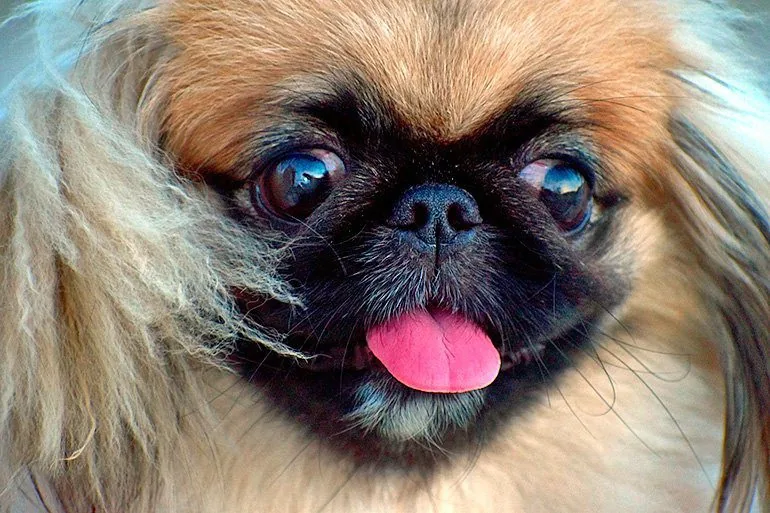
The breed standard set by the Fédération Cynologique Internationale describes him as a small, sturdy, well-balanced dog. The Pekingese's head is large compared to his body. The nose and muzzle are short. The eyes are round, with a dark, bright iris. The ears grow heart-shaped and hang from the head without reaching the muzzle.
The legs are short with knees almost tucked against the body, the front ones sturdier than the rear. The feet are wide and flat, with the front ones usually turned slightly outward. The tail sits high, firm and slightly curved toward the back.
The Pekingese's coat has a double layer, abundant and long, often reaching almost to the ground, though it shouldn't stop the dog from walking. The inner coat is soft and dense, while the outer texture is coarse and full. Thanks to this, the dog looks bulkier than he actually is. Even the ear hair is very abundant, at first glance the ears seem to "disappear" among the rest of the coat.
As for colour, it's usually a mix of cream, chestnut and reddish areas. Some individuals show a black mask on the face. There are also black, white and chestnut Pekingese, either solid or with chest markings. The liver variety and albino Pekingese aren't accepted as show dogs.
- Height: between 15 and 22 cm in males and females
- Weight: approximately 5 kg in males and 5.5 kg in females
- Coat: abundant, coarse and in multiple shades
- Temperament: loyal, affectionate and calm
- Health: sturdy
- Life expectancy: estimated at 12 to 14 years
How to identify a purebred Pekingese
The surest way to know if your dog is a genuine Pekingese is checking whether he has a pedigree. This document certifies the animal is purebred, that his ancestry is entirely purebred, and that no crossbreeding occurred among his ancestors.
Beyond the pedigree, there are unmistakable physical traits. He has a very particular body structure: a large head disproportionate to the body, a flat muzzle, round, prominent eyes, and very short legs. His abundant coat and small size make him unmistakable.
If you get a puppy, always ask for the pedigree of both the animal and his parents. This guarantees you're getting a purebred Pekingese and not a cross or mix with another breed.
Types and varieties of the Pekingese
Although there's only one recognised Pekingese breed, there are variations worth noting. The most notable is the Imperial Pekingese, a term referring to particularly small individuals, generally under 3 kg. These dogs are even more delicate and need special care.
As for coat length, there are two main variants: the long-haired Pekingese, the official standard with a coat reaching almost to the ground, and the short-haired Pekingese, the result of selective crossing that produces a more manageable coat, less characteristic of the breed.
There are also deliberate crosses like the crossed Pekingese with other small breeds. The Maltese Pekingese is a popular cross combining traits of both breeds, resulting in a smaller dog with a white or cream coat. The dwarf Pekingese is simply a term for particularly tiny individuals within the breed.
Finally, the white Pekingese is a recognised colour variety, though less common than the cream and reddish shades. All these types share the Pekingese's essence: small size, independent character and a majestic look.
Pekingese temperament and behaviour
Despite his small size, the Pekingese surprises with his courage. He's able to stand up to large dogs, showing plenty of character, liveliness and sharp intelligence.
He's sociable and affectionate with the family, loves playing and spending good times getting pampered. He builds a strong connection with his owners and enjoys spending lots of time with them. However, he's an independent dog who likes making his own decisions. He'd rather not be chased; he's the one who decides when he wants to spend more time with the family.
With children he's usually tolerant, though he doesn't like rough play. Remember that historically he was a royal dog. He's very intelligent and sensitive, he can sense when you're upset and that can sulk him. With love and good care, he'll be a model of affection.
Common behavioural problems
Although generally balanced, he shows some character traits that can be read as problematic if not properly understood.
Independence is his most marked trait. He isn't a dog who blindly obeys; he'd rather negotiate and make his own decisions. This can look like stubbornness, but it actually reflects his intelligence and his heritage as a Chinese royal dog.
He's reserved with strangers, which can show up as initial distrust. This doesn't mean aggression, but caution. He needs time to accept new people into his circle.
Although he doesn't cope very well with young children, especially ones who play roughly, he usually settles well into family homes if clear boundaries are set. He doesn't need long outings or regular physical activity, so he can become sedentary if not properly stimulated.
The key is understanding that his behaviours respond to his nature, not flaws. With patience, positive reinforcement and early socialisation, the Pekingese is an exceptional companion.
What care does the Pekingese need?
Training the Pekingese isn't hard, since he shows plenty of intelligence. That said, he can be a bit stubborn if you give commands in an authoritarian way, so you need to teach him with patience and affection.
Positive reinforcement will be your best training and socialisation companion. He prefers rewards in the form of petting, and limit dog treats, since the breed tends toward obesity. A good option is offering fruit as a reward.
From puppyhood, start socialising him with other pets and people. During the growth stage, keep in mind puppies are very small, so be very careful when picking them up. Don't let children pick them up without your supervision. Also, avoid letting him run on stairs or attempt jumps to elevated places, since he's very fragile given his small size and short legs.
He needs moderate exercise; don't force long walks on him. Thanks to his calm personality, he prefers games at home over outings to noisy places. Generally, he prefers cool climates. If you live somewhere very hot or plan to take him to the beach, keeping him in cool shade is essential.
Diet and coat care
He needs quality kibble formulated for small breeds. If you prefer to give him homemade food or a natural diet, consult your vet. Avoid calorie-heavy treats or ones rich in carbohydrates and fat; prefer plain yoghurt, hard-boiled egg without salt, and fruit.
Although feeding him is simple, the real challenge is maintaining his coat. You need to be willing to brush him 2 to 3 times a week, preferably with round-tipped metal combs. Knowing the different coat types will help you better understand his needs.
Stay alert for tangles forming and the appearance of ticks and fleas, since they hide easily in the coat. If brushing him is difficult, consider visiting a dog groomer.
Nail trimming and bathing are recommended once a month. His flat face with small eyes and short nose is prone to accumulating tears and mucus; for this reason, once a day you should use a dry towel to clean his face.
Common conditions in the Pekingese
If this breed stands out for anything, it's that he doesn't suffer from serious genetic or hereditary diseases. Generally, very old breeds have problems of this kind, but that isn't the case here.
He can be prone to kennel cough, but this can be avoided with proper vet care and recommended vaccinations. His brachycephalic build can cause some breathing difficulties, especially in hot climates or during intense exercise, something common in brachycephalic breeds.
Pekingese price
A Pekingese puppy's price runs between €400 and €1,900 in Spain, depending on his pedigree. Remember to always ask for your puppy's pedigree and that of his parents.
From SoyUnPerro we suggest adopting a dog instead of buying one. With this action you help give a home to an abandoned pet who will love you just like any other dog.
The Pekingese is an exceptional breed for anyone looking for a small, independent companion full of personality. His ancient history, unique character and majestic appearance make him an ideal choice for families who understand his nature and are willing to give him the care he deserves, especially when it comes to maintaining his abundant coat. With proper socialisation from puppyhood and a patient approach to his training, he becomes a loyal, affectionate dog, extraordinarily suited to urban life, being one of the best breeds for living in flats.
IMPORTANT: This article is for informational purposes only and does not constitute veterinary, nutritional or behavioural advice. Every dog is different, and only your trusted vet can advise you on its specific needs.