 Breeds
Pomeranian
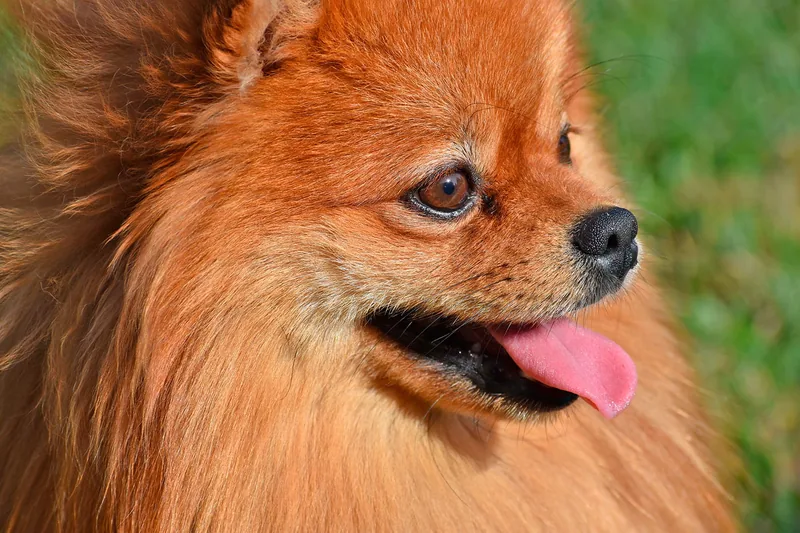
The Pomeranian is a whirlwind of energy wrapped in a magnificent coat. A direct descendant of the Nordic spitz breeds, this little domestic lion combines sharp intelligence with a bold temperament that completely defies its miniature size. If you're looking for a lively, loyal companion with a presence that never goes unnoticed, here's everything you need to know about this fascinating breed.
What the Pomeranian Is Like
The Pomeranian belongs to the dwarf spitz group, standing between 18 and 24 cm at the withers. Despite its plush-toy looks, its build is compact and well-proportioned, carrying itself with a proud bearing that recalls its working ancestors. Weight varies by sex: males fall in a range of 1.8 to 2.5 kg, while females, slightly sturdier, reach between 2.0 and 3.5 kg. These figures match the official American Kennel Club (AKC) standard, the international reference for the breed.
Its most visible trademark is its coat: a double layer made up of a dense, woolly undercoat that acts as insulation, and a long, straight, coarse-textured outer coat. This combination gives it that characteristic round silhouette. The color palette is surprisingly wide, including orange, red, cream, black, blue, chocolate, and white, among others. A well-cared-for Pomeranian's life expectancy runs between 12 and 16 years, a notable lifespan for a dog of its size.
Where Does the Pomeranian Come From?
The breed's origin traces back to the historic region of Pomerania, located between present-day Germany and Poland along the Baltic Sea. There, its ancestors were large sled-type spitz dogs, sturdy animals capable of pulling loads and withstanding extreme climates. Nothing suggested those Nordic workers would end up becoming one of the smallest companion dogs in the world.
The turning point came in the 19th century thanks to Queen Victoria of England. During a trip to Italy, the monarch fell in love with a dog much smaller than the norm and decided to add it to her breeding program. Under her influence, the breed's size shrank dramatically — from around 14 kg originally to the 2-3 kg we see today — and its popularity soared among the European aristocracy, cementing the Pomeranian as a symbol of status and refinement.
The Pomeranian's Temperament
To describe the Pomeranian is to describe a curious, lively, intelligent dog, but also one with a touch of stubbornness that can catch first-time owners off guard. Its energy level is moderate-to-high for its size, meaning it won't settle for a purely sedentary life: it needs stimulation, play, and daily exploration to stay balanced.
One of its most pronounced behaviors is its tendency to bark. It doesn't do this on a whim, but because it retains a finely tuned alert instinct inherited from its watchful ancestors. Any noise, visitor, or change in its environment sets off its voice, something that needs to be worked on from puppyhood with positive training. It's a loyal, protective dog with its family, but can be reserved with strangers if not properly socialized. Punishment or shouting doesn't work with this breed: it breeds distrust and makes barking worse. Only positive reinforcement, with short, consistent sessions, brings out the best in its intelligence.
Fun Facts That Define the Pomeranian
Few breeds can claim to have won over royalty and survived one of history's biggest maritime tragedies. Queen Victoria not only drove the breed's miniaturization, but also traveled everywhere with her Pomeranians, especially her favorite, Marco. Her passion for the breed was so influential that it shaped its genetic direction forever.
Another astonishing fact is that two Pomeranians survived the sinking of the Titanic in 1912. They were traveling first class with their owners and managed to get onto the lifeboats, a testament to how deeply integrated these dogs were into the daily life of high society at the time. What's more, its tiny size hides a big-dog personality: it won't hesitate to confront much larger dogs if it feels threatened, which calls for supervision during walks. Its coat, finally, isn't purely decorative: the double layer acts as an effective thermal insulator, protecting it from both cold and moderate heat.
Care and Health of the Pomeranian
The Pomeranian is generally a long-lived dog, but it has a predisposition to certain health issues worth knowing about. Patellar luxation — displacement of the kneecap — is common in small breeds and can require surgery in severe cases. It's also prone to tracheal collapse, a weakness in the tracheal rings that causes chronic coughing and worsens with pressure from a collar; that's why a harness is always recommended for walks. Obesity is another real risk: even a 200-gram weight gain places excessive strain on its joints and heart.
Caring for its spectacular coat requires frequent brushing, at least two or three times a week, to prevent tangles and remove dead undercoat hair. During seasonal shedding, brushing should be daily. Diet requires strict calorie control: an adult needs between 40 and 50 grams a day of high-quality dry kibble, split into two meals and always measured with a kitchen scale, never estimated by eye. Given its tiny size, even minimal amounts of toxic foods like grapes, onion, or xylitol can be lethal.
As for exercise, 30 minutes a day split into two walks is enough, combined with scent games and puzzles at home to meet its need for mental stimulation. Early socialization, starting at eight weeks, is essential so it accepts other animals and people without reacting with barking or aggression. With consistent care and plenty of affection, the Pomeranian becomes an exceptional companion that fills the house with joy for many years.
IMPORTANT: This article is for informational purposes only and does not constitute veterinary, nutritional or behavioural advice. Every dog is different, and only your trusted vet can advise you on its specific needs.