 Care
Care
Pregnancy Tests for Dogs and Confirmation Techniques
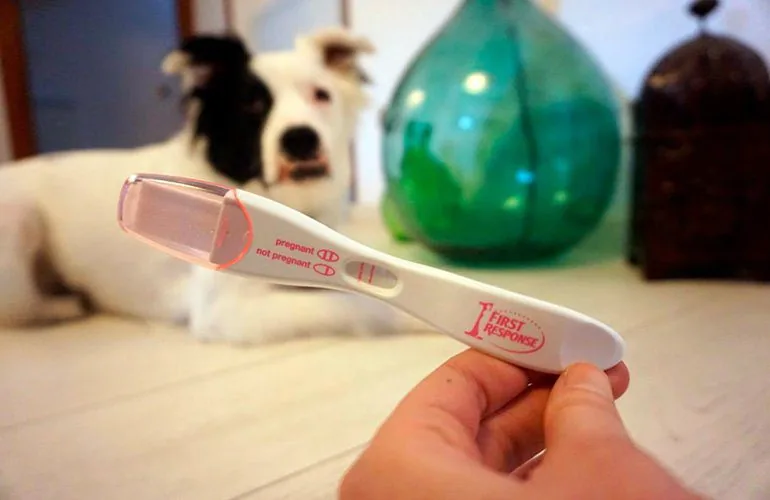
Pregnancy tests are well known, and we know they let us find out, easily and early on, whether or not a pregnancy exists. But that's true for women. For female dogs, it's not so simple.
So, although a relaxin hormone test does exist for them, it's more common to confirm pregnancy in female dogs through palpation, ultrasound, or X-ray. Let's take a detailed look at how to tell if our dog is pregnant.
Pregnancy in Female Dogs
First, we should know that a dog's gestation period lasts about two months, nine weeks, or around 63-65 days. In many of them, we won't notice any changes until the final weeks. That's why owners often want to be able to confirm their dog's condition much earlier.
Whether it was a planned or intentional mating, or the result of an unwanted mating, it's very helpful to have a pregnancy test, similar to the ones women use. The truth is, a test does exist for female dogs, but it isn't widely used. It measures the concentration of a hormone called relaxin.
So, when it comes to diagnosing pregnancy, four methods stand out: palpation, ultrasound, the relaxin test mentioned above, and X-ray. The test allows confirming pregnancy earlier than imaging diagnosis, but it doesn't give information on how many puppies are expected.
Serological Tests for Pregnancy Diagnosis
Experts aim to detect pregnancy in female dogs as early as possible. To do this, they study different hormones more or less linked to this period, searching for the one that offers the most diagnostic accuracy. The problem is that female dogs don't have a specific hormone the way women do. That's where the difficulty in developing a test comes from.
So, progesterone has been ruled out, since it's also elevated in non-pregnant female dogs. Some proteins like fibrinogen increase during pregnancy, but since they're also linked to inflammatory processes, more research is needed before they can be used. The same goes for prolactin, which is also high in dogs with false pregnancy.
It's possible to measure follicle-stimulating hormone, which, at high concentrations, indicates pregnancy between 16 and 18 days after fertilization. The problem is that it's a very expensive test, which is why it isn't used. Work is being done on an estrogen-based test, since estrogen rises in urine around day 21 after mating. For now, the relaxin test is what's used.
Palpation to Determine Pregnancy
As an alternative to the test, palpation is used. The puppies can be felt in the belly around 22-30 days into gestation. What's being felt are the amniotic sacs where the developing puppies are located. This is the traditional method, and the fastest and cheapest.
The only downside is that, for it to actually be useful, it needs to be done by a vet experienced in this procedure. Before this point, the sacs are too small to feel, and afterward, they fill with more fluid and lose their shape, forming a sort of continuous mass between them all.
Palpation becomes reliable again toward the end of pregnancy, once the puppies' skeletons have ossified. It's also worth keeping in mind that palpation can be difficult in obese dogs or those with a tense abdomen.
Ultrasound to See the Puppies
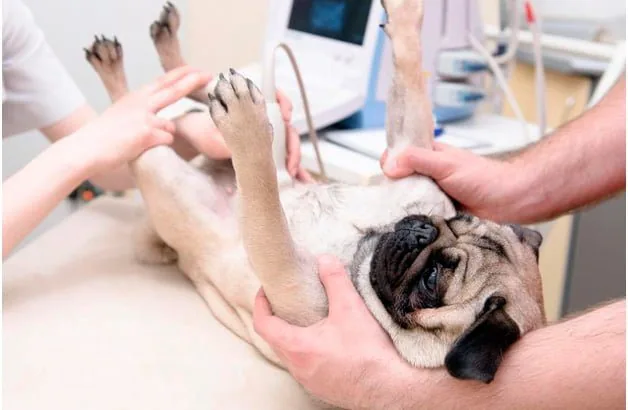
Ultrasound is an imaging diagnostic method that lets us identify the puppies in the uterus from around day 19-21 of pregnancy. Specifically, what can be seen are the amniotic sacs. Sometimes it isn't possible until around day 25.
It's a very effective, accurate, and low-discomfort technique for the female dog. It's recommended she come in with a full bladder, to make visualization easier. It's possible to estimate the number of puppies, although there can be errors, and to assess their development and even viability.
Relaxin Test
What makes relaxin unique is that it's a hormone produced by the placenta. It's therefore the closest thing to a pregnancy-specific hormone in this species. That's why it can be used to determine whether pregnancy exists. It's detectable between 21-30 days after fertilization.
A commercial test exists that works with serum or plasma. One downside to keep in mind is that it can give false results. To avoid this, it's recommended to repeat the test a week later. It can also come back positive for some time after a miscarriage has occurred.
X-Ray
Of the pregnancy diagnostic methods, X-ray is the one that gives us information the latest. It allows visualizing the puppies from day 44-50 of pregnancy onward, since the bones need to be visible. Before that date, an X-ray would only show a distended uterus, which could also be consistent with illness.
Although X-rays do carry some risks, by the end of pregnancy the harm to the puppies would be the same as for an adult dog. It allows counting the number of fetuses, getting a general idea of their development, or detecting a dead puppy.
The Importance of Diagnosing Pregnancy
These methods aren't just useful for diagnosing pregnancy — they also let us set an approximate due date, and some, like ultrasound and X-ray, also give us information on how many puppies to expect. Although there can be errors if the fetuses overlap.
It's important to estimate the likely due date, to avoid problems from premature or delayed births. This is especially important when risk factors are present, such as gestational diabetes, or when problems requiring veterinary intervention are expected. For example, brachycephalic breeds, which usually need a C-section.
Bibliography Mayo, Pedro. 2013. Diagnóstico de gestación y evaluación de la maduración fetal en la perra. Portal Veterinaria. 2014. Fisiología de la reproducción y problemas del aparato reproductor en perros y gatos. Portal Veterinaria.
IMPORTANT: This article is for informational purposes only and does not constitute veterinary, nutritional or behavioural advice. Every dog is different, and only your trusted vet can advise you on its specific needs.