 Care
Care
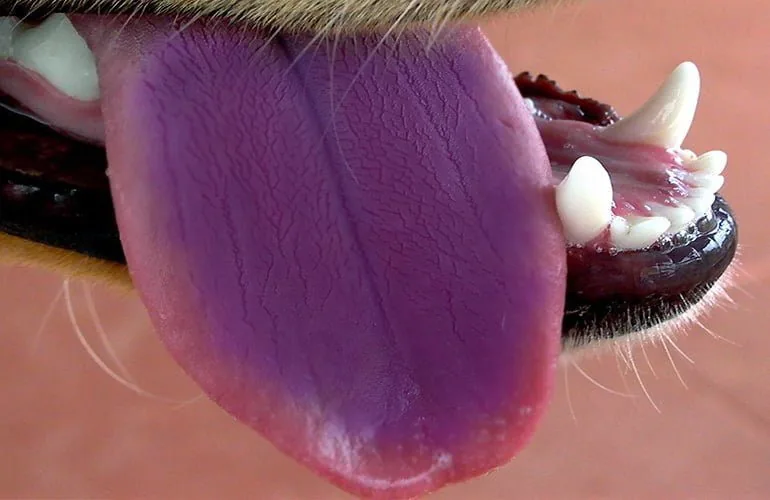
Purple Tongue in Dogs - Main Causes
Our dog's tongue is a very important organ. Beyond giving us kisses in the form of licks, it can tell us about our dog's health status. We should know what a normal tongue looks like, since changes in its color or shape can point to general health conditions.
Most dogs' tongues are normally pink, but some, without having any condition, have a bluish-purple tongue. We'll show you how to spot health problems in your dog through their tongue. Shall we begin?
What is the normal color of a dog's tongue?
In dogs, a healthy tongue is generally a bright pink color, with a slight whitish film covering its surface, and it shouldn't be swollen or have ulcers, lumps, or raised areas.
It's a good idea to include checking your dog's tongue as part of the wellness checks we do at home. We should look at its color, shape, and make sure there are no ulcers, bleeding, or bumps inside the mouth.
We can take the opportunity to check our dog's tongue when it's out of their mouth from panting after a walk, but in this situation, its color will be a bit redder than normal from the rise in body temperature. We should never pull the tongue out of the mouth, especially in small breeds.
Is it normal for dogs to have a purple tongue?
Although the normal tongue color is pink, some breeds such as the Chow Chow and its mixes have a naturally bluish-purple color, or some dogs may have dark pigmented spots on their tongue like moles, and both cases are within the range of normal and aren't linked to any condition.
However, if our dog's tongue is normally pink and at some point we notice it's turned more bluish-purple, it points to a possible breathing problem, with the dog not getting enough oxygen.
Because of this, if we notice a color change in our pet's tongue, we should see the vet as soon as possible, since they could be experiencing a serious problem.

What does a color change in the tongue indicate?
As we've seen, a color change in a dog's tongue can point to illness. Sudden, obvious color changes usually signal significant health issues.
- Blue tongue: a bluish coloring of the tongue and mucous membranes is known as cyanosis, and is due to a lack of oxygen in the tissues; it can be secondary to heart or respiratory disease, or to a choking situation with an airway blockage. So, if our dog isn't a breed with a naturally bluish tongue, and we notice the mucous membranes in the mouth are also turning blue or purple, it's very important to see a vet urgently.
- Purple tongue: if our dog's tongue turns very dark red or purple, and even swells, it can point to blocked blood flow. This can happen, for example, if a thread wraps around the tongue and cuts off circulation. If this situation goes on for too long, the tongue's tissue will start to die, and the dog could end up losing this organ.
- Pale tongue: in animals with anemia or significant blood loss, a pale coloring of the tongue and gums can be seen. This coloring can also appear in situations where the dog is very frightened, but if that's the cause, the mucous membranes return to their normal color once the animal calms down.
- Tongue with dark areas: flat, black-pigmented areas on a dog's tongue and gums are normal. These dark areas result from microscopic melanin granules and aren't a cause for concern. However, if the dark area isn't flat and is raised above the surrounding tissue, it's important to see the vet, since it could be a melanoma.
Can diseases be diagnosed through the tongue?
According to Western medicine, color changes in the tongue can give us some information about the dog's general condition (lack of oxygenation, anemia...), but traditional Chinese medicine goes further, and tongue inspection and evaluation is considered one of the most objective diagnostic methods.
For traditional Chinese medicine, the tongue overall reflects the body's general health, and additionally, certain parts of the tongue reflect the health of specific organs.
The tip of the tongue reflects the heart, the area between the tip and the center reflects the lungs, the center reflects the stomach and spleen, the root reflects the kidneys, bladder, and intestines (and the uterus in females as well), the left edge of the tongue reflects the liver, and the right edge reflects the gallbladder. Based on the color and appearance of each area, the condition of the different organs is determined.
Tongue colors can be assessed according to the principles of traditional Chinese medicine:
- A pale or white tongue can point to a weakened body condition (dogs with anemia, leukemia, blood loss, gastrointestinal problems, weak lungs, malnutrition, etc.).
- A deep red tongue can indicate overactivity in one of the body's systems (bacterial or viral infection, fever, hyperthyroidism, diabetes, cancer, a buildup of toxins somewhere in the body, etc.).
- A bluish tongue or one tinged purple can point to pain or congestion somewhere in the body (a problem with the vascular system, heart disease, circulation problems, respiratory problems, etc.).
- An orange-yellow tongue can indicate gastritis and poor gallbladder or liver function.
As we can see, by looking at our dog's tongue, we can get a lot of information about their health, so if we notice our pet's tongue changing shape, color, or texture, or if we notice any lump, we should see a vet to rule out any underlying condition.
Bibliography: Dolores Puertas, Albert Snijders; Acupuntura en Veterinaria
IMPORTANT: This article is for informational purposes only and does not constitute veterinary, nutritional or behavioural advice. Every dog is different, and only your trusted vet can advise you on its specific needs.