 Breeds
Rottweiler
The Rottweiler embodies loyalty forged over centuries of service alongside humans. Beneath its imposing muscle and alert gaze lies a stable, affectionate temperament, deeply protective of its own. This isn't a breed for first-time owners, but in responsible hands it becomes a family companion that's hard to match.
A Molosser With an Imposing Presence
The Rottweiler belongs to the molosser group, and its build confirms it: a sturdy, compact body, with a wide, deep chest that gives it exceptional lung capacity. The head is massive, with a wide skull, a well-defined stop, and a scissor bite that reflects the power of its jaw. The ears, high-set and medium-sized, fall forward, framing an expression that's always alert yet calm.
Under the official American Kennel Club (AKC) standard, males stand between 61 and 68 cm at the withers and weigh 43 to 61 kg, while females reach 56 to 63 cm and weigh 36 to 45 kg. This marked sexual difference is a defining part of the breed standard. Life expectancy runs between 8 and 10 years, typical for a large breed.
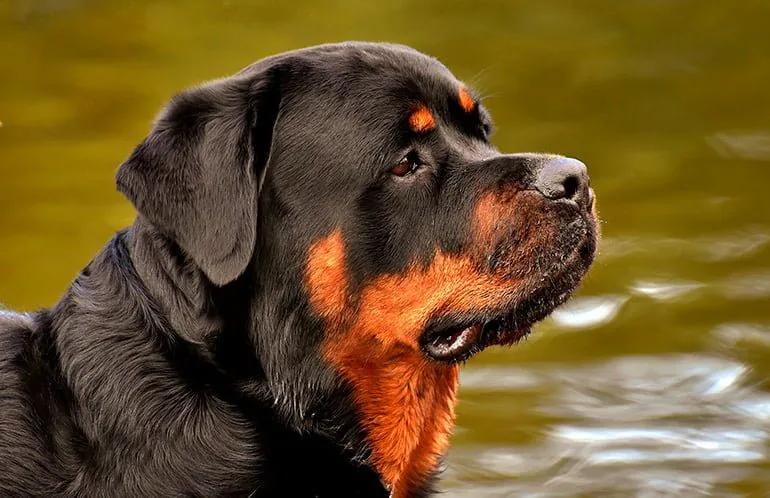
The coat is double-layered: a dense, straight outer coat lying close to the body, and a softer undercoat that insulates against cold. The color is always intense black with tan markings clearly defined on the muzzle, cheeks, chest, legs, and above the eyes, forming the symmetrical pattern that defines the breed's visual identity.
From Roman Legions to Rottweil
The Rottweiler's origin traces back to the Roman Empire, where molosser-type dogs accompanied the legions on their campaigns. Their main job was driving and protecting the cattle that fed soldiers during long marches across Europe, a task requiring strength, stamina, and a firm temperament.
With the fall of the empire, these dogs settled in the region of Rottweil, in southwestern Germany. There, local butchers put their cattle-driving and cart-pulling skills to use hauling meat, earning them the nickname "Rottweil butcher's dog." For centuries they were an indispensable tool in the region's rural economy.
In the 19th century, the arrival of the railroad and new health regulations drastically reduced cattle droving on foot, and the breed came close to extinction. German breeders revived it in the early 20th century, focusing on its guarding and defense qualities, establishing the first official standard and transforming the old herding dog into the household protector we know today.
Temperament: Composure and Loyalty
The Rottweiler is, by nature, a self-assured dog, calm and measured in its reactions. Its temperament doesn't come from gratuitous aggression, but from a working heritage that for centuries selected dogs capable of assessing situations and acting only when necessary. A well-balanced Rottweiler observes, analyzes, and rarely acts rashly.
Within the family it's deeply affectionate and protective. It doesn't demand constant petting, but it forms very close bonds with every member of the household. Its guarding instinct shows up as silent vigilance: it always knows where everyone is, and reacts to anything unusual with calm determination, without compulsive barking or nervousness.
The key to a stable temperament is early socialization and consistent training based on positive reinforcement. A Rottweiler properly guided from puppyhood develops unshakeable confidence and natural obedience that make it a reliable, well-balanced adult.
Fun Facts That Define the Rottweiler
Few breeds can boast a nickname as descriptive as "Rottweil butcher's dog," a direct legacy of its medieval job pulling carts loaded with meat through the streets of the German city. This role as a draft dog is an almost unique historical trait in the dog world.
Another notable fact is that the Rottweiler was one of the first breeds used as a guide dog for the blind in the early 20th century, long before the Labrador took over that role. Its intelligence and temperament made it well suited to the task.
The marked sexual dimorphism between males and females isn't just about size: it also shows in expression and structure, with males noticeably more imposing. Its exceptionally powerful jaw and scissor bite also place it among the dogs with the strongest bite force, a legacy of its past protecting herds and goods.
Essential Health and Care
As a large breed, the Rottweiler has a predisposition to certain health issues. Notable ones include hip and elbow dysplasia, aortic stenosis (a congenital narrowing of the heart's main artery), and bloat, a potentially fatal veterinary emergency. It also shows an above-average incidence of osteosarcoma, an aggressive type of bone cancer.
Daily exercise is non-negotiable. It needs at least an hour of controlled activity, combining long walks with games that stimulate its mind, such as tracking or advanced obedience. It's crucial to avoid intense exercise right after meals to prevent bloat.
Weekly brushing keeps its double coat in good condition, though it should be stepped up during seasonal shedding. But the most important form of care is firm yet positive training from the first months, paired with ongoing socialization. A Rottweiler raised with clear guidelines and structured affection will grow into a mentally healthy adult and an exceptional protector.
IMPORTANT: This article is for informational purposes only and does not constitute veterinary, nutritional or behavioural advice. Every dog is different, and only your trusted vet can advise you on its specific needs.