 Breeds
Scottish Terrier: Temperament, Care and Fun Facts
The Scottie has a reputation as a spirited lapdog, but he was born to work. In the Scottish Highlands he was bred to chase badgers and other burrowing animals. That history shows in the dog's build. His jaw packs a strength you wouldn't expect given his size. You might also be interested in the Jack Russell Terrier.
Origin and history
The Scottie carries the mud of the Scottish Highlands in his veins. In the 19th century, farmers and gamekeepers needed a dog able to go down burrows after foxes, badgers and rodents, and that's where this breed found his purpose. Short legs, an iron jaw and a coat so dense the Scottish cold and damp simply couldn't get through. He couldn't be big, because underground there are places where size is a liability, not an advantage. His roots intertwine with other northern terriers, including the Cairn Terrier and the West Highland White Terrier, though over time each line took its own path until, by the late 19th century, the Scottish type was firmly established.
Captain Gordon Murray was the one who finished fixing that type, cementing above all the black coat that defines the breed's image today. In 1881 the breed standard was established, and shortly after the Scottie began arriving in North America, where he quickly carved out a place for himself during the early decades of the 20th century. The Fédération Cynologique Internationale (FCI) places him in Group 3 – Terriers, small terrier section, a direct reflection of his origin and build. Little remains of his life in the countryside, but the instincts don't fade so easily: tenacity, a fine nose and a tendency to decide things for himself remain the breed's hallmarks.
From the countryside to the city, the Scottie made the transition without missing a beat. With his elongated body, upright ears and that characteristic beard, he became a recognisable icon, even in board games. Adverts, films, illustrations — his silhouette turned up everywhere. But behind that urban-pet image lies an animal bred to work alone, underground, making decisions without waiting for instructions. That psychological profile didn't disappear just because he now lives in a flat, and understanding where he comes from explains many of the behaviours owners find hard to manage.
Physical characteristics
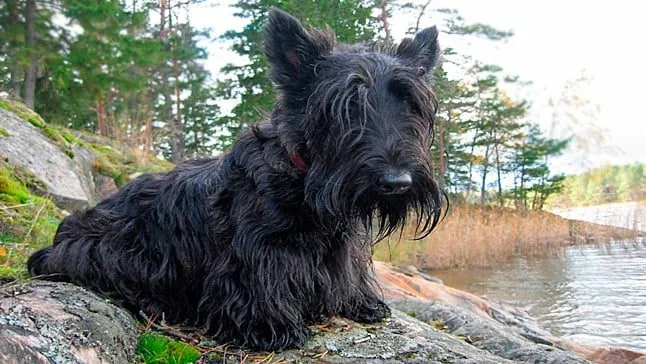
25 to 28 centimetres at the withers and 8 to 10 kilos. Given those measurements, the Scottish Terrier falls into the small-terrier category, but anyone who handles him up close quickly notices there's more dog in there than the numbers suggest. The body is compact and muscular, somewhat longer than tall, with a deep chest and well-sprung ribs giving him a lung capacity many larger dogs would envy. The legs are short, yes, but straight and solid, with tight feet and thick pads built to handle ground that's anything but parquet flooring. The tail, set high and always carried upright, works as a mood barometer.
The head defines the breed before anything else. Elongated, with an almost flat skull and a stop that's present without dominating. The ears are small, pointed and held well erect, giving him that permanently-on-guard expression that suits him so well. Those almond-shaped, very dark brown eyes convey intelligence and strong character in equal measure. The muzzle is strong, and the jaw's power is fairly disproportionate to the animal's size, which makes complete sense once you remember this dog was bred to hunt prey that fought back. The nose is black regardless of coat colour, and the lips close tightly, with no floppy look.
Coat colour can be black, wheaten or brindle. Black is what everyone pictures when they think of a Scottie, and also the most common, but wheaten individuals — that even sandy tone that looks so good — and brindle ones, with dark striping over a lighter base, are equally recognised in the standard. The coat has two layers. The outer one is harsh, dense and wiry in texture; underneath is a soft, thick undercoat that acts as thermal lining. This structure protected the dog from damp, cold and scrapes while working in burrows. Today that same structure still serves companion dogs well. Water runs off, dirt doesn't cling easily.
Temperament and life together
The Scottie isn't a dog who goes around seeking cuddles at every turn. He has character, and it shows from day one. His independence and courage go hand in hand with a very selective loyalty toward his own people, the kind of devotion he doesn't hand out to just anyone. For centuries these dogs went down burrows alone, made decisions with nobody telling them what to do, and got their jobs done unaided. That history explains why they remain dogs with their own judgement today, capable of being reserved around strangers without tipping into gratuitous aggression or shyness. Socialisation from puppyhood is key so that natural wariness doesn't turn into a reactivity problem.
At home he behaves well as long as his need for movement and stimulation is covered. He doesn't bark at everything, but he doesn't let an unexpected visitor or an out-of-place noise slide either; he's a good watchdog without becoming a nuisance. With children he works, though with nuances: he tolerates rough play or being pestered poorly, something fairly common among terriers. Kids need to be taught to respect his space. With other dogs, things vary depending on his socialisation, since the terrier instinct can surface as tension with dogs of the same sex, so it's worth staying alert in parks or shared spaces.
The prey drive is still very much alive in the breed. Decades of selection for chasing small animals leave a mark, and expecting a Scottie to ignore a rabbit or a rodent with no preparation at all is asking a lot. Living with cats or other small pets is possible, but it takes time, gradual habituation and caution. Beyond that, he's a dog who appreciates routine and a certain margin of autonomy. Anyone wanting a companion always available for play and constant physical contact will find a better fit in other breeds. Anyone who understands how the Scottie works, on the other hand, gets a calm dog with a loyalty that's hard to match.
Care and grooming
The Scottie's coat isn't maintained like any other dog's. The outer layer has a harsh, almost wiry texture, and it doesn't renew itself through shedding alone. That's why stripping exists: manually pulling out dead hair, done every two or three months by hand or with a tool designed for it, removing each hair from the root so the new coat grows back with the right texture. Here's the trick: if scissors or clippers are used instead — as most dog groomers do — the hair softens, turns woolly and loses its characteristic water resistance. Stripping doesn't hurt if done properly, because the hairs being removed are in the telogen phase and come out with a gentle tug.
There are three areas that need separate attention: the beard, the eyebrows and the belly, where the hair grows longer. The beard traps food residue and moisture easily, and if it isn't wiped down daily with a damp cloth it can end up causing irritation or bad odour. The eyebrows — which originally protected the dog's eyes during hunting — need regular trimming so they don't block his vision. Bathing, every four to six weeks at most; bathing more often disrupts the skin's natural oily coat. Always with shampoo specific to wire coats, never with products that soften the hair. When drying, towel first; if a hairdryer is needed, low heat, following the direction of hair growth.
The erect ears ventilate well thanks to their upright position, which considerably lowers the risk of ear infections, though they still need regular checking and cleaning. Nails, every three or four weeks; natural wear on hard surfaces sometimes isn't enough, and nails that are too long change how the paw makes contact with the ground, eventually causing joint discomfort. Watch the teeth: in small breeds, dental hygiene often gets neglected, and the Scottie tends to build up tartar. Two or three weekly brushings with enzymatic toothpaste, plus a suitable chew toy, make a real difference long term.
Health and common conditions
Those years of life — generous for the breed's size — don't come on their own. They depend on each individual's genetic load and on the care given from puppyhood. Responsible breeders do much of the work by selecting breeding stock free of known hereditary conditions, but health management at home matters just as much. Regular vet check-ups, vaccinations adjusted to the dog's actual circumstances, and specific screenings from age seven onward — once they count as seniors — help catch problems before they become complicated.
Hereditary juvenile-onset ataxia is one of the most studied neurological disorders in the Scottish Terrier. It affects the cerebellum's Purkinje neurons and progressively deteriorates motor control ‘Genetics of Hereditary Ataxia in Scottish Terriers’ (2017). The dog loses coordination, his limbs tremble during movement, and he struggles to judge distances. All of this appears within the first months of life. There's no curative treatment. The only way to reduce its incidence is identifying carriers before breeding through genetic testing. Along the same lines, a case of primary cerebellar cortical degeneration — or abiotrophy — has been described, where the cerebellum shrinks and the number of Purkinje cells declines, with a clinical picture practically identical to the above ‘Diagnosis of cerebellar cortical degeneration in a Scottish terrier using magnetic…’ (2001). Both conditions are hereditary, which says everything about the importance of choosing the right breeder.
On the blood side, von Willebrand disease is the condition of most concern in the breed. A serious, often fatal hereditary clotting disorder that prevents normal platelet aggregation: a small wound or a surgical procedure can turn into bleeding that's hard to stop. There's a simple, highly accurate genetic test that identifies affected animals ‘Mutation Causing von Willebrand's Disease in Scottish Terriers’ (2000), so no Scottie should go into surgery without having been tested first. Beyond this, at least one case of panhypopituitarism and hypophysitis has been documented in a six-year-old neutered male who presented with progressive lethargy and a week of anorexia ‘Hypophysitis, Panhypopituitarism, and Hypothalamitis in a Scottish Terrier Dog’ (2017). A one-off case, but a reminder that vague symptoms call for a broader differential diagnosis, not just a focus on the breed's most common conditions.
Beyond the strictly hereditary side, the Scottie shows some tendency toward patellar luxation and skin problems linked to allergies — both environmental and food-related — fairly common among small breeds. In older dogs, Cushing's syndrome or hyperadrenocorticism shows up fairly often: excessive thirst, frequent urination, progressively weakening muscles and visible coat changes. Watch for these signs, because the sooner they're caught, the better the treatment response.
Recommended diet
The Scottish Terrier's diet needs to match his moderate metabolism and compact build, with strict portion control to prevent excess weight, which on such a compact skeletal frame can trigger joint problems and worsen his predisposition to patellar luxation. An adult at his ideal weight — 8-10 kg — needs a daily calorie intake that depends on activity level, age and reproductive status, but usually falls around 350-450 kilocalories. The choice between dry kibble, wet food or a homemade diet should be based on nutritional quality, not commercial preference: the percentage of animal-derived protein should be high, with a moderate proportion of healthy fats and controlled carbohydrate content.
Splitting the daily ration into two meals helps keep glucose levels stable and reduces the risk of gastric torsion, a veterinary emergency that, while less common than in deep-chested large breeds, isn't impossible in the Scottie given his relatively broad chest. Raised feeders can be beneficial for older dogs or those with neck problems, but in healthy individuals there's no solid evidence justifying their systematic use. Hydration is another key pillar: fresh water should always be available and, if the dog eats dry kibble, it's worth checking he drinks enough, since insufficient water intake can concentrate the urine and favour urinary stone formation.
During puppyhood, up to roughly twelve months, the diet needs to be formulated to support balanced bone growth, avoiding both the calorie excess that speeds up development — predisposing to dysplasia and osteochondrosis — and calcium or phosphorus deficiencies. Treats and snacks shouldn't exceed ten percent of total daily calorie intake, and functional rewards like dehydrated meat strips or crunchy vegetables are preferable. At any change in appetite, body condition or bowel habits, consulting a vet is the right way to adjust the feeding plan, since individual needs can vary significantly even within the same weight and age range.
Exercise and training
The Scottish Terrier needs 30 to 45 minutes of daily exercise, a figure that might sound modest but needs to happen consistently and, above all, with enough intensity to satisfy his working-dog heritage. A brief walk to relieve himself isn't enough: the Scottie needs to walk at a steady pace, explore varied environments and have moments of free play in safe spaces where he can let his nose run wild. Scent stimulation matters particularly in this breed, since his selection as a burrow hunter sharpened a highly developed sense of smell; tracking games, snuffle mats or simply letting him investigate during the walk are strategies that contribute to his mental balance as much as physical exercise does.
On the training side, the Scottie has a profile that demands patience, consistency and an approach built on positive reinforcement. His intelligence is sharp, but his independence — the same trait that once let him decide how to face a fox inside a burrow — can come across as apparent stubbornness if training relies on mechanical repetition or coercive methods. He responds much better to short, varied, playful sessions, where the reward isn't always food but also access to something he wants — a toy, going out into the garden, interaction with his person. Consistency in the rules is non-negotiable: if he's allowed on the sofa one day and scolded for it the next, the Scottie learns the rules are negotiable and acts accordingly.
Basic obedience training should start from puppyhood and be paired with structured socialisation that gradually and positively exposes him to different people, dogs, environments and stimuli. Group dog-training classes can help, provided the trainer knows the particularities of terriers and doesn't force uncomfortable interactions. One aspect worth working on specifically is managing his prey drive: teaching a reliable recall and practising it in settings with increasing distractions is a time investment that prevents scares down the road. The Scottie isn't a dog who seeks to please at all costs, but he does value a relationship with a handler who offers him interesting challenges and respects his need for a degree of autonomy.
Living with a Scottish Terrier means accepting that independence isn't the same as detachment, but a different way of bonding that requires understanding how he processes the world. The breed fits well in homes that value a dog with a defined personality, one who doesn't demand constant attention but stays present calmly and watchfully. If your lifestyle includes quality daily walks, tolerance for a certain dose of stubbornness, and willingness to keep up a coat-care routine that goes beyond superficial brushing, the Scottie can offer loyal, richly nuanced companionship for many years. The sensible next step is contacting breeders who work with genetically tested stock for the conditions described and visiting their facilities to meet the puppies' parents, observing their temperament and breeding conditions before making any decision.
For a balanced life with a Scottish Terrier, the most practical approach is building scent routines into his daily walks: letting him stop to sniff freely for a few minutes satisfies his hunting instinct and reduces frustration, which often prevents lead-pulling and reactive behaviour. Offering a food-dispensing toy before leaving him alone also channels his mental energy constructively, helping him rest calmly and preventing destruction from boredom.
IMPORTANT: This article is for informational purposes only and does not constitute veterinary, nutritional or behavioural advice. Every dog is different, and only your trusted vet can advise you on its specific needs.