 Breeds
Shiba Inu: Temperament, Care and Fun Facts
The Shiba Inu, a primitive breed of Japanese origin classified in FCI Group 5, has a life expectancy of 12 to 15 years. Knowing his specific needs is what separates a dog who ages with vitality from one who carries avoidable health problems.
Recommended diet for a Shiba Inu
His longevity and quality of life largely depend on preventing hereditary problems such as patellar luxation or allergies, and on a controlled diet that keeps him at his ideal weight (8–11 kg in males, 6–9 kg in females).
Knowing these predispositions allows for proactive action: keeping the dog at his optimal weight (8–11 kg males, 6–9 kg females) reduces the load on the joints, and a routine of eye checks and knee palpation during brushing helps catch early signs. The key is not to normalise symptoms such as occasional lameness or persistent scratching, and to see the vet at any change, because an early diagnosis widens the management options and preserves quality of life for more years.
The Shiba Inu retains an efficient metabolism inherited from his hunting ancestors, meaning he tends to make the most of every calorie, which makes portion control critical to avoid excess weight. A diet based on high-quality animal protein — meat, fish or egg as the first ingredients — with a moderate fat level and a controlled amount of complex carbohydrates, suits his needs well. Kibble formulated for medium breeds prone to weight gain, or clean-composition wet diets, are valid options, as long as they're adapted to the dog's age, activity level and physiological state.
Many Shibas show selective eating behaviour, sometimes described as “picky”. Rotating protein sources within the same quality range, or adding small amounts of wet food as a topper, can stimulate appetite without falling into the trap of constantly offering more palatable alternatives that end up reinforcing the fussiness. Commercial treats and table scraps should be kept to a minimum; an effective strategy is setting aside part of the daily kibble ration to use as rewards during walks or training sessions, which keeps the calorie balance intact.
Hydration deserves the same attention: fresh water should always be available, and for dogs that drink little, a moving water fountain or lightly moistening the kibble can help. Some individuals develop food sensitivities that show up as skin or digestive signs; in those cases, an elimination diet supervised by a vet is the only reliable way to identify the trigger ingredient. Omega-3 fatty acids, found in fish oil, support skin and coat health, and can be added as a supplement on professional recommendation.
Grooming and coat care for the Shiba Inu
The Shiba's coat is double-layered: a dense, soft inner layer that acts as thermal insulation, and a smooth, slightly coarse outer layer that repels water and dirt. Those two layers are the direct cause of seasonal shedding, which arrives twice a year — spring and autumn — and which more than one owner remembers as a genuine snowstorm of fur around the house. The entire undercoat renews itself within a few weeks. During that period, brushing stops being optional.
To work the inner coat without irritating the skin, an undercoat rake or comb is the most useful tool. Next comes a slicker brush or metal-pin brush to smooth the outer layer. And a fine metal comb is good for checking trouble spots — behind the ears and the upper thighs — where tangles show up almost without warning. As for bathing, watch out for this: washing too often disrupts the skin's lipid barrier and ends up causing dryness and flaking. It's best to bathe him only when he's visibly dirty or has come into contact with something irritating. A gentle dog-specific shampoo and a thorough rinse are enough. During peak shedding, drying with warm air — never intense heat — while brushing gets the loose undercoat out much faster.
Something that often gets overlooked is the role diet plays in coat condition. Good levels of essential fatty acids, zinc and biotin really show: the coat gains shine and the skin becomes less reactive. Outside shedding season, brushing once a week is enough to keep the coat in shape, spread natural oils, and strengthen the bond with the dog along the way. And shaving a Shiba Inu — except under veterinary advice for surgery — is a mistake with consequences that can be permanent. The double coat insulates in both winter and summer, and removing it can disrupt the hair growth cycle irreversibly.
Origin and history
Before there were written records, the Shiba Inu was already trotting the hillsides of central Japan. Hunters took him into scrubland and undergrowth to flush birds, catch rabbits and, depending on the region, stand up to wild boar. His name comes from that, from that landscape of brushwood, though some link it to the tile-red of autumn foliage, so similar to the breed's most common coat colour. Centuries of selection under those conditions left a dog that's agile, quiet, with a highly developed sense of smell. What they didn't leave was docility.
In 1936, the Japanese government declared him a national monument. A few years later he nearly disappeared. Bombing during the Second World War and a distemper outbreak drove the population down to critical numbers, and the breed survived by a narrow margin. Recovery began in the 1940s by merging three bloodlines that had held on separately: the San'in, the Mino and the Shinshu. The latter had the biggest influence on the standard we know today. The Fédération Cynologique Internationale places him in Group 5, alongside Spitz and primitive-type breeds, a group made up of dogs whose morphology and temperament have been barely altered by modern breeding.
All that history of self-sufficient hunting shows. The Shiba's independence, his almost cat-like grooming habits, that prey drive still fully intact — none of that arrived by accident. In Japan he's the most popular companion dog, ahead of other native breeds such as the Japanese Spaniel, and he's so tied to the country's image that he appears on pottery, illustrations and rural festivals. Outside Japan things have changed quite a bit in recent years: more and more people seek him out precisely for that distinctive look and that temperament unlike anything else.
Physical characteristics
At first glance, the Shiba Inu gives the impression of a dog built with precision. Every proportion lines up with the next. Adult males stand 38 to 41 cm at the withers and weigh 8 to 11 kg; females run a bit smaller, at 35 to 38 cm and 6 to 9 kg. There's sexual dimorphism, though nothing exaggerated.
The body tells his story. Deep chest, tucked-up belly, straight back with a slightly sloping croup. A structure built to handle rough terrain, to manoeuvre through scrub and rock, not for sprinting across open country. The muscle is there, compact and functional, even if it isn't showy.
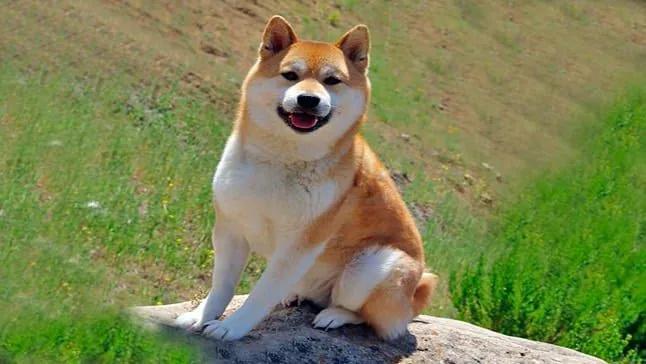
The head has that profile everyone ends up describing as fox-like. The ears are small, triangular, held well upright with a slight forward tilt, and set apart from each other. Dark brown and almond-shaped, the eyes give off a mix of alertness and calm few breeds manage. The muzzle narrows down to a black nose.
The tail is another trait that identifies the breed at a glance. Thick, set high, it curls over the back tracing a sickle shape or a tight ring. Recognised colours are red, black-and-tan, and sesame — red with black tips evenly distributed. Cream also shows up, though not every kennel club recognises it in its standards. Whatever the colour, urajiro has to be present in every individual — those white patches on the cheeks, chest, belly and tail tip that are an essential part of the breed.
In motion the Shiba is light and springy. No wasted steps. The double coat rounds out his silhouette and gives him more presence than his measurements suggest. And if you stop to think about every detail, it all fits. The erect ears were there to pick up movement in the vegetation. With the tail curled over his back, the dog covered his rump while resting in the cold. The pads, thick and tough, absorbed the impact of the rocky terrain of the Japanese mountains.
Temperament and life with a Shiba Inu
The Shiba Inu lives life on his own terms. He loves his people, follows the household routine, is present, but you're unlikely to see him begging for cuddles on the sofa or glued to your legs the way other breeds do. That independence — the same trait that gets him compared to a cat — doesn't mean he ignores his family; a well-socialised Shiba takes part, watches, shows up when he feels like it, and that's already a fair amount of bonding for a breed with this temperament. With strangers he closes off almost automatically, without open aggression but without the slightest interest in making new friends, which makes him a reliable alert dog though not a guard dog in the traditional sense. Is this an aggressive breed? Depends what you mean by that. He has a strong prey drive and defends his space with conviction, and if he feels cornered or an unfamiliar dog invades his space without an introduction, he may respond with growling, sharp barking or that shriek known as the "Shiba scream", which throws people off quite a bit the first time they hear it. That reactivity is mostly defensive, and socialisation from puppyhood is what keeps it within reasonable limits.
Prey drive is what complicates everyday life with this breed the most. A cat crossing the street, a squirrel, a scooter — it takes very little movement for the Shiba to switch into chase mode and tune out everything else. That makes recall unreliable in open spaces even when training has gone well, so a lead outdoors and fenced areas to let him off it are non-negotiable measures. With other dogs there tends to be more understanding with the opposite sex; unneutered males tend to become more reactive toward other males. Controlled introductions from puppyhood help manage this, though they don't eliminate it entirely.
At home he's a very clean dog. Some puppies learn almost on their own not to soil indoors, and watching them lick their paws with that cat-like meticulousness stands out from the start. With children he can do very well if they've grown up together and the kids learn to respect his quiet moments; he won't tolerate rough handling or invasive play, so adult supervision is essential. Training a Shiba calls for patience and short sessions. Coercive methods only make the dog shut down, because he has the intelligence to understand what's being asked of him, but his motivation to obey depends on whether he sees the point of it or not. Watch out for monotony, which switches him off. For anyone who enjoys dog sports, the Shiba can offer plenty in agility, rally or scent work, as long as his pace is respected.
Care and grooming
The Shiba's coat gets the attention, but there are other parts of his care that can't be neglected. His teeth, for instance. Brushing them several times a week with an enzymatic dog toothpaste makes a real difference. Tartar causes bad breath, sure, but it also ends up affecting the gums and, if left to progress, can have more serious systemic consequences. Nails, if the dog doesn't move much on asphalt or other hard surfaces, need trimming every three or four weeks. When they get too long, they change how the paw makes contact with the ground, which ends up straining the joints. Ears deserve a weekly check. Dark wax, an odd smell or redness are signs not to let slide, since they usually point to an ear infection starting, often linked to allergies. And with cotton swabs and similar tools, best not to try. Cleaning should only be done with products specific to the ear canal, without inserting anything inside.
An adult Shiba needs to move for real. At least 45 to 60 minutes a day, split across two or three outings, and the same slow-paced route every time won't cut it. Giving him time to sniff freely, to follow trails without rushing, is far more mentally tiring than it seems; that helps nip in the bud the anxiety and boredom behind so much destruction and endless barking. At home, food puzzles and toys that make him think handle the rest. And if you have a garden, check the fence carefully. It needs to be tall and buried a few centimetres into the ground, because these dogs dig, look for weak points, and once they find one they can vanish before you notice.
Socialisation doesn't end once the dog stops being a puppy. Continuing to expose him regularly to different people, new environments and other animals, always calmly and with experiences that feel positive to him, is what keeps his emotional balance steady over time. Group training classes with a professional who works without punishment are a great help, both for polishing communication and keeping basic obedience current. The Shiba gets bored with mechanical repetition; he prefers short, varied sessions, not ten minutes of robotic paw-shaking. Spending a few minutes each day reviewing cues like "stay", "heel" or "drop it" — this last one especially important to stop him swallowing something dangerous on a walk — simplifies everyday life with him a lot and, above all, adds an important layer of safety when you're out together.
Common health conditions
The Shiba Inu shares a set of hereditary predispositions with other purebreds that are worth knowing before bringing a puppy home. Patellar luxation — the kneecap slipping out of its groove — is one of the most common orthopaedic conditions; it can present in varying degrees, from occasional discomfort to persistent lameness requiring surgery. Hip dysplasia, though less common than in larger breeds, also shows up in some lines and worsens with excess weight and inappropriate exercise during growth. On the endocrine side, hypothyroidism can present with lethargy, weight gain with no obvious cause, and changes in coat quality, and is diagnosed with a full thyroid panel. Eye diseases — primary glaucoma, cataracts and progressive retinal atrophy — have a significant genetic component, which is why responsible breeders put their breeding stock through regular eye exams.
One especially serious and thankfully rare condition is canine GM1 gangliosidosis, a lysosomal storage disease with autosomal recessive inheritance that causes progressive neurological degeneration and is fatal. Canine GM1 gangliosidosis is a fatal disease in the Shiba Inu breed, which makes controlling and reducing its prevalence important for maintaining breed quality and ensuring healthy dogs “Molecular epidemiology of canine GM1 gangliosidosis in the Shiba Inu breed…” (2013). Genetic tests exist that can identify carriers and plan matings that avoid producing affected puppies, a tool every buyer should ask the breeder for.
Skin allergies, particularly atopic dermatitis, are one of the most frequent reasons for vet visits in the breed. Canine atopic dermatitis is a recurring chronic condition that requires lifelong treatment, and modulating the gut microbiota (such as through probiotic use) is a potential intervention “A comprehensive analysis of gut and skin microbiota in canine atopic…” (2023). Intense itching, redness in the armpits and groin, and recurring ear infections are signs that need evaluating without delay. Management usually combines identifying and avoiding allergens, reinforcing the skin barrier with essential fatty acids and, in cases that need it, medication prescribed by the vet. Home remedies or drastic diet changes should never be used without a prior diagnosis, since doing so risks masking symptoms or making things worse.
Prevention remains the most effective strategy: keeping an optimal body weight reduces joint load and systemic inflammation; annual vet check-ups — with bloodwork and a thyroid panel in mature dogs — catch imbalances before they become clinically apparent; and vaccination and deworming adjusted to the dog's lifestyle protect against infectious and parasitic diseases that could complicate an already-predisposed system. The Shiba Inu's longevity and quality of life ultimately depend on informed decisions that start with choosing a puppy from health-tested parents and continue in every daily care habit.
If you're considering sharing your life with a Shiba Inu, look into breeders who run health tests and socialise puppies early, and get ready for an intelligent companion who will challenge you daily and reward you with an understated loyalty.
Living with a Shiba Inu means accepting that this breed isn't looking to please at every turn — he negotiates every interaction. The practical key is respecting his independence without giving up on early, ongoing socialisation, always built on positive reinforcement and avoiding direct confrontations. If the dog resists a command or a situation, the most effective approach is redirecting his attention with a game or a treat, rather than forcing obedience. Far from being permissive, this approach builds a relationship of trust where the Shiba Inu chooses to cooperate voluntarily, which reduces the conflicts typical of the breed and makes living together far more rewarding.
IMPORTANT: This article is for informational purposes only and does not constitute veterinary, nutritional or behavioural advice. Every dog is different, and only your trusted vet can advise you on its specific needs.