 Breeds
Japanese Chin
The Japanese Chin, also simply called the Chin, is a small, delicate dog breed that has captivated imperial courts for centuries. Mischievous, intelligent, and with behavior reminiscent of a cat, this dog has become one of the best household companions for anyone looking for a loyal, communicative animal.
History of the Chin Breed
For centuries the Japanese Chin has been considered an aristocratic dog, kept to accompany and entertain members of the imperial courts of the Far East.
Although it originated in China, it was in Japan that this breed evolved into its current appearance and developed the traits it's known for worldwide today. In fact, it's counted among the most iconic and beloved Japanese dog breeds.
For centuries it was considered something close to a sacred animal in the land of the rising sun. Stealing or harming this dog was once punishable by death.

What Does "Chin" Mean in Japanese?
The word "chin" comes from a Japanese term meaning "cat-like," a name that perfectly describes this breed's nature. The Japanese Chin was deliberately bred to combine traits of both dogs and cats, in both its physical appearance and its behavior.
This duality shows in how it acts: it loves perching in elevated spots, washes its face with its front paws, and spends long stretches grooming itself — all typically feline behaviors. Its quietness is also characteristic: it's a very communicative dog through whimpers and small grumbles, but it isn't a compulsive barker like other breeds.
The name reflects Japanese breeders' intent to create an animal that combined the elegance and independence of a cat with the loyalty and affection of a dog.
Physical Appearance of the Japanese Chin
Standing between 20 and 27 cm at the withers and weighing between 1.8 and 3.2 kg, the Japanese Chin falls into the small or toy dog category.
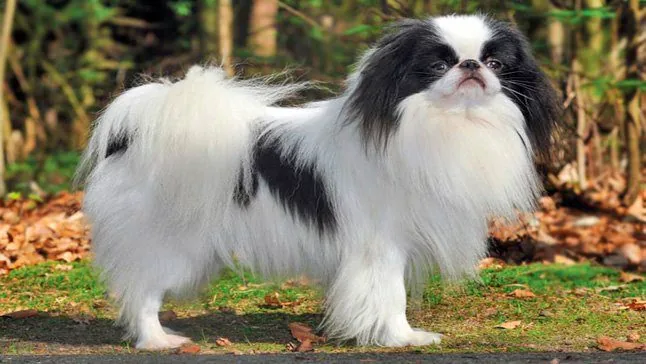
Its small, compact body is topped by a head that's large in proportion to the rest, with an upturned muzzle, "V"-shaped ears, and large, dark, prominent eyes set well apart. The skull is wide and rounded, giving it that characteristic aristocratic, elegant look. Its facial structure places it among the brachycephalic dog breeds, with everything that implies for its respiratory health.
The Chin's Coat
Its coat is long and very fine, with a downy look. Very silky to the touch. It's known for the dense ruff around its neck and chest, the fringing on its ears, and the plumed tail that curls over its back.
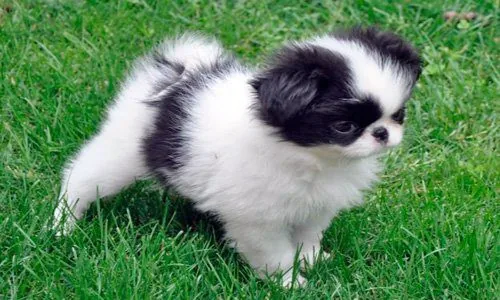
The Japanese Chin's coat can be entirely white, or white and black, and may also show red or tan patches. These color combinations are the only ones accepted under the breed standards.
This delicate coat needs constant care, with meticulous daily brushing to work out tangles and prevent possible skin irritation.
Japanese Chin Temperament
Mischievous and playful, the Chin's temperament is a lot of fun, though it can be aloof with strangers and, at times, fairly stubborn.
Its behavior often recalls that of a cat: it loves perching in elevated spots and spends long stretches licking its paws and grooming itself.
It's a dog highly sensitive to changes in its environment and to the emotions of the people it shares its life with. In fact, the Japanese Chin shapes its own personality around what happens around it: if it lives in a quiet, subdued household, it becomes withdrawn; if instead it lives in an active household, it throws itself into the action.
The Chin's loyalty is beyond question. This dog adores family life, especially the company of children. In fact, being so devoted to its people, it can end up suffering from what's known as separation anxiety, which has a very negative effect on its temperament and behavior.
Is the Japanese Chin a Good Pet?
Bred for centuries to be a companion dog, the Chin is a cheerful, gentle, affectionate little dog that thrives on human company. It doesn't like being left alone for long periods, which makes it ideal for families who can give it constant attention.
It adores children, but given its fragile size, it fits best in a home with older children where there's no risk of it being accidentally hurt.
It's practically ideal for apartments and small spaces. Its tiny size and low energy level make it perfect for city life. That said, it still needs daily walks and mental stimulation to stay balanced.
Training the Japanese Chin
Training the Chin can be a bit tricky and requires a great deal of patience and consistency on our part. The process should start at four months of age, always with gentle, fun sessions. Otherwise, the dog risks getting bored and losing interest.
Training a Japanese Chin puppy might seem complicated, but with patience, and by turning it into a game, it will learn much faster than you'd expect.
Other times, for no apparent reason and despite our efforts, the Chin turns stubborn and completely shuts down to our commands and instructions. When that happens, it's best to let it go and try training again another time.
That said, once we get past these difficulties, this type of Spaniel is capable of working hard to please us. When they misbehave, simply raising your voice a little is enough to correct them — but never take the scolding too far.
Japanese Chin Health and Care
The Japanese Chin is, generally speaking, a healthy dog that doesn't need much more attention than any other breed requires.
The Chin's bones are fine and fragile, even in adult dogs, so overly rough activities should be avoided and falls prevented. Its size makes it perfectly suited to indoor living, even in a small apartment. The Japanese Chin's average lifespan runs around 8 to 10 years.
Exercise and Diet
Like all dogs, the Chin needs its daily dose of fresh air and exercise, always in moderation. A couple of daily walks will be enough to keep it happy and healthy.
It's worth watching its diet, since it tends toward weight gain. It also doesn't tolerate heat well, so in summer it should always be kept in cool spots with constant access to water, to prevent heatstroke. As for food, it's worth investing in good-quality wet or dry food, with an approximate monthly budget of 20 to 30 euros.
Hygiene
The Chin is generally a very clean dog that doesn't need bathing too often. Once a month is more than enough.
That said, it's a good idea to set aside some time for regular cleaning and checking of the ears, teeth, gums, and eyes, in order to catch any fungal issues and prevent infections, to which this breed is quite prone.
Price of the Japanese Chin
If you're considering buying a Japanese Chin, the price of a well-bred pedigree puppy runs around 500 to 600 euros, though it can vary significantly depending on the kennel, the bloodline, and the quality of the dog.
The monthly upkeep cost for the Chin covers quality food, coat care, and vet check-ups. All told, the monthly budget for keeping this dog runs between 50 and 90 euros.
We recommend contacting registered kennels specializing in the breed directly for up-to-date information on availability and specific pricing. A good kennel will provide health guarantees and official pedigree documentation.
A Unique Companion With a Feline Spirit
The Japanese Chin is much more than a small dog: it's a life companion that blends oriental elegance with a captivating personality. Its sensitive nature, unwavering loyalty, and cat-like behavior make it an exceptional choice for families looking for an animal that adapts to their pace of life and is able to connect emotionally with its people.
If you have space at home and time to devote to the care it deserves — especially when it comes to coat maintenance — the Chin will give you years of unconditional companionship. Its size makes it suitable for any type of home, and its calm nature makes it a perfect city dweller. Just remember it doesn't handle prolonged loneliness well and needs to be surrounded by the family it loves.
IMPORTANT: This article is for informational purposes only and does not constitute veterinary, nutritional or behavioural advice. Every dog is different, and only your trusted vet can advise you on its specific needs.