 Breeds
Shih Tzu
Before becoming the darling of Chinese royalty, the Shih Tzu was already revered in Tibetan monasteries as a silky-coated spiritual guardian. Its lion-like silhouette and proud gaze aren't a matter of chance, but the result of centuries of selective breeding with a single goal: creating the ultimate companion dog. Uncovering its imperial legacy is key to understanding its affectionate temperament, its delicate care needs, and that charming stubborn streak that sets it apart from any other breed.
A Miniature Lion: Physical Profile
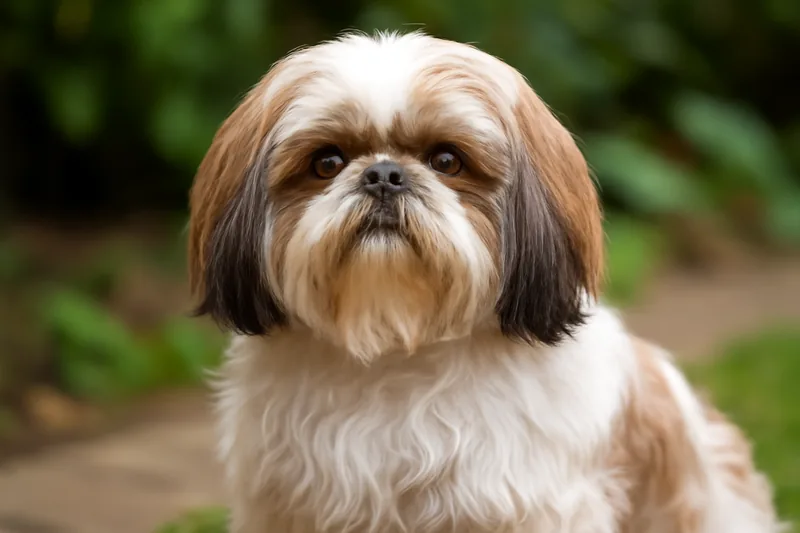
The Shih Tzu is a small dog with a compact, solid build, slightly longer than tall. Under the official American Kennel Club (AKC) standard, height at the withers falls between 20 and 27 cm, while weight ranges from 4 to 7 kg, with no significant difference between males and females. Its life expectancy is notably long, reaching 10 to 16 years with proper veterinary care.
Its most emblematic trait is its double-layered coat: a dense, soft undercoat that provides thermal insulation, and a long, straight, silky outer coat that grows continuously. The standard accepts all colors and combinations, though white dogs with gold, gray, or black markings are especially common. The tail, set high, curves cheerfully over the back, reinforcing its proud, balanced bearing.
From Tibetan Monasteries to the Imperial Court
The Shih Tzu's origin isn't found in palaces, but in the remote mountains of Tibet. There, Buddhist monks bred small long-haired dogs considered sacred companions, valued for their alert temperament and their ability to adapt to life at high altitude. These dogs didn't serve as herders or guards; their mission was purely spiritual and emotional, accompanying lamas during their meditations.
Their leap to royalty came when they were offered as gifts to the emperors of the Tang dynasty. The Chinese court was fascinated by their lion-like look — reminiscent of the stone guardians at temples — and renamed them "lion dogs." For centuries, the breed was refined in the isolation of the Forbidden City, where eunuchs and court ladies perfected its silky coat and cemented an affable temperament reserved exclusively for nobility. Its arrival in the West in the early 20th century allowed the modern standard to be fixed without altering its essence: a dog bred to bring joy to its owners' lives.
Temperament: Sweetness With a Personality of Its Own
The Shih Tzu is, above all, an extremely sociable companion dog. Its history as a palace animal has shaped an affectionate temperament that enjoys human closeness and adapts easily to indoor life. It's not a reserved or wary dog around strangers; on the contrary, it usually greets visitors with a wagging tail and an open attitude, which clearly sets it apart from similar breeds like the Lhasa Apso.
That said, this same imperial heritage has also left it with a subtle but persistent stubborn streak. It's not a naturally disobedient dog, but rather one with its own judgment that sometimes prefers to weigh whether a command really deserves its attention. This blend of sweetness and independence makes it a charming companion, but it calls for patient owners who understand that its training relies more on affectionate persuasion than on force.
Fun Facts Only the Shih Tzu Holds
Few breeds can claim a family tree as closely tied to the wolf as the Shih Tzu's. In fact, a scientific study from the University of Chicago identified it as one of the oldest breeds, genetically closest to its wild ancestors, confirming that its lineage split off very early from the common trunk of domestic dogs. This finding underscores that, beneath its sophisticated plush-toy appearance, beats the heart of a thousand-year-old genetic survivor.
Another quirk is its name: "Shih Tzu" literally means "lion dog" in Chinese, a nod to its natural mane and to the protective statues found at temples. Its lush tail isn't just decorative, either; in imperial tradition, it was prized for curving over the back to form a perfect fan, a symbol of good fortune. For centuries, the breed was a jealously guarded state secret, and no dog could leave the Forbidden City without the emperor's express permission.
Essential Care and Health of the Shih Tzu
The Shih Tzu's majestic coat demands daily dedication. To prevent tangles and keep its silky shine, thorough daily brushing is essential, complemented by regular baths and specific conditioners. Many owners opt for a practical "puppy cut" to simplify upkeep, but even then the grooming routine shouldn't be neglected. Eye care is also a priority, since its large, prominent eyes are prone to irritation and corneal ulcers.
Being a brachycephalic breed, the Shih Tzu can develop breathing problems in very hot weather or during intense exercise, so short, moderate walks are recommended. Its predisposition to obesity means diet needs to be strictly controlled. With regular vet check-ups and preventive care, this long-lived companion can enjoy a full, healthy life for over a decade.
IMPORTANT: This article is for informational purposes only and does not constitute veterinary, nutritional or behavioural advice. Every dog is different, and only your trusted vet can advise you on its specific needs.