 Breeds
Siberian Husky
The Siberian Husky is far more than a hypnotic gaze and a wolf-like coat: it's a born athlete, a tireless companion, and a dog with a personality that's as independent as it is sociable. Bred for centuries to pull sleds across frozen steppes, today it wins over households worldwide, though it doesn't always find owners who can match its overflowing energy. Getting to know its essential traits is the first step to understanding this unique breed.
Physical Traits of the Siberian Husky
The official American Kennel Club (AKC) standard describes a compact, muscular working dog with fluid movement. Males stand between 54 and 60 cm at the withers and weigh 20 to 27 kg, while females fall between 50 and 56 cm and 16 to 23 kg. This light-but-sturdy power-to-weight ratio lets it maintain an efficient trot for hours without wasting energy.
Its coat is a masterpiece of climate adaptation: a dense double coat with a water-repellent outer layer and a woolly undercoat that creates an insulating air pocket. This structure protects it from both extreme cold and moderate heat, which is why shaving it is a serious mistake that destroys its natural thermoregulation. The sickle-shaped tail curves over the back when the dog is alert, but never fully curls. Triangular, erect ears round out an unmistakable silhouette.
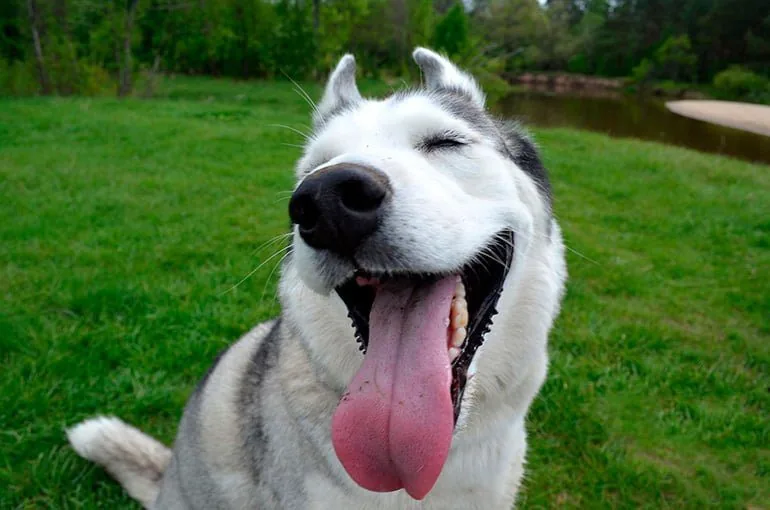
The eyes are its most famous trademark: they can be blue, brown, or show heterochromia (one eye of each color), and even split colors within a single iris. The standard accepts a wide color palette ranging from black, gray, red, and sable to pure white, always with white markings on the belly, chest, and legs. The facial mask, symmetrical yet variable, gives each dog a unique expression. Average life expectancy runs between 12 and 15 years.
Origin of the Siberian Husky
The breed was born in northeastern Siberia, where the nomadic Chukchi people developed it as a sled dog capable of pulling light loads at a steady pace over snow. The community's survival depended on these animals, which had to cover great distances with minimal energy expenditure. As a result, breeding favored dogs that were hardy, cooperative, and had an exceptionally efficient metabolism.
In the early 20th century, Huskies crossed the Bering Strait into Alaska to take part in sled races. Their worldwide fame came in 1925 with the serum run to Nome, where Husky teams — led by the legendary Balto — carried diphtheria antitoxin through blizzards and sub-zero temperatures, saving the city from an epidemic. This episode cemented their reputation as Arctic heroes and sped up their recognition as a breed by major kennel clubs.
The Siberian Husky's Temperament
The Husky is a friendly, sociable dog, not especially wary of strangers, a direct legacy of its past as a sled dog. On team expeditions, aggression was a liability, so breeding favored cooperation and friendliness toward both humans and other dogs. It's not an effective guard dog: it'll greet any visitor with a party of licks and howls.
Its independence is another key trait. They're affectionate, but lack blind obedience. For centuries, the Chukchi relied on these dogs to make their own decisions out on the ice — like avoiding cracks or sensing danger — which shaped an intelligent yet somewhat stubborn temperament. This calls for patient training, based on positive reinforcement and consistency, since a bored Husky becomes a master escape artist.
Unique Fun Facts About the Siberian Husky
Few dogs can boast such an efficient metabolism: a Husky can run for hours without depleting its glycogen stores, entering a fat-burning state almost immediately. This physiological adaptation, studied by scientists, lets it sustain a steady trot with no signs of fatigue, something most breeds simply can't do.
Another quirk is its vocalization. They don't bark often, but they produce a wide repertoire of howls, whines, and "singing" reminiscent of their wolf ancestors. Their escape instinct is also legendary: a Husky can jump fences, dig tunnels, or work open latches with almost feline dexterity. Finally, heterochromia doesn't affect its vision and is a purely cosmetic trait that fascinates fans of the breed.
Care and Health of the Siberian Husky
Exercise is non-negotiable: it needs at least two hours a day of intense activity, ideally running or pulling. Without that outlet, it channels its energy into destruction and escape attempts. Shedding is another challenge: twice a year it blows its undercoat in massive amounts, which calls for daily brushing with tools designed for dense coats. The rest of the year, weekly brushing is enough.
On the health front, the breed is relatively sturdy, but has a predisposition to hip dysplasia, juvenile cataracts, and progressive retinal atrophy. Responsible breeders run genetic tests to minimize these risks. Congenital urinary tract conditions, such as ureteral abnormalities, can also appear in young dogs; in fact, a scientific study from the Instituto de Veterinária recently documented a case of intraluminal ectopic ureter associated with ureterocele in a female dog, underscoring the importance of imaging diagnosis when unusual urinary symptoms appear.
Diet should be high quality and matched to its activity level. In warm climates, it's vital to provide shade, fresh water, and never shave its coat, since the double layer also protects it from heat. With proper care, the Siberian Husky will be a loyal, fun, lively companion for many years.
IMPORTANT: This article is for informational purposes only and does not constitute veterinary, nutritional or behavioural advice. Every dog is different, and only your trusted vet can advise you on its specific needs.