 Care
Care
Skin Diseases in Dogs
Skin conditions are one of the issues we see most often in veterinary visits. There's a wide range of diseases that can affect a dog's skin, and many show up in similar ways, which makes diagnosis harder.
For this reason, we'll try to clarify the causes, symptoms, and treatment of the main skin conditions a dog can develop.
Skin infections
A skin infection is a skin disorder caused by invading pathogens: bacteria, fungi, and/or parasites.
These pathogens are found in the environment or on the dog itself, and if they multiply excessively on our pet's skin, they can cause lesions.
Bacterial skin infections
Bacterial skin infections are called pyoderma and usually occur when there's some skin disruption or an underlying condition weakening the dog's defenses. Pathogenic bacteria can get "seeded" onto a dog's skin through licking or grooming.
Pyoderma is associated with itching, redness of the skin, hair loss, pus-filled pustules, and a bad smell in the affected areas. It can be localized or generalized.
Treatment is based on topical therapy with disinfectant baths and local antibiotics (lotions, ointments) and/or systemic antibiotics, depending on how widespread the condition is.
Fungal skin infections
Skin infections caused by fungi are called dermatophytosis or ringworm, and they're potentially contagious both between animals and to people.
Fungal infections tend to develop in dogs with weakened immune defenses or in those that have been in contact with animals infected with fungi.
It's characterized by circular lesions with hair loss and flaking. Ringworm in dogs doesn't cause itching, at least in the early stages. Over time, these lesions can become infected with bacteria, at which point intense itching and redness can appear.
Treatment usually involves topical antifungal products (lotions, shampoo), and in more advanced, severe cases an oral antifungal is prescribed.
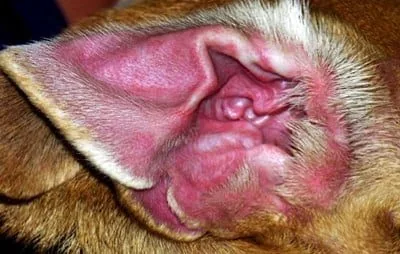
Parasite-caused skin infections
External parasites that can infect dogs fall into two groups:
- Macroscopic: visible to the naked eye. This group includes fleas, lice, and ticks.
- Microscopic: a skin scraping is needed to see them under a microscope. This group includes the mites that cause mange.
Flea or tick infestations are common in dogs, especially during warm months. Treatment and prevention are done by applying external parasite products (spot-on treatments or collars).
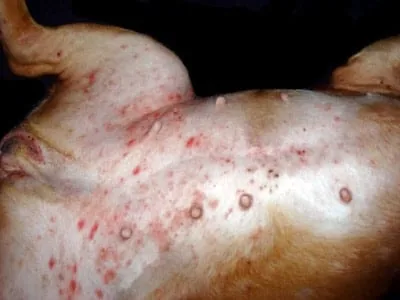
Mange, however, isn't as common. Dogs most susceptible to catching mange are those with weakened immune defenses or kept in poor hygiene conditions. There are two main types of mange:
- Demodectic mange: caused by mites that naturally live on a dog's skin. The disease occurs when the mite population multiplies excessively due to weakened immune defenses. This type of mange is common in puppies with immune problems and causes intense itching. It's not considered contagious.
- Sarcoptic mange: can occur in dogs of any age and often affects animals with weakened defenses or kept in poor hygiene conditions. It's caused by a mite that multiplies rapidly, burrowing tunnels into the skin, which causes intense redness in the affected areas and a lot of itching in the dog. It's highly contagious between animals, and to people.
Mange is treated by applying topical acaricides (baths, lotions) for localized cases, or systemic acaricides (spot-on treatments, injections) for generalized mange.
Allergies
In dogs we can distinguish two types of allergies:
- Atopy or environmental allergy: a hypersensitivity reaction from contact with or inhalation of allergens found in the environment (pollen, plants…).
- Food allergy: an adverse reaction that occurs after eating certain foods.
With both types of allergy, the main symptom we'll notice is itching. Redness of the skin, skin rashes, hair loss, and lesions from scratching can also appear.
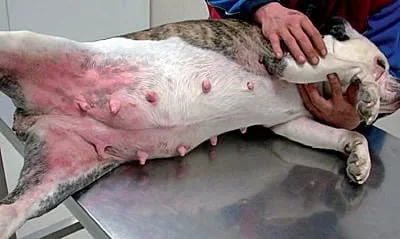
In cases of atopy, it's recommended to determine what the dog is allergic to through intradermal testing, in order to try to reduce exposure to these allergens and formulate a vaccine to help manage the condition. Symptoms can be controlled with medication when needed (corticosteroids, immunomodulators, or antihistamines).
Treating food allergies is somewhat simpler, since there are allergen-free diets available for these patients.
Skin tumors
Growths or masses of varying appearance can develop on the skin, and we need to rule out that they're tumors. The most common skin tumors in dogs are:
- Cutaneous histiocytoma
- Cutaneous mast cell tumor
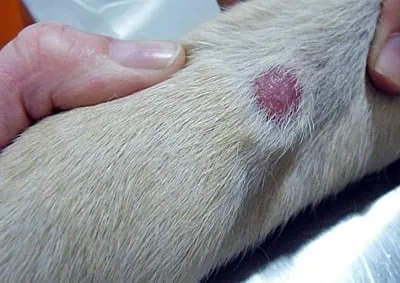
Cutaneous histiocytoma
This is a benign tumor commonly known as a "button" tumor, since it appears as a slight, rounded raised bump on the skin, often hairless (bald).
Because of this, it's a tumor that's easy for owners to spot. Although they tend to resolve on their own, surgical removal is recommended to prevent problems like secondary infections or damage from friction or licking.
Cutaneous mast cell tumor
This is a potentially malignant tumor with a highly variable appearance, which can even be mistaken for other skin lesions or warts. It usually starts as skin nodules, but its progression is very unpredictable, and it's common to see these masses grow and shrink.
Diagnosis is made by taking a needle sample of the mass for cytology, and once this condition is confirmed, the nodules need to be surgically removed. Radiotherapy or chemotherapy may also be needed.
Other conditions
Hyperkeratosis
Hyperkeratosis is a fairly common skin condition in dogs involving excessive keratin production on the nose and/or paw pads. This causes the skin to thicken and harden, and it tends to crack, making secondary infections more likely.
This condition can be a symptom of systemic diseases such as leishmaniasis, pemphigus foliaceus, or zinc deficiency, but it can also occur spontaneously in healthy dogs (especially in older dogs).
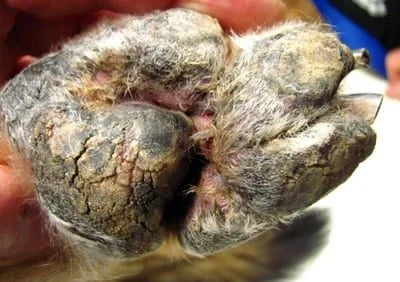
For treatment, if a specific underlying disease can be identified, it should be treated accordingly. If there's no specific cause (idiopathic hyperkeratosis), topical treatment with emollient, moisturizing creams should be applied to improve the lesions. If the cracks become infected, antibiotic treatment should be started.
Canine acne
This is an inflammatory skin condition caused by irritation of the hair follicles, which encourages bacterial growth. Lesions similar to human acne appear (papules and pustules), most commonly on the chin and lips. It can cause itching and pain.
It's more common in puppies and usually resolves on its own once they reach adulthood.
Treatment involves cleaning the affected area with disinfectant shampoo or lotions, and topical or oral antibiotic treatment depending on how severe it is.
Systemic diseases
Some systemic diseases aren't specifically located in the skin but do produce skin symptoms.
- Hormonal diseases: usually linked mainly to hair loss. Examples include hypothyroidism and Cushing's syndrome.
- Leishmaniasis: often produces skin symptoms such as hair loss around the eyes and ears, flaking, excessive nail growth (onychogryphosis), nasodigital hyperkeratosis, among others.
As you can see, the range of skin conditions a dog can develop is very broad, and the symptoms are sometimes shared between them. Because of this, we should never assume a diagnosis on our own, and should always see a vet if any change in the dog's skin is noticed.
IMPORTANT: This article is for informational purposes only and does not constitute veterinary, nutritional or behavioural advice. Every dog is different, and only your trusted vet can advise you on its specific needs.