 Care
Care
What to Do If a Snake Bites My Dog
You've probably heard about, or know someone who's gone through, the awful experience of their beloved dog being bitten by a viper. And we say awful because it really is a terrible experience, one where we need to act as fast as possible if we want to save our furry friend's life.
Some venomous species (Vipera aspis and Vipera latastei) claim the lives of many dogs every year, and most cases happen in spring and summer, since being cold-blooded animals, that's when they come out to bask in the sun. Our dogs approach them out of curiosity, and that's when the attack happens... What should we do if a snake bites our dog? Let's look at all the steps to follow and the possible consequences.
What danger do vipers pose to our dog?
The Vipera aspis and Vipera latastei mentioned above are the most dangerous in Spain, and although it's very rare for them to cause death in humans, in dogs it's fairly common.
The venom injected in the bite has a necrotizing effect (causing part of the tissue to die) and a risk of associated bacterial infection. Severity depends on where the bite occurred and how much venom the viper injected into our dog.
Symptoms can range from swelling at the site to more serious ones like nausea and vomiting. In cases where our dog has been exposed to large amounts of venom, it can cause kidney failure and serious blood clotting problems, which is why it's important to see a vet, who can assess our dog's condition.

What should I do if my dog is bitten by a viper?
As hard as it may be... the first thing to do is stay calm. It's essential to examine the dog and find the bite, which will be clearly identifiable by two puncture wounds (about 8 millimeters apart) and possibly a bit of blood (though blood isn't always visible).
It's important to check this to confirm the bite came from a viper and not an insect (bee, wasp, etc.). Once we've identified the bite area, we should immobilize it, since the more it moves, the more the venom spreads.
It's important not to apply a tourniquet to the bite area, and we shouldn't try to suck out the venom either. If we have soap and water on hand, we should wash the wound, but without rubbing — just superficially — and it would be a good idea to apply a cold compress at this point too, if we have one.
Whenever possible, and with great caution, we should try to spot the snake that bit our dog and take a photo of it with our phone, to bring along with the dog to the vet. Be very careful, since snake bites are also very dangerous for humans, causing serious damage or even requiring amputation of the affected area.
The faster, the better
Next, we'll head to the vet as an absolute emergency (without delay, but without losing our composure — we don't want to have an accident). The vet will give our dog the appropriate treatment, which usually consists of anti-inflammatories (corticosteroids), antibiotics, and large amounts of IV fluids through a line.
Viper bites cause major swelling, which is why anti-inflammatories are given, along with antibiotics to prevent secondary bacterial infections from the bite. Large amounts of IV fluids are given to keep the kidneys working constantly and dilute any toxins in the bloodstream, helping prevent damage to internal organs.
Often, the bite isn't from a viper but from a water snake or a mildly venomous snake... which is why, if we've taken a photo of the snake, the vet can determine the species, its venom, and severity, as well as any other possible complications.
If we get to the vet within the first 6 hours and the bite wasn't near the head, it's quite possible your furry friend will keep you company for many more years, and this will just be one more story to tell.
What will happen to my dog if bitten by a viper?
It really depends on each case — larger dogs have a better chance of surviving than smaller ones, and the chances are also better the sooner we get to a vet (the first 6 hours after the bite are crucial for your pet's recovery).
The symptoms are very clear when a dog is bitten by these reptiles... swelling at the bite site, drooling, dizziness, disorientation, rapid heartbeat, shallow breathing, nausea, and even shock.
Unfortunately, vets don't have magic "antidotes" for this kind of venom (they used to, but not anymore today). The treatment described above is what's given in most cases, and all that's left is to wait and see how the dog responds.
We won't sugarcoat it — there are many cases where dogs don't make it and unfortunately pass away... but there are also cases where the dog survives. We assume it all depends on a wide range of factors: the dog's overall health and immune system, their body weight, age, where the bite occurred, and how quickly they were treated by a vet.
If your dog isn't treated, the most common outcome is death either from suffocation due to the swelling the bite causes, or from damage to internal organs. Depending on the dog's size and weight, this can happen within an hour or over several days — every dog is different.
Differences between vipers, colubrid snakes, and snakes in general
The truth is, whether it's a colubrid snake or a viper that bites your dog, we should follow the same steps regardless, since even though the toxins may not be as strong as a viper's, our dog will need treatment either way.
If possible and it doesn't take too much time, it's a good idea to take a photo of the snake that bit our dog, or, failing that, carefully capture it and bring it with us to the vet, so they can determine what kind of reptile it is and how dangerous it is for our dog.
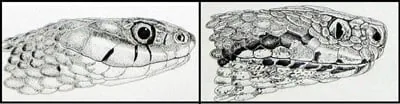
Nobody's a reptile expert (generally speaking), so it's best to follow the protocol described above. That said, as a small helpful guide, here are some differences between vipers and colubrid snakes (both are venomous, but colubrids don't pose as great a danger as vipers):
- Colubrid snakes have round eyes and large, round pupils, like humans. Vipers have more oval eyes and elongated pupils, like cats.
- As for body shape, vipers are stockier with a short tail, while colubrids are more slender with a longer tail.
- Colubrid snakes have large head scales of different sizes, while vipers have small, uniform scales.
Colubrid snakes generally have an elongated head, in proportion with the body. Vipers, on the other hand, usually have a triangular-shaped head.
When and where are there more vipers?
In spring and summer, when the heat sets in, that's when we're most likely to encounter vipers. You probably remember those extremely hot days, when what worries us most is our dog getting heatstroke from the high temperatures... those very days are precisely when we're most likely to run into vipers.
The places most likely to have vipers are dry farmland, grain fields, streams, lakes or reservoirs, hillsides, and so on.
If you see a viper, the best thing to do is turn around, keeping your dog from approaching to sniff it or play with it... We should assume it's their territory, and take a different path.
IMPORTANT: This article is for informational purposes only and does not constitute veterinary, nutritional or behavioural advice. Every dog is different, and only your trusted vet can advise you on its specific needs.