 Care
Care
Swimmer Puppy Syndrome - Symptoms and Treatment
Under normal conditions, puppies start walking on their legs around three weeks of age, but there's a condition that prevents puppies from standing up and walking, known as swimmer puppy syndrome.
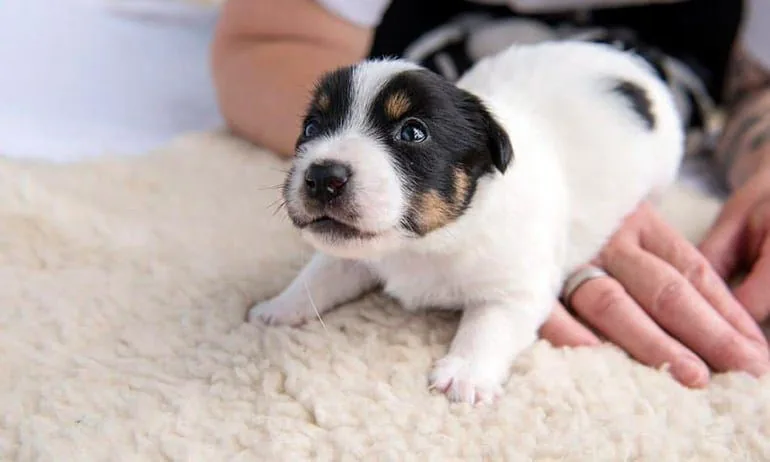
Puppies with this syndrome stay in a position where their chest and belly are in contact with the floor and their legs splay out to the sides, so that when they try to move, their limbs paddle in a way similar to a turtle out of water.
Until a few years ago, most of these puppies were euthanized; however, today the chances of recovery for these dogs, with proper physical therapy and environmental management, are very high. In this article we'll explain the causes of this syndrome and the steps to follow for successful treatment.
What is swimmer puppy syndrome?
Swimmer puppy syndrome is a rare developmental disorder that affects newborn puppies and is characterized by the animal being unable to stand up and walk from around three weeks of age.
The puppy's limbs, mainly the hind legs, splay out to the sides, and to move around, the puppy makes a lateral paddling motion similar to a turtle out of water.
This condition is usually accompanied by ventrodorsal flattening of the chest and hyperextension of the limbs. If these puppies don't start intensive physical therapy, they won't be able to walk and will eventually die from associated complications.
What signs are linked to swimmer puppy syndrome?
Under normal conditions, puppies start walking at around three weeks old. When puppies affected by this syndrome reach that age, they aren't able to stand, walk, or flip themselves over if placed on their back.
Puppies with swimmer syndrome are easy to identify, since they adopt a very characteristic position:
- Chest and belly in contact with the floor.
- Limbs (mainly the hind legs) splayed out to the sides.
- They can only move forward through a lateral paddling motion (crawling).
Because of their limited mobility, they often have trouble feeding and can start losing weight, growing less than the rest of the litter. This condition also predisposes affected dogs to digestive problems and regurgitating their food, with the risk of developing aspiration pneumonia if the right care measures aren't taken.
Because of constant contact with the floor, they often develop sores or ulcers on the chest, which can get worse from contact with their own urine if proper cleaning measures aren't followed.
What causes swimmer puppy syndrome?
The exact causes of this syndrome aren't currently known, but hereditary and environmental factors are believed to play a role.
Although this syndrome can affect dogs of any breed, short-legged breeds such as the English Bulldog or Basset Hound tend to be more predisposed.
Puppies being overweight during development and being kept on flat, slippery flooring are factors that can worsen this syndrome or even contribute to it appearing in the first place.
Treatment for swimmer puppy syndrome
This condition requires early, intensive physical therapy, which, combined with a series of environmental and management measures, will increase the puppy's chances of improving, potentially reaching normal walking ability.
Intensive physical therapy
The foundation of treating this condition is physical therapy, so it's important to see a vet specializing in physical therapy and rehabilitation, who will design a therapeutic exercise plan that we'll need to do with our puppy daily, several times a day. What's more, one of the most recommended therapies for these dogs' recovery is pool hydrotherapy.
Rehabilitation is aimed at increasing muscle tone and strength, restoring joint range of motion, working on coordination, and finally retraining gait so the puppy can stand and walk on their own.
Physical therapy exercises at home
Treatment requires a great deal of dedication from the owner, since the exercises need to be done several times a day:
- Massage: to stimulate circulation and as a warm-up for the muscles before doing passive or active exercises, it's recommended to gently massage each leg from the toes toward the body, and the back from head to tail.
- Passive joint mobilization: this involves gently flexing and extending each of the puppy's leg joints. Each joint should be mobilized individually about 10-15 times. The rehab vet will show us how to do these passive mobilizations to avoid hurting the puppy. These should be done 3-4 times a day.
- Keeping the puppy standing: we need to stand the puppy up so all four legs are in contact with the floor, helping support their weight with our hands, harnesses, cushions, and so on. This exercise should be repeated 3-4 times a day, gradually increasing how long the puppy stays standing.
- Assisted walking on textured surfaces (egg cartons): once the puppy can stand, we should encourage them to walk (helping them keep their balance) on a textured surface. Egg cartons let the puppy take steps more stably by placing their paws inside the egg cups.
- Working on coordination: once the dog can walk on their own, we should work on their coordination, setting up small obstacle courses with different floor textures. For example, we can lay out rugs, artificial turf, and mats on the floor and place bars (like a broom handle) as obstacles for the puppy to step over.
Positional bandaging
The rehab vet may find it helpful for the puppy's recovery to apply bandages to their legs, keeping them in a correct position and preventing them from splaying out to the sides (bandages joining both hind legs together).
These bandages need to be applied by a vet, since if done incorrectly they can restrict circulation and cause serious problems.
Environmental measures
Puppies need to be kept on a soft, non-slip surface and cleaned frequently, since due to their limited mobility they can end up lying in their own urine, which is quite harsh on their skin. After each cleaning, unscented baby powder can be applied to the puppy's chest and belly to help prevent irritation.
Feeding management
Puppies affected by this syndrome can have trouble feeding and often develop digestive issues such as regurgitating their food. Because of this, it's a good idea to monitor their feeding during nursing, or even switch to a formula-based diet.
After each feeding, the puppy should be kept in a slightly upright position for a few minutes to help move the food from the mouth toward the stomach, and a gentle massage can be given from head to tail.
It's very sad that many cases of puppies with swimmer syndrome end in euthanasia, since, with consistency and patience, the treatment described above is generally successful and allows these puppies to recover, going on to become completely normal dogs.
Bibliography Carlson and Giffin. 2002. Manual práctico de veterinaria canina. Madrid. Editorial el Drac.
IMPORTANT: This article is for informational purposes only and does not constitute veterinary, nutritional or behavioural advice. Every dog is different, and only your trusted vet can advise you on its specific needs.