 Care
Care
Types of Harnesses and Collars for Dogs
These days, many types of collars have been invented, each with specific uses depending on what we want it for. There are specific collars for training, collars to prevent a dog from getting lost, and of course, the classic but no less useful walking collars.
Although collars aren't everything, harnesses have also evolved over the years, developing genuinely good, practical models, just as much as, if not more than, some collars. That said, harnesses have mainly been designed for dogs that pull too hard on the leash or are too strong for their owners.
Every dog is different — each needs a different type of collar depending on its needs or issues. So, let's go over the best collars and harnesses for dogs, so you can decide which model best suits your furry friend.
The Classic Walking Collar
You're surely all familiar with this type of collar — you could call it the timeless dog collar, the one that's always been used. It's a fabric or leather collar with a buckle or clip closure, depending on its design.
This type of collar is used to walk dogs with no behavioral issues, meaning dogs that don't pull and behave properly during walks. There are very original collars featuring different patterns, colors, or even textures.
This type of collar is also, by far, the most recommended for teaching puppies to walk. Let's say it's the standard among all available collars, and the most recommended in most cases.
Since technology never stops surprising us, it's very easy to find this type of collar with lights, built-in GPS chips, and even sound systems that alert us when the dog wanders too far.
Classic collars with lights are designed for when we walk our dog through dark areas, like unlit parks or forests. Ones with a sound system are more aimed at distracted owners, who don't pay close attention and end up losing their dog.
Those with a GPS chip are better suited for mischievous dogs prone to running off, making them much easier to locate. These are also collars for hunting dogs, which tend to get lost chasing prey. Thanks to GPS, they can be located very easily.
The Inward-Facing Spike Collar
This is a type of collar with metal pieces or a design featuring spikes, which can be put on the dog with the spikes facing outward or inward.
When this type of dog collar is worn with the spikes facing outward, it's usually done to make the dog look fiercer, or to prevent other dogs from biting it. Having spikes actually protects its neck against attacks from other dogs.
These are usually put on dogs that are often attacked, to somehow prevent other dogs from biting their neck and suffocating them. Though we should clarify this type of collar isn't effective for these cases.
When the collar is worn with the spikes facing inward, it's usually done to try to keep the dog from pulling on the leash, causing it pain from the spikes digging in when it pulls.
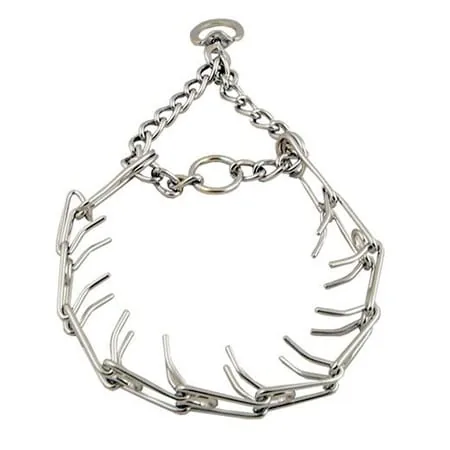
This is a form of torture that not only harms the dog but also doesn't work to stop it from pulling on the leash. In reality, it's a collar that should be completely banned.
The Choke Collar and the Semi-Choke Collar
The choke collar for dogs does exactly what its name suggests — it chokes the dog when it pulls on the leash. It's an excessively dangerous collar for dogs, since it could cause irreparable damage to their trachea and neck.
This type of collar should also be banned, since it poses a serious danger to the health of any dog wearing it. Under no circumstances should you use this type of collar — it's not just dangerous, it can also be fatal.
The semi-choke collar, however, is designed to prevent the dog from suffering trachea or neck problems, featuring a mechanism preventing it from closing too much and choking the dog.
That said, it does apply some pressure by tightening slightly when the dog pulls. We don't recommend it either — for dogs that pull excessively on the leash, it's better to use specialized harnesses instead.
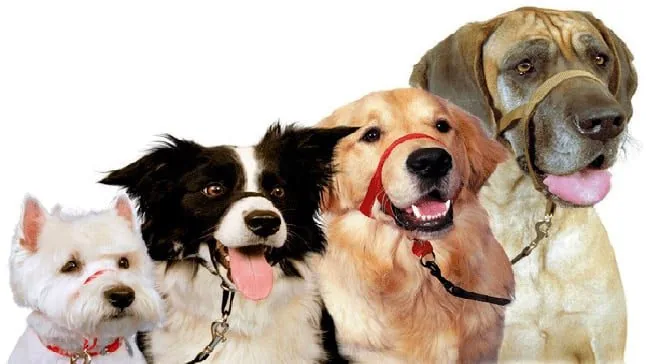
The Head and Muzzle Collar
Here's a good example of a collar for dogs prone to walking too far ahead or constantly pulling on the leash, with all that means for the owner.
This type of collar has a dual function — gripping the dog by the neck the way a classic walking collar would, and also properly holding its snout. So, when the dog pulls on the leash, the force of the pull slightly tightens the part of the leash holding the snout, causing it to turn.
This is actually a very simple, functional mechanism — quite practical and not at all aggressive toward the dog. That said, we should be aware the part holding the snout needs to have plenty of room, since dogs need to stick out their tongue to regulate their body temperature (sweat).
Collars for large, big-sized dogs are usually this type. Or a strong anti-pull harness. Given large dogs' strength, it's necessary to use collars or harnesses specifically designed to prevent them from dragging us if they run off.
Classic Walking Harness
Harnesses for dogs have a big advantage over collars, since they don't press on the dog's neck area but instead fit around its rib cage. This makes the dog much more comfortable and prevents neck problems from continued collar use.
Also, if the dog's health weren't reason enough to convince you, you'll be surprised to learn it's much easier to control a dog wearing a harness than one wearing a collar.
With a harness, you won't need to use as much force to control the dog, should it start pulling on the leash for some reason (seeing another dog, a cat). Without a doubt, a harness for dogs is the most recommended option for walks.
Anti-Pull Harness
This is the most effective, dog-friendly way to prevent constant leash pulling. The anti-pull harness for dogs is specially designed to close slightly at the front when the dog pulls.
This restricts the free movement of its front legs, so the dog won't be able to pull with much intensity. Unlike the classic walking harness, secured on top, meaning across the dog's back, the anti-pull harness attaches at the front of the dog, across its chest.
There are many, many opinions, including our own, confirming that dogs that pull on the leash do so much less often and with much less intensity with this type of harness. So, without a doubt, it becomes the most recommended option for dogs that don't know how to walk properly.
Tips on Harnesses and Collars for Dogs
We should keep some important tips in mind when getting a collar or harness for our dog. Due to the huge number of variables and models out there, we could unintentionally choose a poorly suited model that, rather than helping, ends up harming both the dog and ourselves.
Nylon or metal — that's the main question when choosing a collar. Without a doubt, the answer is nylon. Nylon is much more comfortable and gentler on the dog's health — it's not as rigid and allows for a bit of flexibility.
When putting on a collar or harness, remember you should always leave some slack to avoid it being too tight, bothering or choking the dog. The ideal is to leave at least two fingers' width between the collar and the neck — by width, we mean the slack that should remain.
With harnesses, the main problem can be chafing — if we don't put the harness on our dog correctly, it can cause chafing and injuries, mainly around the joints where the legs meet the rib cage.
Simply fit the harness properly without it being completely tight, checking daily that our dog hasn't suffered any chafing. It's not common, but it can happen.
IMPORTANT: This article is for informational purposes only and does not constitute veterinary, nutritional or behavioural advice. Every dog is different, and only your trusted vet can advise you on its specific needs.