 Breeds
Types of Setter Dogs
Known for its extraordinary qualities as a hunting dog, the Setter is also an excellent companion dog, able to adapt to any family setting.
There are four types of Setter, and each one has unique characteristics. Want to get to know them? At SoyUnPerro.com, we cover all the details.
Different Types of Setter Dogs
Although Setters are classified into different types, they share common traits that identify them as such. Generally, every Setter shows long fur on the ears, chest, legs, and tail. Their weight ranges from about 20 to 32 kg, and they stand around 58-69 cm tall.
Their origin dates back to the late Middle Ages in France. Although considered a descendant of the Braque, some claim it's actually an "improved Spaniel." Many people compare the Setter breed to the Pointer due to their strong resemblance, since the main difference is a lower coat volume in the latter.
This belief is mistaken, since it's documented that the Setter already existed before the Pointer in England, meaning there's no shared blood between the two breeds.
The Setter is known for being used to search for game in open fields — in other words, it's the ideal hunting dog. It's grouped within the "pointing dog" category: hunting dogs.
This name refers to the dog's instinct, which makes it point or indicate with its muzzle the direction where the game is located, letting the hunter move in to get the game within range. Let's look at the different types within this breed:
- English Setter
- Gordon Setter
- Red and White Irish Setter
- Irish Setter
The English Setter
This is the best-known type within the Setter breed. Its breeding began in the 15th century when it was brought to Great Britain from France, where it split into different lines, which we'll also cover further on.
The first club dedicated to this breed was founded in 1890, called the English Setter Club. Today, two parallel lines have formed to classify this breed: the first, larger dogs with heavy feathering, ideal for beauty competitions.
The other consists of smaller dogs, but with unbeatable abilities for field work.

What Does It Look Like?
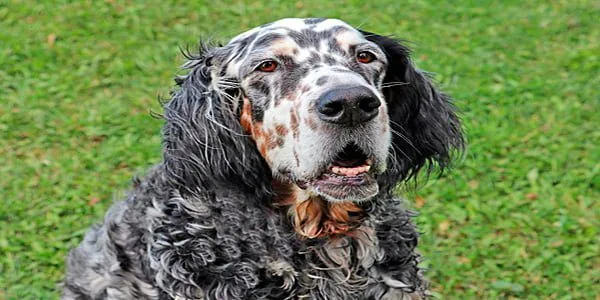
Medium-sized, with a defined silhouette and elegant appearance and movement — what catches the eye most at first glance is its coat.
The English Setter is known for its beautiful coat, usually white with speckling, commonly found in black and white. It's also possible to find fully brown individuals, or even fully white ones.
Visually, this is a long, silky coat with slight waves (never curly), starting from the back of the head, with long feathering running down each of the four legs from the back of the thighs and front legs almost down to the feet.
Interestingly, each coat color in the English Setter, given its variations, has its own specific name. The word "Belton" is used, referring to a region in Northumberland.
This is how the coat's markings are named. When the dog's coat is black and white, it's called Blue Belton. If the dog is white and orange, it's called Orange Belton. If the orange coloring is lighter or darker, this coat is called Lemon Belton or Liver Belton.
Sometimes all three colors combine: white, black, and orange. In this case, it's called Tricolor. When the Setter shows speckling, depending on the distribution of the markings, we'd call it a nearly black or nearly white Blue Belton.
Breed Morphology
As for size, given that this is a medium-sized breed, there's a difference between males and females. Males range from 65-69 cm and females from 61-65 cm. The English Setter is a dog with an elegant, majestic bearing, while also being strong and resilient.
It has a muscular, long neck leading to a wide, proportional chest. With a short back and rounded ribs, the loin area is slightly arched with a somewhat flexed hip.
As for its legs, its hind legs stand out, with especially long thighs running from the hip down to the hocks.
Its eyes are large, bright, and expressive, with a gentle gaze in dark or hazel color. The ears, which hang down along the cheeks, are set low and long. The tail is medium-length with a very gentle curve.
When moving, the English Setter shows a free, graceful movement known for its speed and endurance. Elegant and fast, but never reckless.
English Setter Temperament
The English Setter is known for its friendly, gentle temperament. It's a very active dog with a sharp instinct for hunting. Because of this, it has great endurance, covering a lot of ground, including water.
At the same time, this is a calm, loyal, obedient, friendly dog, though it can sometimes be a bit stubborn, since it's difficult to train.
Ideally, training should start from puppyhood, around three or four months old, to prevent it from becoming too independent. Despite this, it shows great loyalty to its owner, making it a perfect companion. It's intelligent and especially respectful of children and elderly people.
Its sense of smell is exquisite, able to detect a scent trail even hours after the prey has left the area. When tracking game, it does so slowly, quietly, and in perfect harmony with its surroundings, going unnoticed by the prey.
It's commonly used to hunt all kinds of birds, like partridge, quail, and woodcock, as well as waterfowl.
It's a very curious, affectionate dog. Since it needs a lot of space for exercise due to its restless nature, it's not ideal for people living in very small spaces with little physical activity.
It has a very balanced temperament, adapting to any situation. It's recommended for people who enjoy a particularly sociable dog, so if you're looking for a home protector, this isn't your ideal breed.
The Gordon Setter
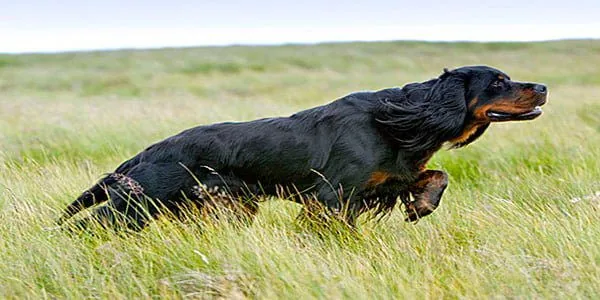
The Gordon Setter is a Setter type known for being a light-framed dog with a wavy black coat marked with chestnut or tan patches. It's the least widespread of the whole Setter breed. It originated in Scotland during the 17th century.
Physical Characteristics of the Gordon Setter
Although physically all Setters are very similar, some differences exist. Its coat is very similar to the English Setter's. Its color is always darker, ranging from bright, intense black to reddish-brown "tan markings" (the name given to the two patches above the eyes, on each side of the muzzle).
It usually has two large patches on the chest with a small white patch. The coat is short and fine on the head and the front of the legs. On the rest of the body, the coat is medium-length, ending in feathering toward the back of the legs. Feathering between the belly and chest is characteristic.
Morphological Traits
The Gordon Setter is medium-length. Males measure between 59-62 cm and females range from 56-62 cm. It's a tall, sturdy dog.
Like the rest of the Setter breed, it has a well-let-down chest with well-arched ribs and a short back. It has a wide loin with a slight curve. Its neck is fairly long, its legs long, and its tail is thick at the base but thinner toward the tip.
Its ears, characteristic of the breed, are set low and medium-sized, thin, hanging close to the head's outline. It has beautiful bright dark chestnut eyes.
It's an elegant-moving dog, very agile, and able to reach high speed. Its look and build are very harmonious and symmetrical.
Gordon Setter Behavior
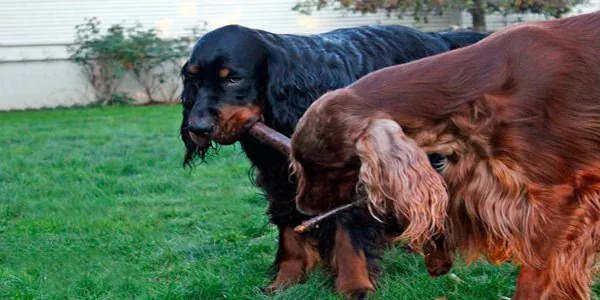
We're looking at an intelligent, very calm, docile, affectionate dog, making it an ideal, pleasant companion. That said, it's a stubborn breed (like Setters in general), so it needs firm training, done with patience and affection.
Although Setters are known for being hunting dogs, its methodical search range is smaller than other types', though it's an extraordinary swimmer.
It has no trouble adapting well to city life, though it's essential for it to get plenty of physical exercise and live in fairly spacious surroundings.
The Red and White Irish Setter
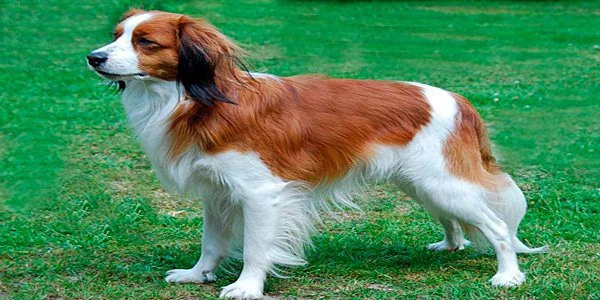
This is the original Irish Setter. Although bred since the 17th century, today it's quite rare to find them, since the red Irish Setter type predominates.
What Does It Look Like?
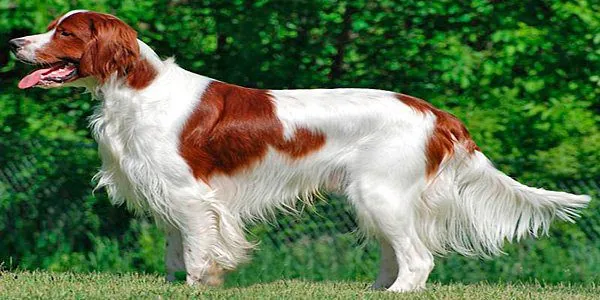
Like the Irish (or red) Setter, this breed has a somewhat wavy coat with a soft, silky feel. In this variant too, we can see the feathering on both the front and hind legs that makes this dog so striking, straight and smooth, sometimes with a slight wave.
As its name suggests, this Setter's coat stands out for a white base color, with the body covered in island-shaped patches of uniform red.
Its coat could be categorized as medium-length, and while it's medium over most of the body, it tends to have short, fine hair on the head, the front of the legs, and the tips of the ears.
This is a breed that requires ongoing coat care to prevent constant shedding, with owners often saying the dog "sheds a lot."
Morphology of the Red and White Irish Setter
This breed stands out for being strong, athletic, and generally large-framed. With a clean, square muzzle, this dog has ears set level with the eyes, lying flat against the head and generally hanging backward.
Unlike the red Irish Setter, it doesn't have as pronounced an occipital bump.
It has a medium/moderate-length tail that tapers from base to tip, where it shows the feathering so characteristic of the whole Setter breed.
Temperament of the Red and White Irish Setter
This is a very intelligent, sharp, gentle dog. It's a perfect breed for homes with children or other animals, since it's generally easygoing and tends to socialize easily. They can be quite boisterous, which is corrected with proper upbringing and training during puppyhood.
Although sometimes impulsive, it loves to please its owners or the people around it. It's usually not very shy with people it doesn't know, making it a perfect dog for settings where there's always company around. They handle loneliness very poorly, becoming nervous and even somewhat aggressive.
It needs high physical activity, so ideally it would live in a rural area or somewhere with outdoor space to run around and enjoy itself.
The Irish Setter
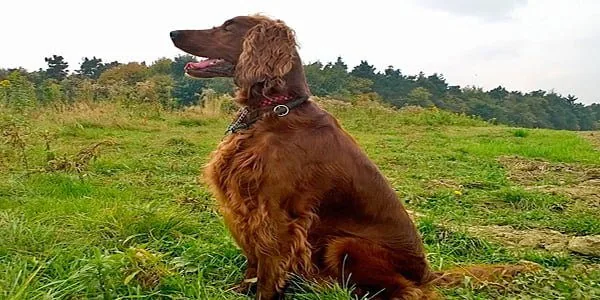
The Irish Setter is a Setter variety that began being bred in Ireland during the 18th century. Its long, straight, fiery reddish coat is very distinctive.
What Does an Irish Setter Look Like?
Generally, this breed is known for its thick, straight coat. It's usually medium-length and flat over most of the body, though in areas like the head, front legs, and ear tips, it tends to be much shorter and finer.
This breed's coat color usually falls within a limited range, with varieties spanning from reddish-chestnut shades to mahogany red individuals.
That's why this breed is known as the Irish Setter or Red Setter. It also tends to have a fairly thick coat (even on the tail), silky to the touch across the entire body.
As for grooming and cleaning, this breed needs medium/moderate care.
Morphology of the Irish Setter Breed
The Irish Setter stands out for being an impressive, large, sleek dog. With an elongated, thin, fine head and an oval-shaped skull. Also, one of the head's most prominent features is the muzzle.
As for color, this dog's nose is usually black or even mahogany (like the coat, often), and its eyes, which aren't usually notably large, tend to be dark brown or hazel.
As for the ears, they usually hang backward and are as silky as the rest of the body.
Looking at the tail, this breed's tail is moderate in length, usually level with the back, sometimes even lower. It's generally covered in what's called feathering.
Temperament and General Behavior
This is a very intelligent breed that loves to play a lot. That's why it's an ideal dog for homes with children. Despite being a gentle, affectionate dog, it sometimes struggles to follow commands.
Being a restless breed, it loves getting involved with other breeds and people, though it always wants to feel respected. Otherwise, its most likely reaction is a growl, without ever getting too serious.
Being a very sharp, clever breed, its training and learning tend to be fairly simple, and it's a dog with which positive reinforcement methods work perfectly.

Possible Diseases in Setter Dogs
Generally, English Setters are especially healthy and lively. They rarely suffer from illnesses, which is why they tend to live long lives. Even so, among the most common conditions this breed can develop are the following.
- CARPAL INJURIES: Being a hunting dog, it tends to be very energetic and tireless. Because of this, inflammatory processes occur in the carpus (our wrist joint).
- HIP DYSPLASIA: although not very common, this problem shows up from time to time. This is a genetic condition involving several genes from both parents. It affects the ligaments holding the femur joint to the hip, causing them to become looser. The joint gains slack, and instead of moving smoothly, the bones knock together and get damaged, leading to the symptoms of premature osteoarthritis. There's currently no effective treatment to prevent this disease, so to avoid it, good genetic selection is important.
- EAR INFECTIONS: This is the most common problem in Setters generally. This breed has all the conditions needed to develop them. Having long ears with abundant fur hinders proper airflow through the ear canal. On top of that, there are summer grass awns that get into the ear during hunting outings, plus this breed's love of water. In short, all the ingredients for an annoying ear infection to develop. It's very important to regularly trim the fur on the inner side of the ear flap.
- TAIL FRACTURE: Since Setters are constantly wagging their tails, it ends up getting damaged by vegetation, and even a coccygeal vertebra can break. This condition is very common in very nervous, active dogs kept in very small kennel cages.
- GASTRIC TORSION: This is actually a condition common to all dogs, but it's especially notable in larger dogs with high physical activity. It involves a twist in the intestine and subsequent collapse of blood flow. It's essential to know the symptoms of gastric torsion to catch it in time and know how to respond.
Feeding and Care for All Setter Types
The ideal daily calorie count for this breed ranges between 1,500 and 1,700 kcal. If the dog does intense physical activity, these amounts should be increased.
Although this breed adapts easily to family life in an apartment, it needs large doses of daily exercise.
As for the coat, brushing 2-3 times a week is recommended to prevent tangles and keep it healthy and shiny, along with healthy skin.
Lastly, it's worth adding that all Setter types, due to their high level of physical activity, have a higher risk of heatstroke. Given how passionate they are about hunting, they sometimes don't know when to stop, and by the time they do, it's already too late.
IMPORTANT: This article is for informational purposes only and does not constitute veterinary, nutritional or behavioural advice. Every dog is different, and only your trusted vet can advise you on its specific needs.