 Nutrition
Vitamins for Dogs
Every dog needs a balanced, nutritious diet including every vitamin and mineral needed for proper development. Vitamins do not only affect a dog's mood; they also play a fundamental role in the development and upkeep of bones and organs.
Plenty of people wonder what the best vitamins are for adult dogs, or dogs with certain health problems, ultimately ending up buying complete vitamin supplements without really knowing what they are giving their dogs.
We are going to explain what the best vitamins are that we can give our dog and how to provide them naturally. As we all know, vitamins in pill form are not good quality and often are not even absorbable by the dog.
Types of Vitamins for Dogs
These are the most sought-after vitamins for dogs, given the important role they play in strengthening a dog's health or supporting proper development.
Depending on whether we want vitamins for hunting dogs or vitamins for malnourished dogs, we need to focus on one specific group of vitamins or another, or on all of them at once if it is a sick or older dog.
- Vitamin A: This vitamin matters a great deal for a dog's overall development, playing a fundamental role in growth and in the dog's skin and coat. It is also credited with an important role in developing eyesight.
- Vitamin B: This is not a single vitamin but the name for a complex group of vitamins that play fundamental roles throughout a dog's body (B1, B2, B3, B5, B6, B9 and B12). Essential for a dog's strength, for their immune system to work well, for maintaining their skin and coat, for properly absorbing nutrients in the digestive system, and for a wide range of vital functions.
- Vitamin C: Essential for a dog's immune system and for proper bone calcification; dogs need this vitamin to develop and maintain strong bones.
- Vitamin D: Also essential for the proper development of a dog's skeleton; it is fundamental for calcium to do its job in the bones. It also plays an important role in nutrient absorption.
- Vitamin E: As well as being a natural antioxidant highly recommended in older dogs, it also plays an important role in forming organic tissue in the dog, that is, in their development and upkeep.
- Vitamin K: This matters a great deal for a dog's circulatory system, as well as being a great ally to the immune system against harmful outside factors.
What Are the Best Vitamins for a Dog?
There are no better or worse vitamins for a dog; you simply need to know what type of vitamin your dog needs and why. Giving a dog a vitamin complex for no particular reason makes no sense, and on top of that, too much of certain vitamins can be very harmful to their health.
Older dogs with a balanced diet do not need complete vitamin complexes; even so, our vet may recommend giving them a vitamin E supplement for its antioxidant properties.
Sick dogs may indeed need some vitamin supplement even with a balanced diet; for example, dogs with leishmaniasis often suffer from widespread anaemia, so a complete supplement is most suitable.
Hunting dogs, who need to make intense efforts at certain times of year, are often treated with vitamins A, D, E and K so they are strong and healthy, ready for the season. The same goes for competition dogs, who need an extra boost of energy at particular times.
How to Give a Dog Vitamins
Although we all know of plenty of companies selling vitamin complexes in pill or liquid form, the truth is that vitamins of this kind are not the most advisable. Vitamins should be natural, obtained from organic sources so they are absorbable and effective, which is why we recommend giving vitamins naturally.
Let's run through the best foods rich in certain groups of vitamins, so we can give them to our dogs in a suitable amount (never overdo it, since a shortfall is just as bad as an excess). Remember that the best way to get healthy vitamins is through fruit.
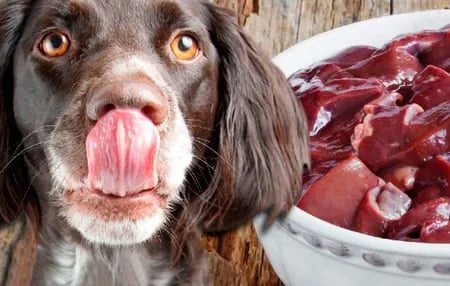
Chicken Liver
Chicken liver contains a large amount of vitamins essential for a dog, such as vitamin C, a good number of the B group vitamins, and a large amount of vitamin A.
Chicken liver also contains minerals important to the dog, such as zinc, copper, iron and even calcium. Even so, too much liver can cause diarrhoea, so we should be cautious and give liver in small amounts alongside their usual food.
We can also use liver from other animals such as lamb or beef, always advisable to boil in water for two or three minutes to prevent possible parasites.
Sardines
Sardines are a food with impressive properties; they contain a large amount of B group vitamins, mainly B12 and B6. They also provide an impressive amount of iron and protein, which will give our dog a great extra boost of energy.
And not only that: they also contain a large amount of beneficial fatty oils such as omega-3 and omega-6, which will help lower the dog's cholesterol and improve their skin and coat.
It is advisable to use tinned sardines, in olive or sunflower oil, draining the oil and chopping up the sardines to give alongside their natural food. A dog over thirty kilos, for example, can have one tin once a week.
Cheese
Cheese is an important source of calcium for our dogs and an excellent source of protein and fat for their nutrition. It also provides a significant amount of vitamin A, important for the dog's overall development.
Cheese contains no lactose, so it is not harmful to dogs; even so, some dogs do not tolerate it fully, so although this happens in only a few cases… it is advisable to always start with small portions to gauge how it agrees with them.
It does not matter whether we use cheese made from cow's or sheep's milk, though sheep's milk is indeed more advisable. We should not give them the rind or outer part of the cheese, since it can contain bacteria (just as we do not eat it either).

Assorted Fruit
Fruit provides a wide variety and amount of vitamins to dogs, though we need to be aware that dogs should not eat fruit seeds. Apple, pear and peach, among many other fruits, are genuinely healthy for a dog.
As with any other food, the amount is the trick. If we give a dog too much fruit we could well trigger diarrhoea, so it is advisable to start with small portions and assess from there.
Some dogs eat apple with no trouble at all, but others may not find it agrees with them and it may be better to give pear instead, for example. It is all about trying things out and using our common sense.
Assorted Vegetables
Vegetables are a great source of vitamin K; chard, cabbage or spinach, for instance, contain large amounts of vitamin K for a dog. Even so, vegetables of this kind are not very digestible for dogs' digestive systems, which is why it is advisable to cook them beforehand.
We should not give our dog large amounts of cooked vegetables, since they loosen the bowels a great deal, that is, cause diarrhoea. A small amount now and then is more than enough.
The Sun
Yes, we know… the sun is not a food. Even so, the sun is an incredible source of vitamin D. Dogs cannot absorb vitamin D through their skin the way we humans do. Their coat retains this vitamin, though.
Have you never seen your dog licking their paws after sunbathing? That is their instinctive way of absorbing the vitamin D the sun has left on their coat; it may sound incredible, but it is entirely real.
Conclusions
Do not self-medicate your dog by buying vitamin supplements for no reason at all, or simply because they seem a little down. It should always be a vet who recommends using vitamins.
Too many vitamins can be just as harmful to their health as a shortfall; dogs need a limited amount of vitamins to enjoy strong health.
If you choose to give them natural vitamins through the foods mentioned, always remember that balance lies in the amount. Do not overdo these foods or ever consider them a sole food source.
IMPORTANT: This article is for informational purposes only and does not constitute veterinary, nutritional or behavioural advice. Every dog is different, and only your trusted vet can advise you on its specific needs.