 Nutrition
We Tried Dogfy Diet and… Woof
Kira, a 4-year-old German Shepherd mix with sensitive digestion, was the perfect guinea pig for comparing Dogfy Diet and Guau&Cat. Seven days of stools, wind, packaging and prices under the microscope: here is what we found.
Perriculum Vitae
The star of this test is Kira, a 4-year-old German Shepherd mix. Since puppyhood she has eaten conventional kibble, but has always carried two specific problems: sensitive skin and somewhat upset digestion with certain brands.
She had been wanting to make the leap to natural feeding for a while, but the lack of clear information on portions and the uncertainty over which brand to choose kept delaying it. That is where Dogfy Diet comes in, with a personalised plan system that promises to clear up those doubts from the very first order.
Kira's profile is not that of a neutral dog: she has a genuine digestive history. That makes this test more useful than a review on a healthy dog with no history.
How to Switch From Conventional Kibble to Dogfy Diet Natural Food?
Replacing kibble with natural food all at once can cause the digestive system to collapse. The gut microbiota needs time to adapt to the nutrient density and the moisture of a fresh diet.
The safest method is a gradual mix. The recommended split is: days 1-2, 25% natural food and 75% kibble; days 3-4, 50/50; days 5-6, 75% natural; day 7 onward, the full switch.
There are two signs to watch during the process. If very soft stools appear, it is worth keeping the current ratio for a couple more days before increasing further. If the dog vomits or seems lethargic, cut back the amount of natural food and stretch out the transition.
A good sign that the pace is right: the stools firm up gradually over the week, without episodes of diarrhoea or constipation. If that happens, the digestive tract is adjusting well.
Trying Dogfy Diet: My Experience
For the first two days, Kira sniffed the bowl warily. By the third she was licking the plate clean. Acceptance was total from the fourth day, when we withdrew the kibble entirely, following the protocol from the previous section.
The most striking change was not the food itself, but her attitude. Her energy became steadier: less of a post-meal slump, more eagerness for evening walks. Her coat, historically dull, started gaining shine after the first week, which we put down to the greater availability of quality protein and fat.
A Guau&Cat user we spoke to described something similar: her dog stopped scratching ten days after the switch. The improvement in the coat seems to be the common thread when moving from kibble to natural food, whatever the brand.
As for stools and wind, the changes were specific enough to deserve their own comparison section. What we can say here is that Kira not only accepted the food, but the change in her day-to-day was noticeable without having to wait weeks.
Composition and Meat Quality: Dogfy Diet vs Guau&Cat
Comparing the beef menus from both brands, the first thing that stands out is the real weight of fresh meat in each recipe. Dogfy Diet states a high percentage of fresh, boneless meat and offal, with no meal or by-products, which translates into a direct protein source.
Guau&Cat also uses fresh meat as its first ingredient, but includes a higher proportion of organic vegetables in its mix. This is not a flaw, but it lowers the net protein content per portion. If the goal is maximising animal protein intake, the balance tips towards Dogfy Diet.
Where the meat comes from is another point of difference. Both brands favour local protein, though Dogfy Diet sets out the specific origin of each batch on its product sheets. At Guau&Cat the information is more generic, which reduces the perceived traceability.
Texture also differs: Dogfy Diet has more compact, visible meat, while Guau&Cat blends the meat-vegetable mix more finely. This does not affect nutritional value, but it does affect how much real meat the dish appears to contain.
The Real Transition: Comparing Stools and Wind Between Dogfy Diet and Guau&Cat
On conventional kibble, Kira's stools were hard and dry. Once Dogfy Diet was introduced, within a few days the stools became firmer and moister, without turning pasty. With Guau&Cat, the texture was similar, but it took two more days to settle.
The volume of stools dropped with both brands: being more digestible, the body makes better use of the nutrients and produces less waste. The smell also changed: from intense and acidic to almost neutral, which you notice on every walk.
As for wind, the difference was the clearest of the whole test. On kibble, Kira had frequent episodes, especially at night. With Dogfy Diet they almost disappeared entirely by the end of the first week. With Guau&Cat they also dropped, but more gradually; there was still the odd occasional escape during the first ten days.
The absence of wind suggests there is no abnormal fermentation in the gut, which is common once grains are removed from the diet. The main difference between the two brands was the adjustment time: with Dogfy Diet the process finished sooner; with Guau&Cat digestive wellbeing arrived just the same, but two days later.
Price per Kilo and Minimum Orders: Which Suits Your Budget Better?
Dogfy Diet sits in a higher price-per-kilo range, a direct consequence of using boneless fresh meat as its base with barely any plant filler. Guau&Cat starts from a more modest price, though its higher proportion of vegetables in the mix cuts the cost at the expense of a lower protein percentage.
Dogfy Diet has no minimum order, which lets you start with a one-week pack and adjust without committing to a large expense from the outset. Deliveries are weekly and you can change the menu between orders.
Guau&Cat, on the other hand, requires a minimum purchase amount, which forces you to order more all at once. Even though the price per kilo works out lower, it means having more bags taking up space in the freezer from day one.
On transparency, Dogfy Diet clearly shows the price per kilo for each menu on its website. Guau&Cat states it too, but the breakdown between meat and vegetables is not as detailed. For a large dog eating several kilos a week, that difference in monthly cost can matter, and it is worth working out before committing to a plan.
Snacks and Supplements: Guau&Cat's Full Ecosystem Versus Dogfy
Once you have been on natural food for a few weeks, the extras start to matter. Guau&Cat has built a wide catalogue that goes beyond the main menu: freeze-dried single-protein snacks, joint supplements, powdered probiotics, spreadable pastes and omega-3 supplements.
Dogfy Diet also includes treats in its plans, mainly dehydrated pieces of natural meat, but with fewer formats and no specific supplements bundled into the same order. If you need to support the joints of a senior dog, for instance, you would have to look elsewhere.
What is interesting about Guau&Cat's extras is that they are formulated so as not to unbalance the base ration. The single-protein freeze-dried snacks fit any menu with no added grains or filler, and the probiotics are dosed straight onto the plate.
If you are looking to centralise the whole purchase in a single order, from the main food to the daily supplements, Guau&Cat's ecosystem handles it with no extra hassle. With Dogfy, the main menu is very well put together, but you need to look for the extras elsewhere.
Packaging and Storage: Sustainability and Fridge Space
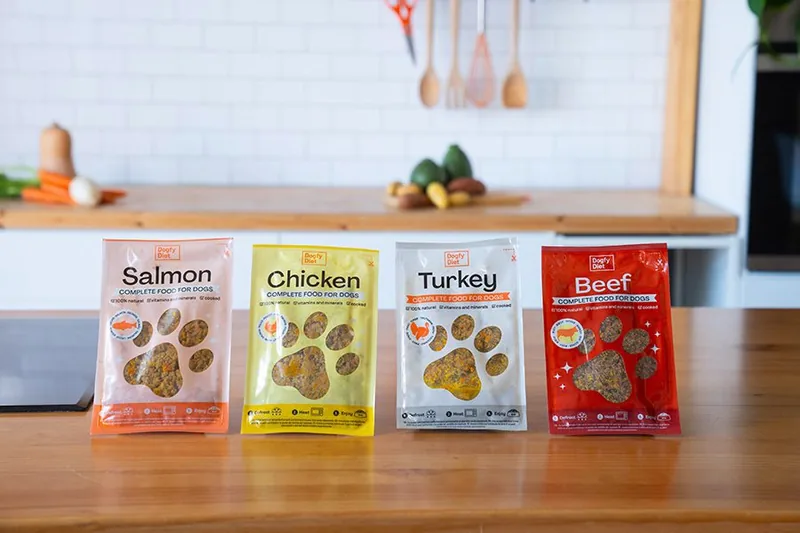
Dogfy Diet uses individual vacuum-sealed bags, one per portion. They are light, produce less waste in volume and can be frozen flat, stacked like books, which frees up space if you buy large batches. The downside: they are elongated and do not always fit well in the lower fridge drawers.
Guau&Cat favours rigid, lidded containers, easier to stack in the fridge and reusable, but which take up more volume per portion. In small fridges they compete directly with your own food. Frozen, the lids bulge and do not allow the same stacking efficiency as flat bags.
As for storage, Dogfy Diet's vacuum seal reduces food oxidation once the weekly batch is opened, which matters if the dog eats several portions a day over several days from the same pack. Guau&Cat's tubs, sealed with a lid, also keep well, but without a vacuum seal their fridge life once opened is a little shorter.
Both brands use recyclable materials. The practical difference lies in the volume of waste: the bags generate less plastic per unit than the rigid tubs, worth bearing in mind if you have a large dog and get through plenty of packs a week.
IMPORTANT: This article is for informational purposes only and does not constitute veterinary, nutritional or behavioural advice. Every dog is different, and only your trusted vet can advise you on its specific needs.