 Care
Care
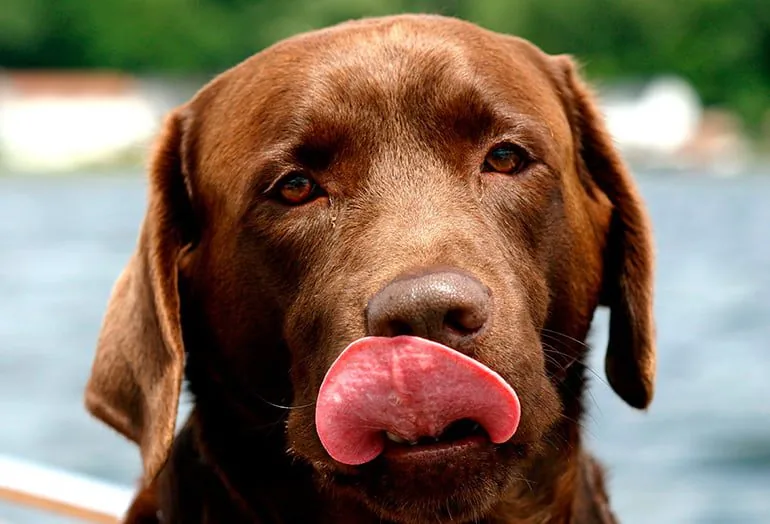
Why Does My Dog Lick Its Mouth?
To know why your dog licks its mouth, you need to look at the context. Licking right before you feed it isn't the same as licking after intense exercise or when it's sick.
Below, we'll go over the most common situations where we'll see our dog lick its mouth. Perhaps the most striking thing is that this lick is included among communicative signals — let's begin.
The Stages of Digestion in Dogs
A very common situation where we'll see our dog lick its mouth is when it's expecting food. It doesn't matter if we're about to fill its bowl, or it's simply smelling what we're preparing for ourselves. We'll notice this behavior starts as soon as it knows it's mealtime.
Dogs are creatures of routine and quickly learn when we'll take them for a walk, take them to the vet, leave the house, or when it's mealtime. They anticipate, and since digestion begins in the mouth, they start producing saliva. We'll notice them licking their mouth and drooling. It's a conditioned reflex, as Pavlov demonstrated.
In his experiment, he rang a metronome at the same moment he fed several dogs. After a few repetitions, the dogs started salivating just from hearing the metronome, without being given any food. So, licking the mouth is completely normal when the dog senses it's about to eat.
Canine Calming Signals
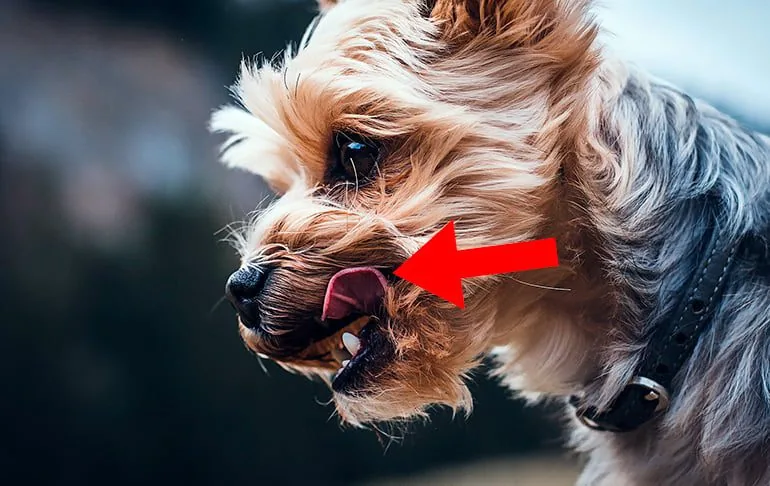
A much less obvious meaning behind licking the mouth is found in communication. Dogs don't talk, but instead, they use a huge number of visual, auditory, gestural, and olfactory signals.
This whole language has developed both to communicate with their own kind and with people. Licking the mouth is included among the so-called calming signals. These are the ones a dog gives off when it feels uncomfortable. It's in a situation it wants to get out of without getting hurt.
In human terms, we could translate it as "please, stop and leave me alone." For example, your dog might do this gesture if petted by a stranger. Other calming or appeasement signals include yawning and turning the face away.
Anxiety in Dogs
Calming signals are normal, but if licking the mouth becomes a compulsive habit, we're dealing with a behavioral issue reflecting anxiety and stress. In these cases, vets specialized in canine behavior or ethologists can help us.
When a dog is nervous, we instinctively tend to touch and pet it to calm it down. But what the dog interprets is that we're rewarding that altered behavior. So, without meaning to, we're reinforcing it. That's why, to combat anxiety, it's recommended to improve the dog's living conditions.
We need to offer it both physical and mental stimulation, as well as reward the behaviors we want to establish. Specialists can give us specific guidelines for our dog's case.
Body Temperature Regulation in Dogs
Dogs don't have the number of sweat glands humans do. That's why they've had to develop another system to regulate their body temperature: panting. When dogs are hot, they open their mouth and stick out their tongue. This way, they promote evaporation and lower their temperature.
To speed up the process, they often drink water and lick their lips repeatedly. This way, they keep the tongue very wet, ensuring proper evaporation. Under normal circumstances, a dog will pant after intense exercise or when it's hot. Within a few minutes, it'll have managed to regulate its temperature.
But this method has a drawback: if the ambient temperature is very high, the dog won't manage to cool off. That's why, if panting is very intense or doesn't stop, we need to move the dog to a cooler location. Otherwise, we risk it suffering heatstroke. This is a veterinary emergency that can be fatal.
Symptoms of Illness in Dogs
Sometimes a dog licks its mouth because it's not feeling well. Like us, it can suffer nausea and retching. In these cases, it'll lick its mouth repeatedly, may drool excessively, and might strongly contract its stomach as if about to vomit, though it doesn't always manage to. There are quite a few conditions that can present with retching.
And these aren't always digestive in origin, since if, for example, the dog swallows an object like a bone or toy and it gets lodged somewhere in its throat, retching will appear in an attempt to expel it. It may also rub its mouth hard with its front paws, as if trying to get the object out.
A dog occasionally feeling nauseous and vomiting isn't concerning. But if there are other symptoms, vomiting is frequent, or it contains blood, you should see a vet. On another note, any injury to the muzzle can make the dog lick itself repeatedly. Minor injuries will heal on their own. If they don't, call the vet.
Bibliography Carlson and Giffin. 2002. Dog Owner's Home Veterinary Handbook. Madrid: Editorial el Drac. Morris, Desmond. 1988. Dog Watching. Barcelona: Plaza & Janés.
IMPORTANT: This article is for informational purposes only and does not constitute veterinary, nutritional or behavioural advice. Every dog is different, and only your trusted vet can advise you on its specific needs.