 Care
Care
Why Does My Dog Like Having Its Belly Rubbed?
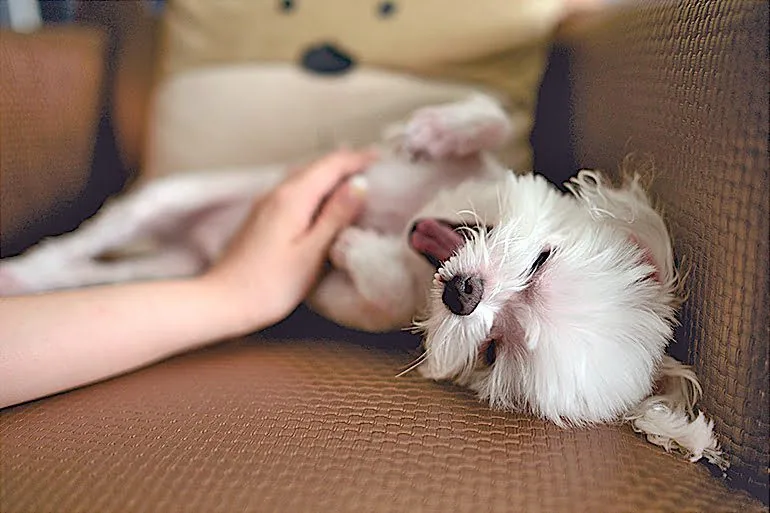
Dogs have many ways of telling us how they feel. One of the most universal is rolling onto their back so we'll pet them when they're happy. This behavior strikes us as curious and leads us to ask: why do dogs like having their belly rubbed?
Although it might not seem like it, our canine companions do talk — in their own way, of course. Barks and growls show a state of alertness or distrust, while tail wagging is almost always a sign they're feeling happy.
A Belly-Up Dog Is a Relaxed Dog
When a dog rolls over and takes on this pose, it could be signaling that it's calm, but also that it trusts us. Consider that, by lying on its back, it's exposing the softest, most fragile parts of its body. This is a position it would rarely take in the wild, and by doing it, it's showing us that we're part of its most intimate circle.
At the same time, this position is interpreted as the opposite of an alert state — meaning it's not preparing to attack. In short, it poses no danger or aggression toward others.
Why Does My Dog Like Having Its Belly Touched?
Now that we know what this position implies, we can start to understand why dogs love being petted so much when they show themselves defenseless in front of us. A dog showing us its most sensitive part is telling us it likes us, that it's not afraid of us. In short, that it wants to give and receive affection.
According to canine behavior expert Susie Aga, dogs love physical contact with members of their pack. This can certainly extend to the people they live with and toward whom they feel special affection.
Several studies have confirmed that many animals have a type of neuron linked to hair follicles. These react positively to petting, sparking an intense kind of pleasure. Other research has shown that the act of petting a dog is equally positive for humans.
Tell When a Dog Is Signaling Calm and When It's Submission
Rolling over and lying belly-up doesn't just indicate a calm state — it can also be a position of submission. In this situation, petting its belly might not be a great idea. While it won't react violently, you could increase its stress level. Some signs that it's rolled over to submit are:
- Ears pulled back.
- Half-closed or wide-open eyes, but not focused on you.
- Yawning or lips stretched into a kind of grimace.
- Sometimes they may release a small trickle of urine.
- Its body generally looks more tense than relaxed.
If you live with more than one dog at home, or if your furry friend plays with other dogs at the park, its body language could mean something different.
Lying on Its Back as a Play Strategy
Until not long ago, it was believed that when two dogs or wolves faced off to decide who was alpha, rolling over to expose the neck (and thus, one's life) was an unmistakable sign of submitting to the other.
In 2015, a group of experts observed something different. During play between dogs — both adults and puppies — rolling onto their back wasn't necessarily a sign of submission. The study of these interactions concluded these were defensive or offensive strategies used during moments of fun.
But… Is It Possible My Dog Doesn't Like Having Its Belly Petted?
To each their own, and that's true in the canine world too. Experts suggest always letting the dog decide whether it wants petting in that area or not. Socialization from puppyhood will make it more exposed to human contact, so a socialized dog will be more receptive.
You also shouldn't think a dog doesn't trust you just because it won't let you pet its belly. That has nothing to do with it. It depends on the dog's personality, how it was raised, its relationship with household members, and many other factors. It's simply an individual choice your companion makes. And, as such, you should respect it.
Based on your own experience, does your dog enjoy having its belly petted, or is it a bit reserved? Do you agree it can help relax both of you? Leave your thoughts in the comments.
IMPORTANT: This article is for informational purposes only and does not constitute veterinary, nutritional or behavioural advice. Every dog is different, and only your trusted vet can advise you on its specific needs.