 Care
Care
Why Does My Dog Stare at Me?
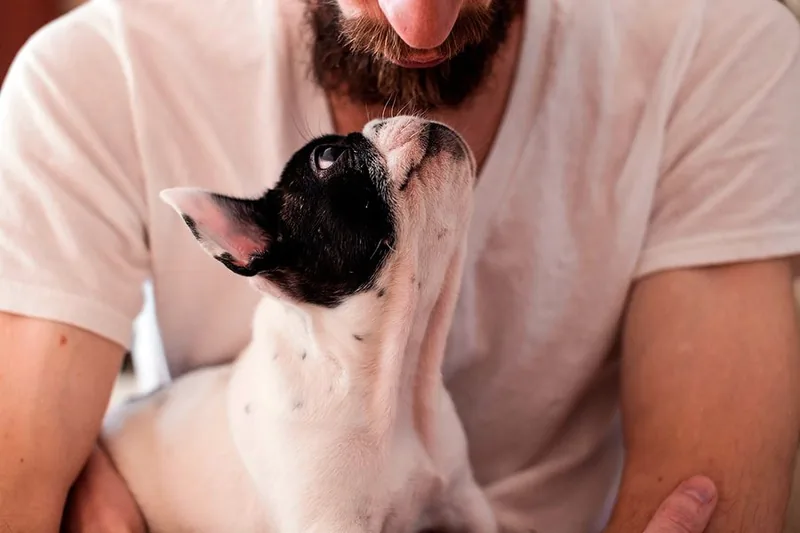
There are many situations where we find our dog staring at us, or exchanging a knowing look with us, even if just for a few seconds. All these situations have an explanation, since visual communication is just another way dogs and humans communicate.
Let's look at the most common situations where our dog stares fixedly at us and what they mean.
When a Dog Looks for Your Eyes to Ask Permission
If we've properly trained our dog and spend time with it, we'll have built what's known as a strong emotional bond. This isn't just about the dog and human getting to know each other better — the trust between them is such that with a simple look, we can tell what it wants.
If we're out walking with our dog and it suddenly stares at us, it's very likely asking for permission to run around off-leash for a while, or to go greet another dog it's spotted along the way. Our dog will look for our eyes to get confirmation — with a simple "okay" or "go ahead," the dog will understand perfectly that it can go greet the other dog.
The same happens when, for example, we're eating something and our dog sits next to us staring fixedly — it's asking for a bit of food, or permission to sniff and eat a little.
Its stare is nothing more than a way of getting our attention to ask us something. The same goes if it wants us to throw the ball, a stick, or play in some other way. They can't understand most of our words, but body/visual communication is more than enough for us to understand each other most of the time.
Staring at You Intensely for Long Stretches
You've surely been sitting on the couch at home watching TV or reading a book more than once, when you noticed your dog's intense, penetrating gaze, knowing it's staring right at you and you can't quite ignore it. That continuous stare that puzzles us so much, since we don't know what our dog is thinking or what it wants.
It could be our dog trying to get our attention for, say, dinnertime (if it's close). It might want to play with us a bit, or have us throw or hand it its favorite toy. Though it could also simply be watching us with no other intention at all.
Dogs are very observant — their life is quite simple, and long stretches at home can sometimes make them bored. So it's no surprise our dog watches us for a good while out of sheer curiosity.
This is nothing to worry about at all, as long as our dog is healthy and shows no signs of feeling unwell. Sometimes, when they need to pee or poop, they'll also pressure us with their stare to signal they urgently need to go outside.
They Look at Us When Scared or Happy
A look is a great communication tool between dogs and humans, though we humans often don't know how to read it. If our dog is in an uncomfortable situation, or has simply been scared by something, if it's afraid, it'll look for our eyes to let us know.
It doesn't need to say anything — we'll know perfectly well when it's a look of fear or pain, because it's simply something you can notice. On the other hand, when our dog is very happy, like when we give it a new toy or feed it something really tasty, its look will also show us its level of joy.
You could even say the sparkle in its eyes is completely different — something we love, since we know it's feeling good. Looks of happiness or sadness are knowing looks, the kind only a dog and its human know how to share and interpret.
Meaning of Looks Between Dogs and Humans
Just as our dog communicates with us through its gaze, it also does so with other dogs. Dogs have many ways of communicating with each other, from their tail movement, which can indicate mood or intention, to their ear position or the way they look at each other.
If two dogs that know each other look each other in the eyes, they're simply greeting each other or checking each other out. That said, if two dogs that don't know each other stare intensely at one another, it can be dangerous, since it's a sign of a challenge.
The same goes for unfamiliar dogs and humans — we should never stare fixedly into the eyes of a dog we don't know, since it might interpret this as a sign of a challenge and attack us. Staring into our own dog's eyes, which already knows us and will never interpret it as a challenge, isn't the same as staring into an unfamiliar dog's eyes.
IMPORTANT: This article is for informational purposes only and does not constitute veterinary, nutritional or behavioural advice. Every dog is different, and only your trusted vet can advise you on its specific needs.