 Breeds
Xoloitzcuintle
More than 3,000 years ago, the Aztecs believed this dog accompanied the dead on their journey to the underworld. Today, the Xoloitzcuintle remains a rarity outside Mexico, but its bare skin and loyal temperament make it one of the most fascinating dogs there is.
History of the Xoloitzcuintle
It's been called "the first dog of the Americas," since archaeological evidence shows this breed has existed for more than 3,000 years, making it the first domesticated dog on the continent.
Clay statues and pottery pieces shaped like this dog have been found in ancient Mayan and Aztec burial sites. These peoples revered the Xoloitzcuintle as a kind of divine being and credited it with all sorts of magical powers. In Aztec mythology, it was believed to accompany the dead on their journey to Mictlán (the underworld), helping them cross the river Chiconahuapan based on how they had behaved in life.
The Meaning of the Name Xoloitzcuintle
The word Xoloitzcuintle comes from Nahuatl and combines two terms: Xólotl, the Aztec god of dusk and death, and itzcuintli, meaning dog in the Mexica language. Literally, then, it means "dog of the god Xolotl," reflecting its divine origin according to Aztec belief.
Some scholars also interpret the name as a reference to the animal's physical appearance, suggesting it could mean "strange or wrinkled dog," alluding to its bare skin. In English-speaking countries it's simply called the Mexican Hairless Dog, a very descriptive name that, however, is also applied to the coated variety.
Temperament and Behavior
The Xolo is a calm dog, wary of strangers but deeply affectionate with its family, especially with whichever member it picks as its favorite. Puppies are very active, though as they mature their temperament grows calmer.
It's noble and highly loyal. It also makes an excellent guard dog, though it won't bother you with barking unless there's a good reason to. Highly territorial, it doesn't usually get along well with other dogs, which makes early socialization essential. Its loyalty and emotional balance place it among the breeds with the best temperament for those looking for a lifelong companion.
Physical Characteristics
Its height at the withers ranges from 50 to 75 cm, with a weight of 11 to 18 kg. There's a smaller variety, the Toy Xoloitzcuintle, whose size and weight are roughly 60% lower than the standard variety's.
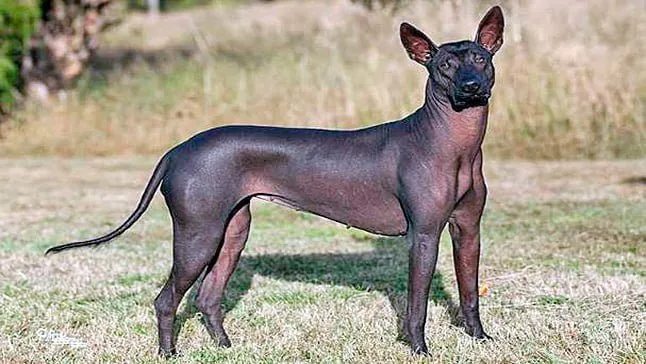
The Xolo's body is compact, with a slim head featuring upright triangular ears and almond-shaped eyes, almost always dark brown. Nose color matches the skin, or the coat in the case of coated Xolos. The Xoloitzcuintle became widely known around the world after being featured in numerous works by Mexican artists Diego Rivera and Frida Kahlo.
Hairlessness and Its Genetic Causes
Total hairlessness is one of the defining traits of the Xoloitzcuintle. It's caused by a natural genetic mutation that affects the ectoderm during the embryonic stage, impacting both coat development and dentition.
This mutation is directly linked to the absence of premolar teeth, a trait shared by every dog of this breed, whether coated or hairless. Bare skin also compensates for body heat loss: its skin temperature reaches 40°C, higher than in other dogs. This genetic trait links it to other hairless dog breeds that share similar characteristics.
Roughly one in five Xoloitzcuintles is born with a coat, usually short and coarse, limited to areas like the head and tail.
Why Do Some Xoloitzcuintles Have a Coat?
Although the breed is famous for its hairlessness, there's an internationally recognized official coated variety. Coated dogs have a short, coarse coat, either covering the whole body or limited to certain areas, always in ochre, orange, black, brown, or gray tones.
Both forms (hairless and coated) share the same genetic mutation and the absence of premolars. The difference is that coated dogs can't hold their ears erect the same way hairless ones do, though they keep every other trait of the breed.
Training and Socialization
The best way to train a Xolo is with a structured method and plenty of consistency. It's best trained using positive reinforcement techniques that motivate this intelligent, sensitive dog to learn quickly.
Thanks to its gentle temperament, a stern look is often enough to correct our Xoloitzcuintle and call it to order. Training results will always be better if the dog has been properly socialized during puppyhood, especially to ease its natural wariness of strangers.
Health and Longevity
Although it's a very healthy breed, some conditions can show up fairly often, such as patellar luxation, elbow and/or hip dysplasia, and certain liver-related digestive disorders. Another particularly sensitive area for this breed is its skin.
The Xoloitzcuintle is one of the longest-lived dog breeds known, capable of living up to 20 years. This exceptional longevity makes it a long-term life companion for anyone willing to provide it with proper care.
Exercise, Diet, and Weight
A daily walk or a bit of vigorous play is enough to meet its exercise needs. Any yard or garden where our Xolo spends time should be fenced, since it's an athletic dog and a great jumper that will always try to escape.
Given its tendency toward weight gain, it's important to watch this dog's diet and follow your vet's guidance. Obesity in the Xoloitzcuintle can lead to, among other issues, significant joint problems.
WATCH THE TEMPERATUREWith no coat to protect it, the Xoloitzcuintle is sensitive to sudden temperature changes. In winter it needs warm clothing; in summer, sun protection. Avoid exposing it to cold drafts or extreme heat.
Special Skin Care
The Xoloitzcuintle's bare skin is especially vulnerable to temperature changes and other external factors. It needs regular baths with specific products to keep it hydrated and protected.
In winter it's essential to provide proper warm clothing, while in summer it needs sun protection to prevent burns. The skin should be checked regularly for any irritation, infection, or unusual change that might need veterinary attention.
How Much Does a Xoloitzcuintle Cost?
The price of a Xoloitzcuintle varies significantly depending on where it's purchased and the dog's genetic value. In Mexico, where it's among the country's most common breeds, the cost tends to be no less than five thousand pesos, rising considerably depending on how many competitions the dog or its parents have taken part in.
In Europe, the approximate price is around 400 euros, though it can vary depending on the kennel and the quality of the dog. Adoption is always the most responsible and accessible option, giving a home to a Xolo that needs one.
Is the Xoloitzcuintle the Right Dog for You?
The Xoloitzcuintle is ideal for anyone looking for a loyal, intelligent companion of manageable size, but it requires dedication when it comes to skin care, temperature protection, and early socialization. Its territorial nature and wariness of strangers make it better suited to households without other dogs, with owners who can provide structure and consistency in training.
Its exceptional longevity means adopting a Xolo is a two-decade commitment. If you're ready to take on its specific care needs and appreciate its thousands-year-old history, this hairless Aztec dog could become one of the most extraordinary companions you'll ever have.
IMPORTANT: This article is for informational purposes only and does not constitute veterinary, nutritional or behavioural advice. Every dog is different, and only your trusted vet can advise you on its specific needs.