 Breeds
Hairless Dog Breeds
Although it might seem like these are genetically engineered dogs, the truth is several hairless breeds have existed for much longer than genetic engineering itself has even existed. So we can be sure these breeds are entirely natural, a product of Mother Nature's own whims.
The benefits offered by dogs with no hair on their body are quite significant, for people allergic to dog hair or mites, people allergic to parasites, or people who simply hate constantly cleaning up hair around the house.
The various dog breeds without hair don't cause common allergies, aren't prone to catching parasites like fleas, and of course don't fill the house with hair every time shedding season comes around. Honestly, there are so many benefits that it's strange there are so few breeds like this.
Let's go over the most common breeds that, by their own genetics, have no hair on their body, their characteristics, and of course the care they need.
 Xoloitzcuintle
Xoloitzcuintle
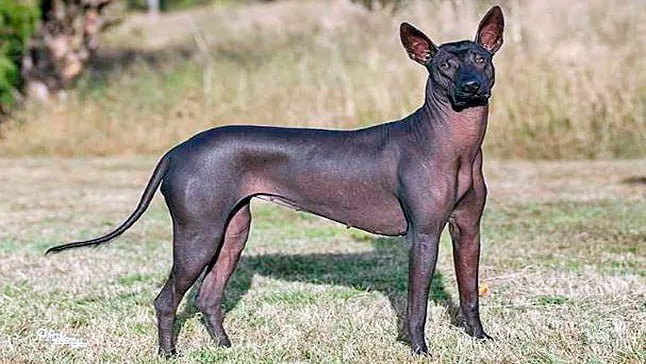
Also known as the Aztec dog or Xoloitzcuintle, the Mexican hairless dog is undoubtedly one of the oldest known breeds. Its origin dates back to the 14th century, when it was used as a spiritual dog or, at times, as food.
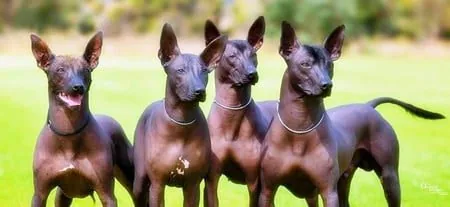
It's a small-to-medium dog reaching fifteen kilos in weight as an adult, with dark skin and not a single hair. It tends to have wrinkles across its body, which makes it an even more beautiful dog.
Loyal, super affectionate, and playful, the Mexican hairless dog has become a perfect example of what any dog should be like, regardless of breed. Although its origins are Mexican, it can be found anywhere in the world, including Spain, of course, where it's becoming more and more trendy.
Argentine Pila Dog
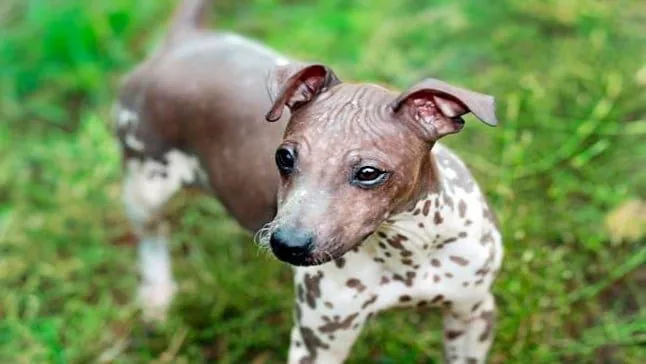
The Argentine hairless dog, also called the Pila dog, is very similar to the Mexican dog, which is why it's suspected to be a direct descendant of it, bred for centuries on the American continent.
Its adult size barely exceeds thirty-five centimeters in height, with a weight between twelve and sixteen kilos. Its body has no hair, and its skin is thick and dark, usually mottled with lighter patches.
The Pila Argentino breed is very sociable and intelligent, able to learn any trick with just a few training sessions. It adapts perfectly to living in small spaces like apartments. It's undoubtedly an excellent choice as a hairless four-legged companion.
The Peruvian Hairless Dog
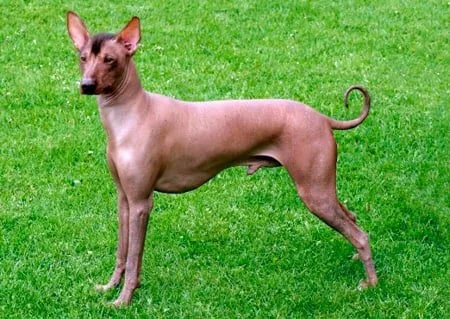
It's very likely the Peruvian hairless dog is also a direct descendant of the Aztec dog, given their many similarities. That said, this breed is known to have existed in the Peruvian region long before colonization, so its origins are actually uncertain.
The Peruvian hairless dog is somewhat larger than the other breeds mentioned so far, weighing close to twenty kilos as an adult. At the withers, its height can reach half a meter.
This breed has barely any hair on its skin, except for a few loose hairs on top of its head. Its skin is dark, though not uniform, showing color variations in most individuals (mottled).
The Peruvian Pila's temperament is calm and friendly, lively but respectful, tremendously sociable and affectionate. This is one of those breeds that wins you over just by being around, fully recommended for any kind of family setting.
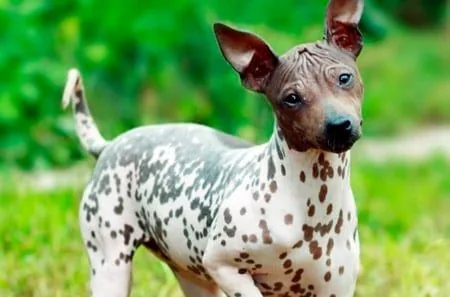
The American Hairless Terrier
If you already know most Terrier breeds around the world, like the Pit Bull or the Stafford, you'll be surprised to learn there's also a completely hairless Terrier. Its origins are uncertain, though it's suspected to descend from the Rat Terrier.
The Hairless Terrier's size is somewhat smaller than what we've covered so far, reaching a maximum height of about forty centimeters at the withers and a weight of about twelve kilos as an adult.
Its skin color is usually a mix of light brown and flesh tone, with uniform-colored individuals being quite rare. Its temperament is social and playful, though like every Terrier it's also watchful and brave — worth keeping in mind, since if not properly trained it can become dominant.
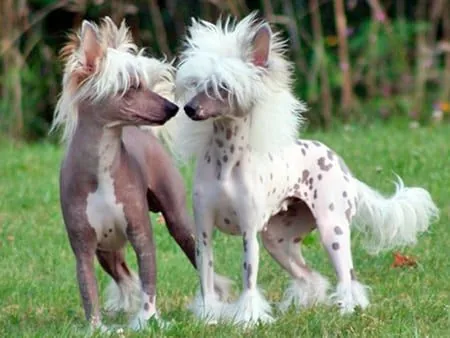
Chinese Crested
Depending on where and who you ask, its origins are said to be Chinese or African, though it's on the Chinese continent that this breed has developed the most, which is why we believe its origins are Chinese.
This is actually a breed with some hair, since it does have hair, just in certain areas like the head, legs, and/or tail. That said, there are also fully-coated Cresteds, entirely covered in hair... the choice will be tricky, since both varieties are gorgeous.
The Chinese Crested is small, reaching a maximum of six or seven kilos as an adult. They're elegant and poised, almost like runway models. With a very playful, cheerful, fun character, they're one of the best choices if you're set on a hairless dog breed.
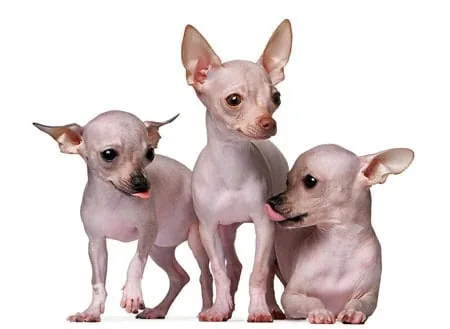
The Hairless Chihuahua
Despite what rumors might suggest, the Hairless Chihuahua isn't the result of a genetic experiment or lab work. That said, it's also not an ancient or purebred breed like the ones mentioned above.
Its origins are fairly recent, being the result of crossing a coated Chihuahua with a hairless breed, then crossing the offspring over and over until arriving at what we know today as the Hairless Chihuahua.
So it's the result of several years of breeding and selection work with the Chihuahua breed, aiming for a final result identical to the Chihuahua but hairless. Its size is fully mini, not exceeding three kilos in weight as an adult.
If you like Chihuahuas and their cuddly, affectionate but rarely social temperament, this could be an excellent choice for expanding your family.
What Care Does a Hairless Dog Need?
Hairless dogs come with a whole range of advantages, but also drawbacks, so we should understand in depth everything needed so they don't suffer from the absence of their coat.
Advantages of hairless dogs:
- They don't shed, don't make a mess, and don't trigger allergies.
- They're practically free of mites, compared to coated dogs.
- Fleas and ticks won't want to latch onto a hairless dog — they prefer coated ones.
- They don't need to be bathed as often, since they don't get as dirty.
Drawbacks of hairless dogs:
- They need specific skin care, like sunscreen and moisturizing creams.
- They're not suited to extreme climates, like southern or northern Spain. They need stable, mild climates.
- Some dogs mistake them for cats due to their lack of coat, and they can become targets of attacks.
Generally, hairless dogs are like any other type of dog, of any breed, but with the catch that we need to pay special attention to their skin care. The sun can burn them and badly damage their skin, just as cold can crack it and cause pneumonia.
As long as you take care of their skin whether it's hot or cold, they don't need much more care beyond good nutrition and the usual vet checkups for any breed.
IMPORTANT: This article is for informational purposes only and does not constitute veterinary, nutritional or behavioural advice. Every dog is different, and only your trusted vet can advise you on its specific needs.