 Breeds
Akita Inu: Everything About the Japanese Samurai Dog
The Akita Inu, bred in Japan for big-game hunting of bear and wild boar, is today a national treasure with a loyal, reserved temperament. However, owning one in Spain is subject to Royal Decree 287/2002 on potentially dangerous dogs, a regulation every prospective owner needs to know before deciding to adopt.
History and origin of the Akita Inu
Akita prefecture, in northern Honshu, is where it all began. During the Edo period, people in that mountainous region selected a dog capable of taking on bears, wild boar and deer. Large, hardy, with a presence that commanded respect. The first written records that document the breed with any rigour date from the 20th century, but the breeding tradition goes back much further. In 1934 the official standard was set. Today the Akita Inu is considered a national treasure in Japan, one of the few breeds to hold that distinction.
The Second World War came close to wiping it out. Between food shortages and culling orders, numbers plummeted, and bringing the breed back required crossing the few surviving purebreds with local mountain dogs. Japanese breeders pulled it off, though it took a very demanding selection effort. Then came the American occupation. Many soldiers took Akitas back to the United States, where they were crossed with German Shepherds and Mastiffs, and from those crosses came the American Akita. In Japan, meanwhile, the original type was preserved, with a bear-like head, erect ears, a tightly curled tail and a face with no colour other than white. Any black mask or marking that breaks up that facial uniformity is a serious fault under the Japanese standard; in the American line, that trait is accepted without issue. Each body applies its own criteria, and that's why the two lines have been drifting apart for decades.
In Spain, interest in the breed took off in the 1990s. The Akita Inu falls under the Potentially Dangerous Dog classification per Royal Decree 287/2002, which brings specific obligations in public spaces, liability insurance and adoption restrictions. This isn't minor paperwork. For centuries, this dog was bred to act alone, defend his territory and make decisions without waiting for orders. That psychological profile needs to be managed with very specific training from day one, and not everyone is in a position to do that.
Physical characteristics of the Akita
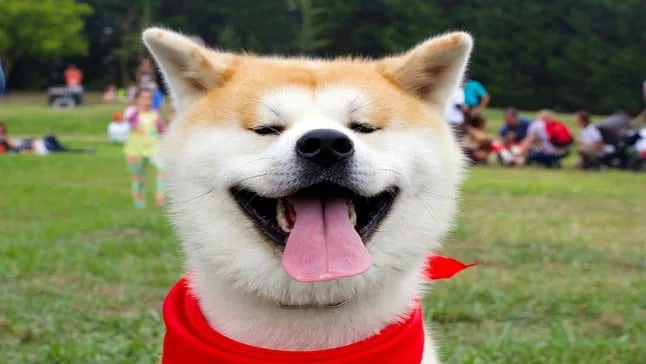
The Akita Inu is a large dog, with a sturdy build and heavy bones. Weight can range roughly between 30–50 kg in males and 25–45 kg in females. His double coat — a hard, straight outer layer and a dense, woolly undercoat — gives him remarkable cold tolerance, but also makes him very sensitive to heat. He does best in cool temperatures; above that threshold he can easily suffer heat stress, especially in Spain's Mediterranean or continental climates.
The ears are triangular, erect and tilt slightly forward, and the tail curls over the back in a single or double curl. A notable physiological quirk: some Akita dogs show particularities in erythrocyte potassium levels, a trait worth knowing about to avoid misreading it as hyperkalaemia on blood tests “Clinicopathologic and electrocardiographic features of Akita dogs with high and low…” (2014). This trait doesn't indicate disease, but it can lead to false diagnoses if the vet isn't familiar with the breed.
The coat needs frequent brushing — at least three times a week — and this intensifies during seasonal shedding, which can last several weeks. Ear cleaning and nail trimming are basic routines. On the question of whether Akita Inus are aggressive, it's worth clarifying that aggression isn't an inherent breed trait, but a possible consequence of poor socialisation, inadequate handling or a lack of clear boundaries. His imposing build can make any warning behaviour come across as a threat, but a well-trained Akita is balanced and selective in his interactions.
Akita Inu temperament: loyalty, dominant instinct and family life
With family, the Akita Inu gives everything. With everyone else, he prefers to keep his distance, and that has nothing to do with fear. His past as a solitary hunter forged a self-sufficient temperament, with a strong sense of judgement and territory. The most common behavioural issues in this breed — and also in the Tosa Inu — revolve around dominance toward dogs of the same sex, possessive attachment to resources like food, toys or certain spaces, and reactivity that flares up in response to sudden or abrupt stimuli. The genetics that drive these dogs to defend hierarchy and territory have been selected for generations. That doesn't reset with a few weeks of training.
With other animals at home, things need planning. Like the Shiba Inu, the Akita can have low tolerance for dogs of the same sex, and with cats or small rodents the prey drive can kick in fairly easily. Raised alongside children from puppyhood, he usually accepts them well, but the size difference and the dog's reaction speed are reason enough never to leave them alone together under any circumstances. Working on socialisation from the start, and keeping it active over the years, can soften these behaviours, though managing them will always be part of the deal. They don't disappear.
Physical punishment and intimidation only produce a more distrustful dog, more prone to reacting defensively. Calm, consistent leadership backed by positive reinforcement works better. The Akita isn't a beginner's dog. He receives a command, processes it on his own terms, and decides whether it seems reasonable. Anyone who fits with that personality and doesn't try to break the dog ends up with one of the most loyal companions there is.
How to socialise an Akita Inu in the city
For an Akita, the socialisation window closes sooner than it seems. It needs to start from the first day at home and not let up until past six months. In cities like Madrid, Barcelona or Valencia, the problem isn't a lack of stimuli, but quite the opposite: there's too much all at once. The plan is to go from less to more. Quiet streets first, then areas with some activity, then genuinely busy neighbourhoods. Short sessions work better than long ones, and it's always worth ending on something good — a treat or some playtime — so the dog files the walk away as a positive experience.
People of all ages, with hats, with umbrellas, with children running nearby. The more varied the exposure in these early weeks, the better. Other dogs count too, but they need to be balanced animals with up-to-date vaccinations. Puppy classes at specialist centres help a lot here, and most Spanish associations recommend them. Watch out for this: the Akita has a very strong exploratory instinct and may ignore being called when something catches his attention, so work on that from the start. In public, a safety harness and short lead; PPP law requires it, and with this breed there's no room for carelessness.
Cars and public transport deserve special attention if you live in a city, because sooner or later you'll need to get around with the dog. The same goes for the vet. If the first visits are neutral, without drama or struggling, the animal learns that nothing bad happens. Socialisation isn't just a puppy thing and then done. Throughout his whole life, the Akita needs regular, controlled contact with people and animals to avoid becoming reactive. In urban settings, this breed can also shut down if he feels there's no way out. The owner has to learn to read his body language and get him out of the situation before he reaches his limit.
Specific diet to prevent bloat
Bloat (gastric dilatation-volvulus) is a life-threatening emergency that's especially common in deep-chested breeds like the Akita Inu. To reduce the risk, feeding should be split into at least two or three meals a day, avoiding single large meals. High-quality dry kibble, with animal protein as the first ingredient and free of inflammatory grains, is a sensible base, though there's no single consensus. What matters most is the feeding pattern: never do intense exercise within an hour before or two hours after eating.
The use of raised feeders has been controversial; some studies suggest they can increase air intake if the dog eats too fast, while others find no link. As a practical measure, many Spanish behaviourists recommend slow feeders (maze-type) to slow down eating speed and reduce aerophagia. It's also advisable to offer water in small amounts after meals, not during, to avoid the stomach distending suddenly.
Owners should know the warning signs: unsuccessful attempts to vomit, a distended abdomen, restlessness, excessive drooling and heavy panting. Any of these symptoms means an emergency vet visit; there are no home remedies. Some Spanish clinics offer prophylactic gastropexy (surgical fixation of the stomach) during neutering or as a standalone procedure, an option that can be discussed with the vet by weighing risks and benefits.
Health, hereditary diseases and essential genetic tests
The Akita Inu lives on average between 10 and 12 years, and although he's a sturdy dog, he carries some genetic weaknesses worth knowing before getting one. On the eye front, microphthalmia, congenital cataracts, posterior lenticonus and retinal dysplasia have been documented in litters sharing a common male ancestor, suggesting recessive hereditary transmission “Multiple congenital ocular defects in the Akita dog” (1985). For that reason, any serious breeder puts breeding stock through regular eye exams and pulls them from the breeding programme if there's a problem.
Sebaceous adenitis also deserves attention. It's an inflammation of the sebaceous glands that shows up more often in Akitas, Samoyeds and Poodles, and presents with patchy hair loss, flaking and folliculitis “SEBACEOUS ADENITIS IN AKITA DOG – CASE REPORT” (2022). Confirming it requires a skin biopsy, and treatment — which only relieves symptoms — needs to be handled by a vet trained in dermatology. On top of that there's uveodermatologic syndrome, an autoimmune condition that combines progressive uveitis with skin depigmentation, and which has been linked to a higher presence of the DQA1*00201 allele in the breed “Uveodermatologic (VKH-like) syndrome in American Akita dogs is associated with an…” (2005). If not caught and treated early, it can lead to blindness; at any change in pigmentation or sign of eye discomfort, see a specialist without delay.
The range of issues doesn't stop there. Hip and elbow dysplasia, hypothyroidism and certain cancers are also among the breed's common conditions. Before breeding two Akitas, the minimum required tests are an official hip dysplasia X-ray, a full thyroid panel and eye exams for both parents. A puppy without that documented health history is a box of surprises. Ask for the certificates, and if the breeder doesn't have them or makes excuses, look elsewhere.
Akita Inu vs American Akita: physical differences and legal obligations in Spain
They share an origin, yes, but they don't look alike up close. The American is bigger and heavier-built, with a more square head, smaller ears and a tail with less curl than the Japanese Inu's. Accepted colours differ too: the American allows any colour, including a black mask, while the Inu can only be red, brindle, white or sesame, always with urajiro, that lighter shading on the cheeks, muzzle, neck, chest and belly. From a legal standpoint, Royal Decree 287/2002 treats both as the same breed, unless the dog has a pedigree from the Japanese studbook explicitly stating "Akita Inu".
Whichever line it is, an Akita falls under the PPP (potentially dangerous dog) category. Muzzle in any public space, a lead no longer than 2 metres, and the corresponding administrative licence. Liability insurance is also mandatory, and this varies depending on where you live: the state minimum falls below the €120,000 required by some autonomous regions. Madrid, Catalonia and the Basque Country set higher figures, and some town councils add their own conditions, so it's worth checking the local ordinance too. Going without insurance can mean a significant fine and, in extreme cases, the animal being seized as a precaution.
A damage claim — to a person or another animal — can get very expensive. That's why it makes sense to take out insurance that includes legal defence on top of basic damage cover, because when a claim comes in, that makes all the difference. The distinction between the American and Japanese lines mainly matters to breeders and conformation judges; whoever has the dog at home has a different priority: complying with the regulations and avoiding incidents. The American is bigger and heavier than the Inu, which can worsen the consequences if something goes wrong, though the two lines are fairly similar in temperament.
Checklist for an ethical Akita Inu adoption
The first thing to check before bringing an Akita Inu home is how reliable the breeder or association is. Puppies need to stay with their mother until the legal minimum age, no exceptions. The parents should have up-to-date genetic tests — hip dysplasia, thyroid, eye exams — and any serious breeder will happily show you their facilities and let you meet the mother in person. Always ask for the adoption contract along with the vet history and pedigree if applicable. A very low price or a listing with no papers: you already know what that means.
Space matters, but not absolutely. A garden or nearby access to green areas helps, and a large flat can work just as well if walks are long and mental stimulation is guaranteed. What can genuinely become a problem is heat: without air conditioning in summer you'll need concrete solutions, because heatstroke is a real threat for this breed. Add to that the monthly cost — quality food, PPP insurance, vet care, unexpected expenses — and see whether the budget holds up.
Beyond space and money, there are questions worth asking yourself. Have you lived with strong-tempered dogs before? Can you commit to socialisation throughout the entire first year? Time matters too: two daily walks of at least an hour is the minimum this breed needs. And get familiar with your region's PPP regulations before taking the step. Adopting an Akita Inu calls for careful thought beforehand. This isn't a dog to have as decoration; it demands constant dedication, clearly marked boundaries and long-term consistency.
If the answer to all that is yes, it's time to look for a responsible breeder or a breed-specialist association. Ask for references, visit in person, and see with your own eyes the environment where the puppy was raised. Home delivery or shipping without a prior visit: never. A breeder's transparency is the most reliable sign that things are on the right track; when that transparency is missing, there's usually a reason.
IMPORTANT: This article is for informational purposes only and does not constitute veterinary, nutritional or behavioural advice. Every dog is different, and only your trusted vet can advise you on its specific needs.