 Breeds
American Leopard Hound: Characteristics and Care
The American Leopard Hound, recognised by the UKC in 2016, is a treeing hound shaped over generations for small-game hunting. His selective history and the key differences from the Catahoula Leopard Dog reveal why this breed remains unfamiliar to many dog lovers.
History of the American Leopard Hound breed
In the southern United States, hunting was a daily activity. That called for a dog able to handle rough terrain, follow a trail hours after the animal had passed, and have the temperament to stay at the foot of a tree barking — with the raccoon or squirrel up above — until the hunter arrived. That's where the American Leopard Hound comes from. His genetic base starts with the hounds who crossed the Atlantic with the first colonists — the Basset Hound, the Foxhound and other European scent hounds — later mixed with local dogs already carrying the merle gene, the one producing that characteristic mottled coat. An animal built to work, with a fine nose, physical stamina and that calm temperament letting him wait for hours without losing the trail.
While breeds like the American Bully racked up magazine covers and social media followers, the American Leopard Hound remained little more than a secret among hunters in North Carolina, Georgia and Alabama. No formal registry. No written standard. Each breeder selected their dogs based on what they did in the field, full stop. That way of breeding — functional, with no concessions to looks — explains why he remains hard to find today outside hunting circles. Anyone wanting a good individual needs to seek out a genuine breeder, with a serious programme and a waiting list, because mass-producing litters isn't how people who've spent decades working these lines operate.
In 2016, the United Kennel Club (UKC) added the breed to his hound group with his own standard. That step helped bring order where there'd been a fair amount of confusion. The resemblance to the Catahoula Leopard Dog led many to mix them up, and having a separate standard made clear they're different breeds, with different histories. Since then he's gained some visibility, though he remains niche territory — mainly hunters, and families with real space and a genuine willingness to give a dog like this what he needs.
Key differences between the American Leopard Hound and the Catahoula Leopard Dog
The similar name and mottled coat get them constantly mixed up, but they're breeds with breeding histories that have little to do with each other. The Catahoula Leopard Dog comes from Louisiana — he's the state's official dog — and was selected to work pigs and cattle over difficult terrain, as well as hunt large game. That's where his dominant, territorial character comes from, always keeping an eye on controlling his surroundings. The American Leopard Hound is something else: a treeing hound whose job is to follow a prey trail, corner it and bark from the foot of the tree until the hunter arrives. No herding involved.
The physical differences are just as obvious. The Catahoula is bulkier — reaching up to 43 kg (95 lbs) — with a wide, powerful head, a pronounced stop and a heavier overall look. The hound, by contrast, ranges between 16 and 34 kg (35-75 lbs), has a finer skull, lower-set ears and that unmistakable classic hound face. Coat-wise, both show the merle or leopard pattern, but here's the catch: the Catahoula allows extensive white and a wide range of colours and combinations, while in the American Leopard Hound heavy white is penalised in the standard.
That difference in function has very direct consequences for daily life. A Catahoula with no livestock to manage tends to look for a substitute, and can end up exerting that control over people or other animals in the home. Without outlets for tracking and treeing, the American Leopard Hound channels his energy wherever he can: escaping, non-stop barking, wrecking whatever he can get to. Knowing in advance what each was bred for lets you adjust daily stimulation and avoid asking the dog for something that goes against his nature.
American Leopard Hound breed standard according to the UKC
The United Kennel Club standard describes the American Leopard Hound as a medium-to-large dog, powerfully built but agile, standing 21 to 27 inches (53-69 cm) at the withers with a proportionate weight of 35 to 75 lbs (16-34 kg). The overall silhouette should convey the impression of a rugged athlete, with a deep chest, strong loin and well-angulated limbs letting him cover uneven ground for hours without losing efficiency. The tail, set moderately high, is carried with a slight upward curve when the dog is active, but never curled over the back.
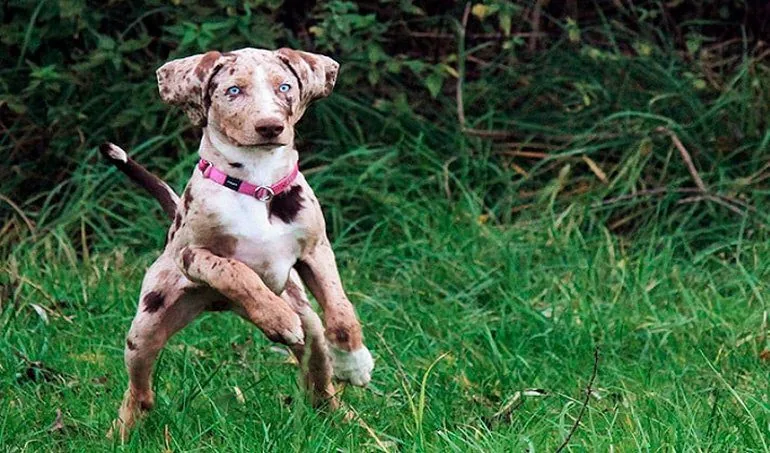
The coat is one of the most distinctive traits. The standard recognises four colour patterns: leopard (merle, with dark spots on a lighter base), solid (one uniform colour), brindle, and painted (small colour spots on white, similar to a ticking pattern). The coat is short, dense and lying close to the body, with a texture that repels dirt and dries fast, a functional adaptation for a dog working through scrub and streams. The eyes can be brown, blue or even odd-coloured (heterochromia), and the ears are medium-length, wide at the base and drooping, typical of a scent hound.
In motion, the American Leopard Hound should show a fluid trot of moderate reach, with good front extension and rear drive, without side-to-side sway that would cost efficiency. The standard penalises any deviation interfering with hunting function: an undershot jaw, erect ears, a permanently curled tail or an excessively white coat in leopard-patterned dogs, since extensive white is linked to a higher risk of congenital deafness. Evaluation always prioritises working ability over purely aesthetic detail.
American Leopard Hound temperament
The American Leopard Hound is a dog who thinks. While tracking he makes his own decisions without waiting for constant instructions, which makes him a resourceful, fairly intelligent hound and, let's be honest, a bit stubborn when commands clash with what his nose is telling him. That field independence doesn't mean coldness at home, and he builds a strong bond with the family with a degree of protective instinct, though without the reactivity seen in breeds specialised in guarding, like the American Staffordshire Terrier.
With children and other dogs he gets on well, provided he's had serious socialisation from puppyhood. Play is intense but rarely goes overboard. Where things change is with small animals: cats, rabbits, rodents — the prey drive is very strong, and underestimating it ends badly. Without direct supervision, keeping them physically separated is essential. And then there's the home. If the biggest weekly activity is a lap around the block, this dog will be a constant source of problems. He needs an active family who gets out and gets involved.
In the right environment he gives a lot. He learns fast, eagerly, and has a kind of canine sense of humour that throws off anyone unfamiliar with the breed. Training works with positive reinforcement and activities involving scent; mechanical repetition switches him off within minutes. Barking isn't a minor issue either. It's powerful, he uses it to flag finds, and in a residential area you need to work on a quiet command from day one. Anyone offering him a real occupation — sport tracking, demanding hikes, advanced training — has a dog here who responds.
The American Leopard Hound is a breed who ages well. With reasonable care he reaches 12-15 years without trouble, and his health record is considerably cleaner than breeds selected purely on looks. Several generations of breeding for field work have left a functional animal, without the morphological excesses that so complicate health in other breeds.
Health and hereditary diseases
The most studied weak point revolves around the merle gene, the same one responsible for the mottled pattern that gives the breed its name. In dogs carrying this gene, the link between pigmentation and hearing is direct: genes that alter white pigmentation — whether piebald or merle — raise the risk of congenital sensorineural deafness, and blue-eyed individuals carry even more risk, according to the study ‘Canine deafness’ (2012). When two merle individuals are crossed, the problem spikes: unilateral or bilateral deafness, microphthalmia and other eye malformations show up at a frequency no serious breeder can ignore. That's why the protocol is always crossing a leopard-patterned individual with a solid or brindle one, and running the BAER test — brainstem auditory evoked response — on every litter before they go out into the world.
Beyond the merle issue, gastric torsion deserves attention. A deep chest, fast eating and exercise right after a meal form a dangerous combination, and the American Leopard Hound fits that profile. Watch out for this. Environmental skin allergies can also show up, though without becoming a systematic problem in the breed.
When choosing a puppy, ask for the parents' health certificates: hip dysplasia, an eye exam and the BAER test. A breeder who provides them without being asked twice is a clear sign. After that, a vet familiar with the dog's active lifestyle who adjusts the preventive plan — weight, vaccines, deworming — does the rest.
Daily exercise and mental stimulation
The American Leopard Hound isn't a dog who's satisfied with a couple of short walks a day. His heritage as a treeing hound demands vigorous, prolonged physical exercise, ideally in natural settings where he can trot, gallop and use his nose without restriction. An effective minimum routine usually includes structured activity, split across trotting sessions alongside a bike, running in safe areas or demanding hikes with elevation change. Without this outlet, pent-up energy turns into unwanted behaviours: digging, compulsive barking, escape attempts or destructive chewing on furniture.
Just as important as physical exercise is scent-oriented mental stimulation. A hound's brain is wired to process scent trails over long periods; depriving him of this activity generates chronic stress that can show up as hypervigilance or apathy. Games like hiding treats around the house, using snuffle mats, practising mantrailing (tracking people) or taking part in scent-work trials offer the kind of challenge this breed needs to feel fulfilled. Advanced obedience training, with exercises demanding self-control and decision-making, also helps balance his temperament.
Repeating the same walking route every day quickly dulls a dog this intelligent. Varying routes, introducing new natural obstacles, practising agility or even teaching him to find objects by name keeps his mind occupied and strengthens the bond with his handler. Anyone who enjoys hiking, running or sport hunting will find in the American Leopard Hound a tireless companion; anyone who prefers exercising in urban settings needs to plan outings to large parks or peri-urban areas where the dog can express his natural motor patterns off lead, always with reliable recall in place.
How to care for an American Leopard Hound
With a rubber grooming glove or a soft brush, a weekly pass is enough to remove dead hair and spread the coat's oils. The coat stays glossy and fairly water-resistant with little effort. Baths, only when the dog's gotten filthy — a gentle, non-harsh shampoo to avoid damaging the skin. The ears deserve more attention. Falling over the ear canal, they trap moisture easily, and in dogs working through wet scrub that ends in ear infections. A weekly check and a clean with ear solution and gauze — cotton swabs, out — nip the problem in the bud.
How much food he needs depends on what the dog did that day, not a generic chart. One who heads out into the field daily burns far more than one who just walks in the park, and the kibble needs to match that. High animal protein, sufficient calorie density, no excess that ends up as fat. Two meals rather than one large one, partly because the risk of gastric torsion in deep-chested breeds is no joke. Intense exercise right after eating, never. Teeth are looked after with regular brushing and a chew toy that helps control tartar, and nails need trimming every few weeks, since a dog running on grass or dirt doesn't wear them down on his own.
Up to 16 weeks there's a window that doesn't repeat. Everything the puppy experiences in that time — different people, noises, other animals, unusual surfaces — shapes how he faces the world as an adult. Skipping that phase has a cost that's very hard to make up for later. Training works with positive reinforcement and short sessions; with this type of dog, boredom is the biggest mistake you can make. Watch the prey drive, which is very strong. If you have a garden, fencing needs to be at least 1.8 metres high with no weak points he could slip through. Regular vet check-ups should watch hips, eyes and hearing, the most sensitive areas in this breed.
Before bringing one home, be honest with yourself. This breed needs real exercise, scent stimulation and room to move. If that fits your day-to-day, great; if not, the dog ends up paying for it with anxiety and destructive behaviour. When the answer is yes, look for breeders who put health and temperament ahead of looks, and get ready to have by your side a hound hard to match.
If you're already living with an American Leopard Hound, the key is giving an outlet to what's inside him. Tracking, agility or any activity that engages his nose and mind turns that energy into something working in your favour. Combine it with consistent, positive-reinforcement-based training, and what would be a handling problem in another context becomes a real advantage.
IMPORTANT: This article is for informational purposes only and does not constitute veterinary, nutritional or behavioural advice. Every dog is different, and only your trusted vet can advise you on its specific needs.