 Breeds
Basenji: The Dog Who Doesn't Bark and Will Steal Your Heart
The Basenji, a silent hunter from the Congo, sparks curiosity for his inability to bark in the conventional way, a trait that places him among the breeds that bark least. This primitive breed, with a history spanning millennia, has an independent temperament and a practical intelligence that make him a fascinating companion.
Origin and history of the Basenji: the Congo dog
Few dogs have a past as clear and ancient as the Basenji's. For centuries, pygmy tribes of the Congo Basin bred him with one very specific goal: hunting in silence. No barking. Tracking, cornering and driving prey toward nets without making the slightest sound. That highly specific job shaped a lightly built animal, with senses at full alert and a capacity for independent decision-making few breeds possess. The Fédération Cynologique Internationale classifies him in Group 5, the Spitz and primitive type, acknowledging just how little humans have altered him.
In the late 19th century there were several attempts to bring him to Europe. All failed. The dogs died of distemper and diseases they had no defence against. It wasn't until the 1930s that English breeders managed to bring individuals directly from the African interior and establish a stable population. The founding dogs, "Bongo" and "Bokoto", laid the groundwork for the standard we know today. From Britain the Basenji reached the United States, where he carved out a place at dog shows and drew in people looking for something different from a Labrador or a shepherd dog. Popularity, however, didn't change his character: he remains independent, somewhat reserved with strangers, and highly inclined to solve problems his own way.
In ancient Egyptian tombs and carvings there are depictions of dogs with that characteristic silhouette — curled tail, erect ears, compact body — suggesting this canine type has been with us for several millennia. The curled tail, incidentally, isn't an aesthetic whim: in the undergrowth of the central African jungle it protects the rump and doesn't catch on vegetation. And the lack of barking isn't a flaw either; it was a direct advantage for a hunter who couldn't afford to alert his prey. Everything about this dog has a functional explanation, and knowing it helps make sense of why living with a Basenji feels more like sharing a home with an ancestral canid than with an ordinary pet.
The Basenji's build
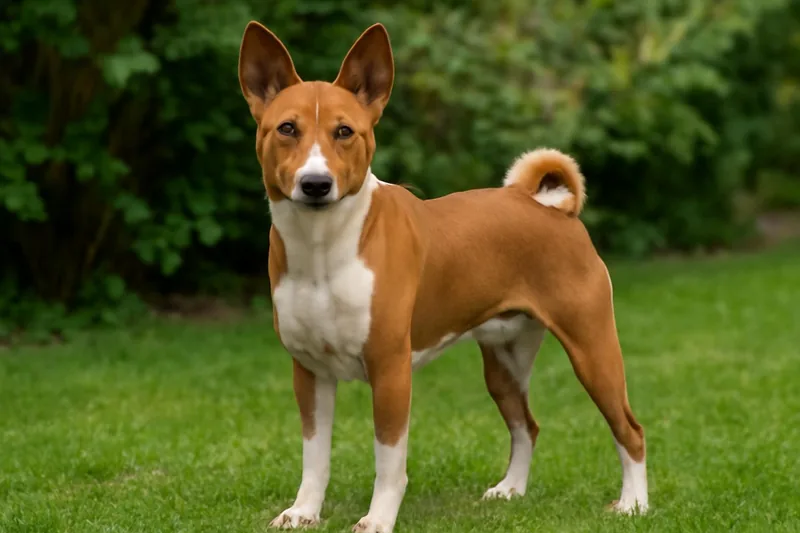
Males stand between 40 and 43 centimetres at the withers; females, between 38 and 41. They're medium-sized dogs with a light, almost ethereal look, a bearing more reminiscent of a greyhound than a conventional companion dog. The body is square and the topline straight, with a chest that isn't especially wide but is notably deep, giving him the stamina to run without tiring. A flat head, moderate stop and, when the dog is alert, forehead wrinkles that appear almost out of nowhere, giving him an unforgettable expression.
Dark hazel, the almond-shaped eyes convey intelligence and a distance that makes you wonder what he's thinking. The ears are small, erect, tilted slightly forward, and pick up any sound before you've even processed it. Curled over the back, the tail forms a single or double ring that never fully unwinds. The coat is short, glossy and lying very close to the body — extremely fine, built for moving through vegetation without catching and for shedding heat easily. Red, black, tricolour (black, tan and white) and brindle are the accepted colours, all with the obligatory white markings on the feet, chest and tail tip.
There's one anatomical trait that sets him apart from any other domestic dog. His larynx has shallow ventricles and vocal cords with a different morphology from the norm, making the typical bark physically impossible for him. He vocalises other ways — howls, rhythmic panting and that guttural sound known as the "baroo", which, if you've never heard it, leaves you quite baffled the first time. His way of moving also stands out. That long, fluid trot seems to cost him nothing, and he can sustain it over considerable distances. On top of that, he grooms himself with an almost cat-like consistency, has practically none of the typical wet-dog smell, and drools very little.
Basenji temperament and behaviour
The Basenji runs on his own agenda. Plain and simple. Generations of solitary hunting have left him with a curious, alert and fairly stubborn temperament, very different from breeds bred to please humans on command. With his family he builds a real but quiet bond: he prefers silent closeness over an exuberant welcome. Around strangers he comes across as cool and reserved; not aggressive, but capable of keeping his distance when someone approaches without tact. That reserve runs deep, a primitive inheritance that acts as a social filter from the very first moment.
That the Basenji doesn't bark is the breed's best-known fact, and it has a specific anatomical explanation. His larynx lacks the deep ventricles that amplify barking in other breeds; the vocal cords are flatter than usual and the epiglottis sits in a position that prevents the explosive vibration characteristic of a conventional bark. He isn't mute, though. He howls, pants rhythmically and produces the famous "baroo", an undulating sound used to convey excitement, loneliness or alertness, and one you need to hear at least once to really get. The origin of all this lies in jungle hunting, where a barking dog scares off prey before it can be caught. The Basenji learned to communicate through visual signals and low-intensity vocalisations, and that pattern has survived to this day almost unchanged.
Living with a Basenji means living with someone who has his own solutions. He opens doors. He finds a way over the fence you thought was tall enough. And if something small darts by nearby, the prey drive switches on with no room for negotiation. Watch out for this: he needs genuine mental stimulation and regular social contact; boredom or prolonged isolation lead to destruction and vocalisations that aren't easy to ignore. A dog selected for centuries to make his own decisions in the field doesn't become an order-follower just because he now lives in a flat.
Life with children and other pets
The Basenji isn't the typical tolerant family dog who puts up with clumsy handling without flinching. His tolerance threshold for physical handling is limited, so living with young children requires constant supervision and two-way training: children need to learn to respect the dog's space and signals, and the dog needs early socialisation teaching him to associate a child's presence with positive experiences. With older children, able to understand and respect his body language, the relationship can be very rewarding, since the Basenji enjoys interactive play and the mental challenges a creative human companion can offer him.
His relationship with other dogs, like the Basset Hound, is variable and depends heavily on socialisation during puppyhood and on managing the environment. Many Basenjis show reactivity toward dogs of the same sex, especially between males, a trait consistent with his heritage as a solitary hunter or one working in small family groups. This doesn't mean they can't live with other dogs at home, but introductions need to be gradual, on neutral ground and supervised. Living with cats can work if the Basenji is raised alongside them from puppyhood and learns to inhibit the chase instinct; even so, any sudden movement from the cat can trigger the prey response, so safe cohabitation should never be taken for granted without careful management.
With small pets like rabbits, guinea pigs or birds, the risk is very high. The Basenji's hunting instinct doesn't distinguish between wild prey and a domestic animal that moves fast or squeals. Even a Basenji who's lived peacefully alongside one for months can react suddenly if the context triggers his hunting sequence. The wisest recommendation is permanent physical separation or, more simply, avoiding coexistence with this type of animal altogether. In households with several pets, resource management (food, toys, resting spots) needs to be especially strict to prevent conflicts over possessiveness, another trait common in the breed.
The Basenji needs to move and think, and that needs taking seriously
The Basenji comes from hunting over long distances, and that past shows. A short walk around the neighbourhood doesn't give him what he needs. Think controlled runs, chase games in enclosed spaces, or dog sports like lure coursing, which taps into his prey drive without him ending up chasing something he shouldn't. When his energy has no outlet, the dog burns it off other ways: he bolts, digs, escapes, puts on a show. Intense daily exercise isn't a bonus, it's the foundation everything else rests on.
And exercise alone isn't enough either. A Basenji who only runs is still a bored Basenji if his mind isn't working. This breed solves problems on his own, and if you don't give him something to occupy himself with, he'll find his own way. Food puzzles, scent games or clicker sessions keep his brain ticking over. Watch the routine: repeating the same circuit or the same game every time switches him off fast. Changing the walking route, hiding the toy somewhere new each week, teaching a different trick every now and then — small variations that make a real difference. A dog like that, with his mind occupied, has far less interest in redesigning the furniture or digging tunnels in the garden.
Speaking of the garden, it needs proper preparation. The Basenji climbs wire fencing, jumps heights that are surprising for his size, and digs with remarkable patience. The minimum fence height is 1.8 metres, ideally with the top angled inward, and if there's soil involved it's worth burying the mesh or adding an underground barrier. Out on the street, always on lead: a very strong prey drive combined with fairly selective obedience makes recall in open spaces unreliable even after years of training. For him to run free without a scare, enclosed dog parks are the only real option.
Basenji health and hereditary diseases
The Basenji is, generally speaking, a sturdy breed with a life expectancy between 12 and 14 years. However, as happens with many breeds with a narrow genetic base, he shows a predisposition to certain hereditary conditions every owner should know about. The most emblematic is Fanconi syndrome, a renal tubular disorder that prevents reabsorption of essential nutrients, causing loss of glucose, amino acids and electrolytes through the urine. Symptoms usually appear in middle age and include a sharp increase in thirst and urination, weight loss and progressive weakness. A genetic test exists that identifies carrier and affected dogs, and responsible breeding has reduced its incidence over recent decades.
Other conditions documented in the breed include progressive retinal atrophy, which leads to gradual vision loss, hip dysplasia, hypothyroidism and umbilical hernias. On the dermatological side, progression from pigmented plaques to invasive, metastatic squamous cell carcinoma associated with two canine papillomaviruses has been documented in two related Basenji dogs ‘Two Canine Papillomaviruses Associated With Metastatic Squamous Cell Carcinoma in…’ (2016). This underlines the importance of watching any pigmented skin lesion that changes appearance and seeing the vet at the slightest sign of growth or ulceration. On the digestive side, Basenji dogs, both asymptomatic and those with chronic diarrhoea, can show hypertrophy of the gastric folds, lymphocytic gastritis and gastric mucosal atrophy; affected dogs may need dietary management and veterinary follow-up ‘Gastroenteritis of basenji dogs’ (1988).
Prevention comes down to choosing a breeder who runs genetic tests and health screenings on their breeding stock, along with keeping a schedule of regular vet check-ups. Screenings should include urine tests to catch early glucose loss linked to Fanconi syndrome, eye exams and abdominal palpation in puppies to rule out hernias. Early detection of any gastric or skin abnormality significantly improves the outlook. This isn't a sickly breed, but it is one that demands an informed, proactive owner when it comes to health care.
Feeding and daily care for the Basenji
The Basenji weighs between 9 and 12 kilos and tends to hold his weight without much effort, provided he gets the movement he needs. Watch out for a sedentary lifestyle, because his light build can be deceiving, and excess calories eventually show. A good diet for this breed prioritises quality animal protein and doesn't overdo fat, two criteria that cover his needs without overloading his metabolism. The daily ration needs adjusting to each dog's weight, age and actual activity level, never trusting a generic figure. And it's best not to leave the bowl full all day. Some individuals eat with genuine anxiety, while others are so picky they'll simply skip meals if the food doesn't appeal to them.
The Basenji's coat takes very little work. It's short, close-lying, and the animal manages to keep himself clean almost entirely on his own, with an almost cat-like consistency. A weekly pass with a rubber grooming glove or a soft-bristle brush removes dead hair and stimulates skin circulation. Bathing can be spaced out quite a bit, only when he's genuinely dirty, using a gentle shampoo that won't disrupt his natural barrier. Where you do need to stay on top of things is the nails. Being such a light animal, he doesn't wear them down well on hard surfaces, and they need trimming every two or three weeks to stop them causing discomfort or affecting his gait.
To round out the routine, teeth and ears. The Basenji builds up tartar easily, so brushing three or four times a week plus dental treats makes a real difference long term against periodontal disease. Being erect, the ears ventilate well, though it's still worth checking them weekly for any sign of infection or a foreign body getting in. And there's something worth knowing from the start. This dog feels the cold. His fine coat and scant subcutaneous fat leave him exposed to wind and low temperatures, so in winter he appreciates a coat for walks and, indoors, needs a warm spot free of draughts.
Training the Basenji: keys to working with him
With the Basenji, forget about automatic obedience from the start. This dog weighs every request and decides whether it's worth his while; plain and simple. For training to work, rewards need to genuinely be worth it: top-quality food, toys that get his brain firing, or tapping into his hunting instinct with a lure. Short sessions always beat long ones, and variety isn't optional. Repeat the same exercise three times in a row and you've already lost his attention. The clicker works very well with this breed. It marks the exact instant the dog gets it right, which helps chain together more complex behaviours without frustration creeping in.
Socialisation can't wait. Between 3 and 16 weeks there's a window that, if not used, costs dearly later. Exposing him to different people, noises, other animals and varied environments during that period is what separates a curious dog from one who reacts badly to any novelty. Recall training starts from day one, yes, but it needs to be clear that no Basenji is 100% reliable off-lead in open space. His prey drive can override any amount of training in seconds. That's why obedience needs to go hand in hand with careful environmental management: a long lead for practising recall safely, serious fencing at home, and double barriers at doors to prevent escapes.
Punishment doesn't work with this breed. Not even the mildest kind. Faced with any coercion, the Basenji responds by cutting off trust or turning defensive, and winning that bond back costs far more than getting it right from the start. The alternative is ignoring what you don't want repeated and giving him something better to do instead: a chew toy if he's going for the furniture, a sit cue with its matching reward if he jumps on visitors. Watch out for this — it sounds simple but demands consistency. When you combine positive reinforcement with activities that make him think every day, that independence so characteristic of the Basenji stops being an obstacle and starts working in your favour.
Anyone who chooses to live with a Basenji knows they won't have a textbook dog. What they will have is an intelligent animal, loyal in his own way, capable of a connection few expected. Before taking the step, look for a breeder who works thoughtfully, prioritising genetic health and temperament over business. And prepare the home before he arrives. Safe spaces, enough stimulation, without leaving that work until the last minute.
IMPORTANT: This article is for informational purposes only and does not constitute veterinary, nutritional or behavioural advice. Every dog is different, and only your trusted vet can advise you on its specific needs.