 Care
Care
Causes of Red Eyes in Dogs
There are different circumstances in which we might see our dog's eyes turn red, and several causes can explain this redness. Some have no clinical relevance, while others are serious disorders that can lead to blindness.
Once we've ruled out the harmless ones, any doubt about our dog's eye health should be resolved by the vet. With eye conditions, starting treatment early is very important to avoid complications. Let's look at the most common causes.
Conjunctivitis, One of the Main Causes
Conjunctivitis, also known as red eye, is the first cause that comes to mind when explaining red eyes in a dog. It involves inflammation of the eye's conjunctiva and is a very common disorder.
There are several causes of conjunctivitis, such as allergies, contact with irritating substances, certain systemic diseases like distemper, or, if it only affects one eye, foreign bodies or a hair growing and rubbing against the eye. It's worth knowing that there are different types of conjunctivitis depending on the clinical picture present.
These are serous, follicular or mucoid, and purulent conjunctivitis. Treatment should be prescribed by the vet after diagnosis. The symptoms generally characterizing conjunctivitis are the following:
- Redness in one or both eyes, since conjunctivitis can be unilateral or bilateral.
- Serous, mucoid, or purulent discharge. Thick discharge can form crusts on the eyelids.
- Absence of pain, which is a very important detail when telling conjunctivitis apart from other eye conditions.
- In allergic conjunctivitis, there's itching, and the dog will rub its eyes and face.
Uveitis Also Causes Red Eyes
This condition is also known as soft eye. It's caused by inflammation of certain eye structures, such as the iris, which controls pupil size, and the ciliary body, which produces aqueous humor and controls pressure inside the eye.
There are several causes of uveitis, such as bacterial infections, systemic diseases, corneal ulcers, etc. It's essential to see the vet. This is a serious condition, and delaying treatment could result in blindness or other serious complications. Its symptoms are the following:
- Pain.
- Red eye.
- Tearing.
- Strabismus (crossed eyes).
- Photophobia, meaning intolerance to light.
- Protrusion of the third eyelid.
- Cloudiness in the eye.
- Sometimes, a soft eye to the touch.
Changes to the Third Eyelid or Nictitating Membrane
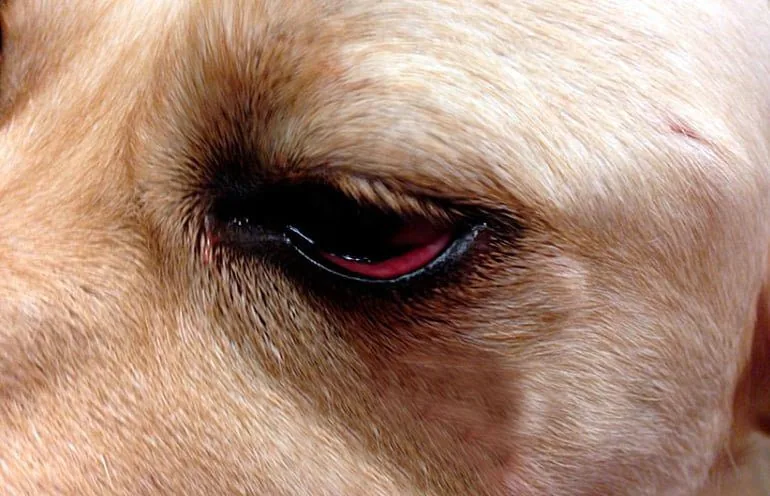
Also known as the nictitating membrane, it serves important functions in dogs. It's located at the inner corner of the eye. It's normally not visible, but in certain situations it extends and partially or fully covers the eye's surface.
When prolapsed, it can give the impression that the eyeball has rolled back inside its socket. This effect can also happen while the dog is sleeping, making it look like the eyes are rolled back. An example of this membrane's function is when a foreign body enters the eye.
In these cases, the third eyelid can extend or protrude in an attempt to protect the eye. Besides the protruding membrane, other symptoms can appear, such as tearing, blinking, strabismus, or itching. Protrusion of the nictitating membrane is a reason to see the vet.
Ectropion
This condition involves the lower eyelid turning outward, causing it to separate from the surface of the eye. As a result, a red area becomes visible between the two.
This eversion of the eyelid leaves the eye unprotected, exposed to any irritating agent. Over time, dogs with ectropion can develop chronic conjunctivitis or corneal damage. This problem is more common in dogs with loose facial skin, such as Spaniel or Hound-type breeds.
It's also more common in older dogs that have lost tone in this facial skin. Unless it causes no associated condition at all, the vet should perform surgical repair.
What Is Cherry Eye in Dogs?
This is the prolapse of the tear gland of the third eyelid. It appears when the supporting structures inside the third eyelid are weak, leaving the tear gland exposed. With the naked eye, we'll see a reddish, cherry-like lump, hence its name. It's also known as canthus prolapse.
The problem is it ends up rubbing against the eye's surface, which can lead to conjunctivitis. The most common treatment nowadays involves repositioning both the gland and the eyelid through surgery.
Care for Red Eyes in Dogs
The mildest cases of red eyes in dogs, such as some types of conjunctivitis, can be resolved at home by keeping the eye clean, washing it with gauze soaked in saline solution. We can repeat this several times a day.
But if the condition doesn't improve within a day or two and the discharge and discomfort increase, we need to see the vet. We should never apply medication to the eye on our own, even eye drops or an ophthalmic cream we've used before.
Spotting a foreign body in the eye, the eye not opening normally, prolapsing, or, on the contrary, looking smaller, blood, changes in color, swelling, or any systemic symptom is an emergency requiring prompt veterinary attention.
Bibliography Carlson and Giffin. 2002. Manual práctico de veterinaria canina. Madrid. Editorial el Drac.
IMPORTANT: This article is for informational purposes only and does not constitute veterinary, nutritional or behavioural advice. Every dog is different, and only your trusted vet can advise you on its specific needs.