 Breeds
Cavalier King Charles Spaniel
Mitral valve disease affects almost every Cavalier King Charles Spaniel from age 10 onward. Learn to look after his heart with the right diet and exercise.
Behind his sweet expression and silky coat lies a dog requiring constant vet monitoring and a diet designed to protect his heart.
Even so, his affable temperament and adaptability to family life make him an irresistible choice for anyone who understands his needs well.
Breed history
The Cavalier King Charles Spaniel's origin goes back to the companion dogs of 17th-century British nobility, especially during the reign of Charles II, who felt genuine devotion for these small spaniels. They were so common at court that the king himself allowed their presence anywhere, including Parliament.
Over the centuries, the breed was shaped through crosses with flatter-faced individuals, giving rise to the short-muzzled King Charles Spaniel we know today. In the early 20th century, however, a group of breeders set out to recover the original type — longer muzzle, less domed skull — as it appeared in Van Dyck's paintings.
Unlike the Cocker Spaniel, selected for hunting, the Cavalier never lost his essence as a lapdog. The breed was officially recognised by the British Kennel Club in 1945 and today is one of the most popular in homes across Europe.
Physical appearance and difference from the King Charles Spaniel
The most obvious difference between the two breeds is in the head. The Cavalier shows an almost flat skull between the ears, a muzzle of moderate length — around 3.8 cm — and a subtle stop. The King Charles Spaniel, by contrast, shows a domed skull, a very short muzzle and a pronounced stop, the result of influence from brachycephalic breeds like the Pekingese.
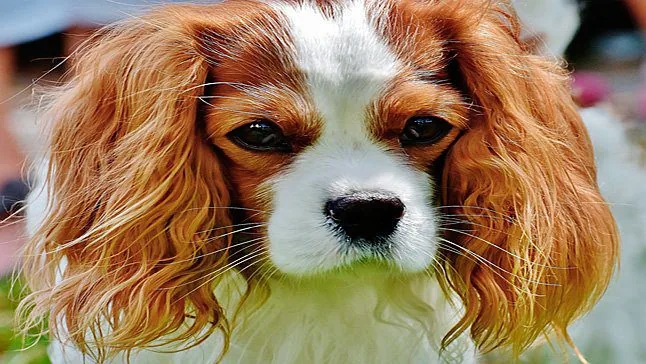
The Cavalier has a sweet, intelligent expression, with large, dark eyes conveying a warm, lively look. His compact size — never exceeding 33 cm at the withers — and his medium-length, silky coat complete an elegant silhouette without fragility.
Compared to the Clumber Spaniel, much sturdier and heavier, the Cavalier is a light, well-proportioned dog, built for companionship rather than physical work.
Structure and proportions
The breed standard describes a dog slightly longer than tall, with a body length exceeding the height at the withers by around 10%. Ideal height sits between 30 and 33 cm and weight ranges between 5.4 and 8.2 kg, with males somewhat sturdier than females.
The head is one of the most characteristic parts: the flat skull, the long ears well covered in hair, and the muzzle measuring at least 3.8 cm from the stop to the tip of the nose. The neck is medium-length, slightly arched, and blends into a moderately deep chest.
The legs are straight with moderate bone, while the tail is carried cheerfully but without curling over the back. These proportions give him agile, easy movement with no apparent effort.
Temperament and character
The Cavalier King Charles Spaniel has a very balanced temperament: affectionate without being clingy, playful without being hyperactive, and calm without tipping into apathy. His low aggression makes him an ideal companion for families with children and elderly people.
Although the Japanese Spaniel shares his origin as a companion dog, the Cavalier is even more dependent on human interaction. He needs daily contact with his family and doesn't handle prolonged solitude well; he can develop separation anxiety if left alone for many hours.
He isn't a guard dog and won't show wariness toward strangers. His friendly attitude with other dogs and animals makes living together easier in homes with several pets. Early socialisation remains key so this natural temperament expresses itself with no fear or insecurity.
Hereditary health problems
Mitral valve disease is the breed's main health concern. It involves progressive degeneration of the valve separating the left atrium and ventricle, causing a heart murmur that can lead to congestive heart failure. The first signs usually appear from age 5-6, and most Cavaliers develop some degree of the condition before turning 10.
Another serious condition is syringomyelia, a neurological disease caused by a malformation at the base of the skull that compresses the spinal cord. It causes intense pain, neck sensitivity and the characteristic "phantom scratching" with no contact with the skin. Patellar luxation and hip dysplasia also show up in some lines, as do eye problems like cataracts and progressive retinal atrophy.
Cavalier King Charles Spaniels are among the breeds at highest risk of chronic pancreatitis, according to a post-mortem study in first-opinion dogs.
According to Prevalence and breed distribution of chronic pancreatitis at post-mortem examination in first-opinion dogs (2007), this breed shows a significantly higher prevalence of chronic pancreatitis compared to others. Symptoms include intermittent vomiting, abdominal pain and loss of appetite, so any digestive disturbance deserves a vet visit.
Proper diet for a healthy heart and silky coat
A diet rich in omega-3 fatty acids — found in oily fish, salmon oil or specific supplements — helps reduce inflammation and supports cardiovascular health. These nutrients also show in a glossy coat and healthy skin, two highly recognisable traits in the breed.
Kibble size is another factor many owners overlook. Given his moderately short muzzle, the Cavalier handles small-kibble formulas better, chewing them effortlessly and digesting them more easily. Opting for formulas specific to mini or toy breeds reduces choking risk and supports proper dental hygiene.
It's worth avoiding high-calorie treats and controlling portions precisely, since excess weight directly worsens mitral valve disease. A Cavalier at his ideal weight won't just live longer — he'll have a better quality of life during his senior years.
Moderate exercise and weight control
The Cavalier doesn't need intense exercise, but he does need daily walks of at least 30 minutes at a brisk pace. That moderate pace stimulates circulation without straining a potentially delicate heart. Explosive runs, repeated jumping or very long play sessions aren't advisable.
MONTHLY WEIGHT CHECKA gain of just 500 grams can worsen heart failure. Use a kitchen scale to weigh your Cavalier every month and adjust his ration if needed.
While the American Cocker Spaniel enjoys more intense play sessions, the Cavalier benefits from calm, consistent activity. Excess weight, besides overloading the joints, increases pressure on the heart and speeds up the progression of mitral valve disease.
On hot days, walks should happen early or late in the day, since his tolerance to high temperatures is limited. A harness instead of a collar reduces pressure on the trachea and prevents discomfort in dogs with syringomyelia.
Daily grooming: brushing and ear cleaning
The Cavalier's silky coat tends to tangle easily, especially behind the ears and on the legs. Brushing with a long-pin metal comb every 1-2 days removes dead hair, undoes incipient tangles and maintains the coat's natural shine.
The long, drooping ears create a damp, dark environment favouring bacterial and yeast growth. Weekly cleaning with an ear solution recommended by the vet is the most effective measure to prevent otitis and recurring infections.
- Apply the cleaning solution into the ear canal without inserting the applicator deeply.
- Massage the base of the ear for 20-30 seconds so the liquid carries the dirt out.
- Remove the excess with a clean gauze; never use cotton swabs, which push wax further inward.
Bathing can happen every 4-6 weeks with a gentle shampoo respecting skin pH. Pay special attention to drying the ears and the spaces between the toes, since residual moisture is the main cause of dermatological problems in the breed.
In Spain, the price of a Cavalier King Charles Spaniel puppy with pedigree and health guarantees ranges between €1,000 and €2,000, depending on the breeder's reputation and whether the parents have been tested for heart disease and syringomyelia. Be wary of offers below €800: they usually hide mass breeding or a lack of vet checks.
A good breeder will readily show you the parents' cardiac ultrasounds and MRI scans, let you meet the mother, and hand over the puppy at at least 12 weeks old, vaccinated and dewormed. Adopting a Cavalier is a commitment going well beyond the purchase price: cardiac and neurological care needs to be planned from day one.
IMPORTANT: This article is for informational purposes only and does not constitute veterinary, nutritional or behavioural advice. Every dog is different, and only your trusted vet can advise you on its specific needs.