 Breeds
Sicilian Greyhound: Characteristics, Care and Temperament
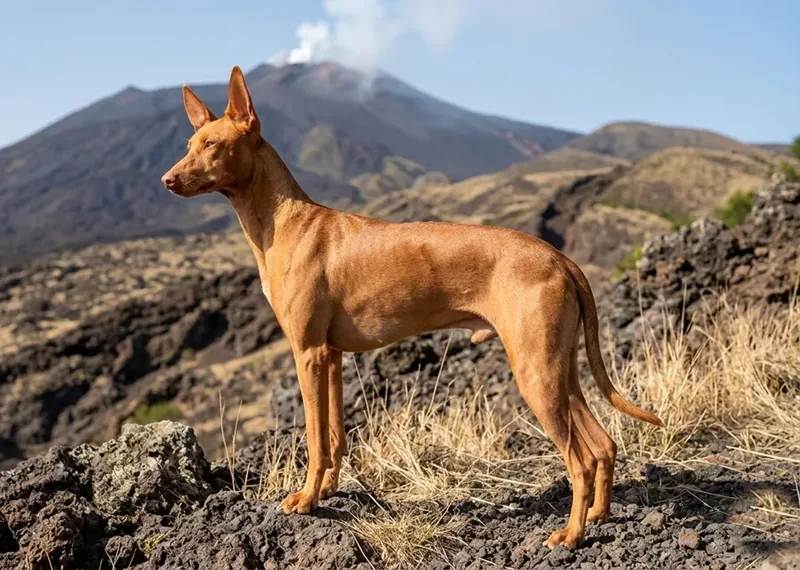
Discover the Cirneco dell'Etna, a primitive-type dog who has hunted for centuries on the slopes of the Sicilian volcano without human selection altering his essence. This article explores how nature, not aesthetic whim, sculpted a dog of extreme endurance, adapted to the Mediterranean climate with remarkable resilience.
Three thousand years of history at the foot of Etna
Few breeds have a past you can trace on coins. The Cirneco dell'Etna is one of them. His profile appears minted on pieces from pre-Roman Sicily and carved into reliefs more than two and a half thousand years old, making him one of the most historically documented dogs in the Mediterranean. The hypothesis with the most backing among specialists points to descent from the sighthounds of ancient Egypt, spread along maritime trade routes by Phoenician merchants until some individuals reached the slopes of Europe's tallest volcano. But that's where the story diverges. While other sighthounds of antiquity were shaped in controlled settings, among noble hunters and breeders with an eye for looks, the Cirneco was left loose on one of the continent's harshest terrains. The selection wasn't human. It was the landscape itself that decided which dogs carried on.
The slopes of Etna functioned for centuries as a laboratory with no agenda of its own. Volcanic isolation kept the breed away from crosses with other bloodlines and forced every generation to fight the same obstacles. Hunting rabbits and hares over lava flows where the ground cuts, the heat crushes and water runs short. Sicilian farmers bred the Cirneco because he worked where other dogs couldn't, and that was reason enough. From continuous work in that environment came a very specific anatomy. Thin skin capable of withstanding the scrape of volcanic rock, a thermoregulation capacity that surprises vets studying the breed for the first time, and hearing so precise the dog can locate prey hidden among rocks without needing to see it. None of that was designed. It happened.
In the early 20th century, with foreign breeds gaining ground across Europe, a group of Sicilian breeders decided that dog couldn't be allowed to disappear. They launched a recovery programme that led to official recognition by Italian cynology and, later, classification by the Fédération Cynologique Internationale (FCI) within Group 5, Section 7, reserved for primitive-type breeds with an active hunting function. The standard drawn up then wasn't looking to exaggerate anything. It documented what the dog already was, preserving the harmony of an athlete built to perform under extreme conditions. No anatomical hyperbole, no concessions to the show ring.
Official breed standard according to the FCI
The Cirneco dell'Etna is a slender dog, with long lines and a light build. Males stand between 46 and 50 cm at the withers; females fall between 42 and 46 cm. As for weight, males run around 10-12 kg and females 8-10 kg. At first glance that leanness can be deceiving, because under the thin skin lies dry, compact muscle, far more than the silhouette suggests. That ratio between weight and power is what lets him jump over volcanic stone walls or change direction at full speed without wrecking a joint.
The head is oval and the stop is barely marked, giving an expression that's always alert, that of a dog who works with every sense tuned in. The ears matter a great deal here. Erect, broad at the base with rigid cartilage, they point forward and pick up the rustle of prey in dry scrub before the eye locates it. The eyes are small, ochre or amber, with a fixed gaze that has nothing sweet about it. The standard penalises any trait that brings the Cirneco closer to a modern racing sighthound, whether the English Greyhound or the Whippet, because his primitive typicity is exactly what sets him apart from those breeds; if you want to compare builds, you can also check out the Italian Greyhound.
There are two recognised coat varieties. The most common is short, smooth hair over the whole body; the other allows a semi-long coat with slight feathering on the tail and thighs. Colours range through every shade of fawn — from pale sand to deep red — to pure white or fawn combined with white on the chest, tail tip and toes. Black, tan and brindle have no place in the standard. The tail, set low and sickle-shaped, finishes off a silhouette that in motion looks as if it were drawn with a compass across the lava landscape.
Physique: a body built for the volcano
The Cirneco dell'Etna's speed has little in common with a Greyhound's, even though both are lightly built dogs. The Greyhound is built for sprinting down long straights; the Cirneco, for reacting fast, turning in a tight space and staying steady on rough ground. The narrower chest and moderately arched rib cage let him change direction without losing his balance. The angulation of the shoulder blade and the length of the forearm give him a springy trot that burns little energy. And the feet, with arched toes and thick keratin pads, are built for Etna's solidified lava, terrain that would wear down the paws of many other dogs.
The skin deserves separate attention. Extremely thin and closely adhered to the body, it has almost no subcutaneous fat, which helps him dissipate heat during hours of hunting under the Sicilian sun. The large, erect ears, densely supplied with surface capillaries, act as small radiators as well as amplifying sound. He copes well with heat. Damp cold is another story, and in continental winters he needs extra protection.
The lumbar vertebrae are slightly longer than in most dogs his size. That anatomical detail, invisible to the naked eye, has huge consequences when the animal runs at full pace. While galloping, the hind legs momentarily overtake the front ones at the point of maximum extension, doubling the effective stride length without increasing energy expenditure. Muscle mass concentrated in the hindquarters and a low centre of gravity keep vertical bounce to a near minimum. That's why many individuals seem to float while galloping. Almost every ounce of push converts into horizontal advance.
Temperament: independent, but not at all difficult
Anyone coming to this breed expecting a dog who obeys on the first try and seeks cuddles from any stranger is in for a surprise. The Cirneco has spent centuries hunting alone, or in small packs, with nobody giving him instructions of any kind. That leaves a mark. He doesn't expect anyone to tell him what to do — he reads the situation, weighs it up and acts. Some first-timers read that as stubbornness, when in reality it's a very finely tuned functional intelligence that simply doesn't execute what it doesn't understand.
With family, things are different. He isn't the type who throws himself at the first person through the door, but once he forms a bond, the loyalty is solid and the communication constant. It's worth learning to read his body language. The position of his ears, how he tilts his head, the fixedness of his gaze — all of that reflects his emotional state fairly precisely. And he barks a lot less than people expect. He communicates through posture and quiet sounds, well below what you'd expect from a dog, which means a flat isn't out of the question, provided he gets the exercise he needs.
In behavioural terms, this profile is known as neophilic but cautious. He's drawn to anything unfamiliar, but approaches with a very measured caution that, seen from outside, can come across as fear. Think of how he'd approach a burrow he doesn't know is occupied. Sniffing, pulling back if something doesn't add up, acting only once there's enough information. Forcing that process during socialisation is the most direct route to insecurities that later turn into avoidance behaviour. Give him that margin, and he repays it with enthusiastic cooperation. No pressure or punishment needed.
Socialisation and life together: interaction with children and other pets
The Cirneco dell'Etna needs to get to know the world gradually. From eight weeks, the puppy needs contact with people, noises, different surfaces and varied environments, but always at a pace that lets him process each experience without becoming overwhelmed. He usually does well with children, as long as adults set some basic rules from the start. This dog handles sudden shouting, unexpected running or being grabbed at the wrong moment poorly, because his nervous system is highly reactive and any of those stimuli can trigger an alarm response. Teaching children to approach calmly and respect his rest periods is the foundation of a relationship that lasts for years without setbacks.
With other dogs he handles himself with balance if he's had proper socialisation during the first months. His heritage as a pack hunter means he understands canine appeasement signals and rarely looks for conflict. Watch out, though, with pairing him with very high-energy breeds or ones fond of intense physical play — his light build and thin skin leave him exposed to accidental injury during a scuffle. With cats and small animals, assessment needs to be individual. Many learn to tell the family's animals apart from what they consider potential prey, but the chase instinct is very strong, and a sudden, unexpected movement can trigger it, especially outside the home environment.
On walks, keep in mind that even a well-trained individual can bolt after a rabbit, a hare or a stray cat if the stimulus appears without warning. That behaviour carries thousands of years of functional selection behind it, and when it kicks in, obedience takes a back seat. The solution lies in channelling that instinct, not suppressing it. Tracking games, controlled chase with lures, walks on a long lead in traffic-free areas. From puppyhood, working on recall with extremely high-value rewards — wet food, toys that move erratically — is a time investment that separates a relaxed walk from a risky situation.
How to train a Cirneco dell'Etna without losing patience
Forget about repeating commands until you're exhausted. The Cirneco dell'Etna has operational intelligence and associative memory well above average, but the way he processes things has nothing to do with a Border Collie's or a Labrador's. He learns fast when something delivers value to him — pleasure, usefulness, reward — and switches off completely when he sees no point in what you're asking. Verbal scolding, seemingly harmless, can trigger an emotional shutdown that leaves the dog closed off. And once there, winning back his attention costs twice as much as setting things up properly from the start.
The system that works with this breed rests on differential positive reinforcement. Thoroughly rewarding the behaviours you want — with whatever genuinely motivates him, which is often a quick tug-of-war game or a short chase rather than a treat — and actively ignoring the ones you don't, redirecting toward something incompatible instead. If he jumps up to say hello, don't scold him: ask for a sit and reward that. That way he grasps the logic, not just the consequence. The Cirneco needs to understand the why behind every rule, and when you go head to head with him directly, his innate determination means he always ends up winning.
Short, varied sessions with a clear ending. Ten well-structured minutes four times a day get more out of him than an hour of repetitive drills that end up boring a dog bred to solve changing situations out in the field. Cognitive enrichment helps a lot too: snuffle mats, interactive toys, boxes with hidden treats. Watch out for this, because a Cirneco with no independent mental activity finds his own solutions, and they usually involve chewing what he shouldn't or barking non-stop.
Planning the Cirneco dell'Etna's daily physical training
Designing a Cirneco dell'Etna's routine requires being clear about what kind of dog you're working with: an endurance athlete with explosive bursts who needs progressive conditioning built from several angles at once. Practice bears this out. What works is three combined blocks of training: long trots of twenty to thirty minutes at a steady pace — on dirt or grass, since asphalt punishes the joints more than it seems to; short sprints in fenced areas chasing a ball or a lure, to wake up the fast-twitch muscle fibres that a gentle trot doesn't engage; and proprioception work, the part most often overlooked: walking over stones or uneven surfaces, weaving between cones, gentle slopes up and down. Without this last piece, the stabilising muscles don't get worked, and injuries arrive sooner.
The Cirneco carries fewer conditions than other sighthounds, something linked to his primitive origin and to the fact his selection was never as focused on looks as in other breeds. But that doesn't erase the risks. A frameshift variant in the AMPD2 gene has been identified in dogs of this breed causing retinal degeneration and tremors, as reported in ‘Frameshift Variant in AMPD2 in Cirneco dell'Etna Dogs with Retinopathy and…’ (2024); you might also be interested in the Spanish Greyhound. The condition is uncommon, but it justifies demanding genetic testing in breeding stock and regular eye exams. On top of that comes sensitivity to certain anaesthetics — common in breeds with so little body fat — and skin injuries, since his thin skin pays the price for charging into scrub without a second thought. Managing body condition, avoiding jumps from height in puppies and handling exercise sensibly are the three main levers for prevention.
Rest carries as much weight in training as active sessions. After intense work, the Cirneco needs to recover somewhere warm and quiet; his thermal insulation is minimal, and if he stays still in a cold environment his muscles suffer quickly. Building in one or two days a week of gentle activity — walks with generous time for sniffing — lets the tissues repair without rushing. Overtraining is more common than it seems, especially among very hands-on owners who unknowingly build up chronic physical stress in the dog; the joint consequences arrive, and sooner than you'd expect. The most reliable sign that something's off is the dog himself: if he loses interest in play, falls behind on the walk or seeks rest earlier than usual, it's time to lower the intensity.
The daily routine: diet, hygiene and environment
The Cirneco has a relatively active metabolism and very little body fat, which calls for careful thought about diet. Quality kibble, with animal protein topping the ingredient list and a good proportion of healthy fats, usually covers the dog's needs if the ration is adjusted to his actual activity level. During periods of more exercise it can help to increase calorie density or add omega-3 fatty acids, which protect the joints and keep the skin in good condition. Two meals a day instead of one avoid the blood sugar dips that some very active individuals can experience if they go too many hours without eating. On breeding, a fourteen-year retrospective study carried out in Sicily recorded that the average age of females at their first whelping was 39.13 ± 21.7 months ‘A retrospective study on whelping seasonality of the Cirneco dell'Etna dog…’ (2024), which speaks for itself about a breed with slow maturity, where breeding too early has real consequences for the health of both the female and the puppies.
The short coat and balanced-pH skin make maintaining a Cirneco fairly manageable. A weekly pass with a rubber grooming glove to remove dead hair and stimulate circulation, and little more. Baths should be reserved for when there's genuinely visible dirt, since frequent soaping breaks down the skin's lipid barrier and opens the door to dermatitis. The ears do need more attention. Their erect shape and constant exposure to wind and dust mean they build up dirt in the flap easily, so checking them every few days and cleaning with gauze dampened in a specific solution when excess wax appears is part of the regular routine. Watch the nails too. A dog who runs on soft surfaces doesn't wear them down naturally, and if they grow too long, paw placement changes and the metacarpal joints end up paying the price.
This dog needs warmth, vantage points and a soft corner to retreat to. His primitive instinct drives him to seek out elevated spots from which to watch over his surroundings, so a bed by a window or safe access to a sunny terrace is something he'll take advantage of whenever he can. In winter, the Cirneco's physiology simply isn't equipped to retain heat in cold environments; blankets, a heated bed and a coat for walks stop being a luxury and become part of the basic kit. In summer, by contrast, he'll seek out the coolest spots in the house and lie on tiled or marble floors the moment he gets the chance. Attending to those temperature and height preferences is part of this dog's wellbeing, and it shows in how balanced and bonded he is with his family.
Living with a Cirneco dell'Etna means understanding that his affection works differently from other breeds'. He's a dog who chooses to cooperate when treated with respect and patience; trying to manage him with commands alone usually hits a wall. Anyone thinking about taking the step of living with one should visit breeders working with genetically tested lines and spend time observing adult dogs in their usual environment before making any decision.
IMPORTANT: This article is for informational purposes only and does not constitute veterinary, nutritional or behavioural advice. Every dog is different, and only your trusted vet can advise you on its specific needs.