 Nutrition
Dog Biscuits
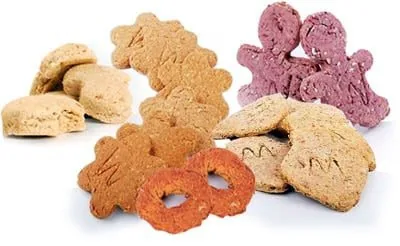
Dog biscuits are one of the most widely used everyday treats, but not all of them are equally safe or equally useful. Knowing what's in them, how many to give and when to bake your own makes the difference between a snack that looks after your dog and one that harms them.
What Is a Reward, and What Does Rewarding a Dog Involve?
A reward is anything the dog values — food, a toy, strokes — given immediately after a desired behaviour. In ethology this is called positive reinforcement: the reward increases the likelihood the dog will repeat that action. It is not a whim, but a clear communication tool.
The most common confusion is mixing up reward with bribery. A bribe is offered before the behaviour, to avoid something we don't want. A reward is given after the dog does what we asked. This difference is key for the animal to understand exactly which behaviour we are reinforcing.
In the early stages of training it is usual to reward every success to establish the behaviour. As the dog takes it on board, reinforcement is spaced out and alternated with other kinds of reward. This keeps motivation up without creating dependence on food.
Rewarding with biscuits with no clear purpose is not training: it is feeding without any criteria. A genuine reward for a dog shows them what they did right and why they deserve it. Without that link between behaviour and reward, the treat loses its educational function.
Are Dog Biscuits a Healthy Food?
Dog biscuits are not a complete food, but an occasional snack. Their real nutritional value depends almost entirely on the ingredients they are made with.
Commercial versions usually include refined flour, added sugar, low-quality fat and additives. These ingredients provide empty calories that barely benefit the animal's health. To assess them, look at the first three ingredients on the list: if they are grains or sugars, the product is more of a treat than a functional snack.
Home-made biscuits let you control every component. With oats, pumpkin or apple you get fibre and vitamins, but always as a complement, never as the basis of the diet. The amount should stay within the 10% limit of the total daily ration.
Signs that a biscuit does not agree with a dog include soft stools, vomiting, skin itching or progressive weight gain. If any of these symptoms appear, check the composition and consult the vet before carrying on giving them.
Toxic Ingredients in Commercial Biscuits: A Visual Guide to Protecting Your Dog
Xylitol is the most dangerous. It appears in "sugar-free" biscuits as a sweetener, and in dogs it triggers a massive insulin release that causes hypoglycaemia within less than an hour. Symptoms include weakness, tremors and collapse. Look for it on the label as "xylitol", "E-967" or "birch sugar".
The preservatives BHA and BHT are added to extend the shelf life of cheap biscuits. The International Agency for Research on Cancer classes them as possible carcinogens. On the ingredient list they appear as "butylated hydroxyanisole" or "butylated hydroxytoluene". Avoid any product listing them among the first ingredients.
Propylene glycol is used to keep semi-moist biscuits soft. In dogs it can cause digestive irritation and, at high doses, affect the nervous system. Look for it as "propylene glycol", "E-1520" or "1,2-propanediol". Premium brands tend to replace it with vegetable glycerine.
Artificial colourings such as Red 40, Yellow 5 or Blue 1 provide no nutritional benefit and are linked to skin allergic reactions in some dogs. Spot them by their "E" code (E-129, E-102, E-133) or names like "tartrazine". Very brightly coloured biscuits usually contain them.
Excess salt is a silent problem: many biscuits use it as a preservative and flavour enhancer. High intake can overload the kidneys and raise blood pressure. On the label it appears as "salt", "sodium chloride" or "sodium".
If you suspect any poisoning — vomiting, diarrhoea, lethargy or tremors — remove the treat immediately and contact your vet. Always bring the packaging or a photo of the ingredient list to help with diagnosis. Quick rule: if you don't recognise more than three ingredients, that product is not safe.
To avoid overfeeding your dog, the number of biscuits should be matched to their weight and activity level. The figures below are based on biscuits the size of a 2 € coin, baked with basic ingredients (wholemeal flour, egg, unsalted stock), and respect the 10% daily ration limit.
1 – 5 kg: 1 biscuit a day if sedentary, 2 if active.
5 – 10 kg: 2 biscuits a day if sedentary, 3 if active.
10 – 20 kg: 3 biscuits a day if sedentary, 4 if active.
20 – 30 kg: 4 biscuits a day if sedentary, 5 if active.
30 – 40 kg or more: 5 biscuits a day if sedentary, 6 if active.
A dog who runs or plays for more than an hour a day can safely have the higher figure in the range. If your dog tends to gain weight, always stick to the lower figure. Deduct the biscuits' energy from their kibble ration to keep the calorie balance right.
Keep a weekly weight log and feel their ribs: if you notice them being covered by fat, halve the amount for a few days. If in any doubt about the right ration, check with your vet.
How to Adapt Any Home-Made Recipe to Special Needs: Allergies, Seniors, Puppies and Brachycephalics
Generic home-made biscuit recipes usually ignore each dog's particular needs. Adapting the ingredients and texture makes the difference between a safe treat and one that could cause upset.
For dogs with food allergies, the first step is identifying the allergen. If the problem is chicken, replace it with turkey or lamb as the protein source. If the intolerance is to wheat, swap the flour for oat or rice flour, which is better tolerated and has more soluble fibre. Introduce only one new ingredient at a time to spot possible reactions.
In senior dogs, the priority is ease of chewing and a low-fat profile. To get a soft texture, add unsalted, onion-free stock or pumpkin purée to the dough. Use lean meats such as turkey breast and avoid added oils to look after their weight and digestion.
For puppies, the texture should be very soft and the size small, about the width of their muzzle. Use hypoallergenic ingredients such as oat flour and pumpkin and bake for less time so they stay tender. Their digestive system is more sensitive, so portions should be especially small.
Brachycephalic breeds (bulldog, pug, boxer) need biscuits shaped and sized to minimise the risk of choking. Go for large, flat biscuits, at least 4 cm across, that force them to bite rather than swallow whole. Avoid small round or elongated shapes that slip down easily.
If you have any doubts about allergies, conditions or specific needs, check with the vet before baking.
Cost-Benefit Analysis: Baking at Home vs Buying Premium Brands
Comparing only the price per gram gives an incomplete picture. The choice between baking at home or buying premium brands means weighing up ingredients, shelf life and control over what the dog eats.
The cost per 100 g of home-made biscuits is usually noticeably lower than premium brands, especially if you use basic ingredients such as wholemeal flour, eggs and pumpkin. The saving shrinks if you use high-quality protein or special flours for allergy sufferers.
Preparation time is the main drawback of the home-made option: mixing, baking and cooling can take between 30 and 60 minutes per batch. Premium brands offer guaranteed quality with no effort, but often include preservatives that extend their shelf life up to 12 months.
Home-made biscuits keep well in the fridge for up to two weeks and up to 3 months in the freezer. Premium ones, being dehydrated or treated, last for months in the pantry. Shelf life shapes how often you need to bake and the risk of them spoiling if not eaten in time.
A cheap premium biscuit may contain filler grains and sugars; home-made lets you control every ingredient and avoid unnecessary additives. If the dog has allergies or specific needs, the home-made option wins on personalisation. For dogs with no restrictions, a premium brand with a clean label can be more practical without sacrificing quality.
Safety Checklist for Baking and Storing Dog Biscuits (Vet-Backed)
Most home-made recipes lack food safety protocols. These points fill that gap to avoid unnecessary risks.
Before baking: check that no ingredient is toxic to dogs (no grapes, raisins, onion, garlic, chocolate or macadamia). Use clean utensils and disinfected surfaces to avoid cross-contamination.
While baking: always bake at a temperature that guarantees thorough cooking, around 180°C, for the time stated in the recipe. If the dough is still raw inside, leave them in longer before taking them out of the oven.
When cooling: let the biscuits cool completely on a rack before storing them. If stored warm, condensation builds up moisture and encourages mould.
For storage: use airtight containers in a cool, dry place. Write the baking date on the container. In the fridge they keep well for up to two weeks; in the freezer, wrapped in baking paper inside an airtight bag, up to three months.
Before each use: check the biscuits for visible mould, a rancid smell or changes in texture (soft or sticky). If you spot any of these signs, throw them away immediately without giving them to the dog.
If the dog has any condition (kidney failure, diabetes, diagnosed allergies), check with the vet which ingredients to avoid before preparing any recipe.
What Different Rewards Can We Use?
Biscuits are not the only option for rewarding a dog. Depending on the context and level of distraction, it is worth varying the type of reward to keep motivation up.
Safe fresh fruit and vegetables such as raw carrot, seedless apple pieces, cooked green beans or blueberries are low-calorie rewards rich in vitamins. They are ideal for training at home or low-intensity exercises where high motivation is not needed.
High-value snacks such as small portions of unsalted cooked chicken, dehydrated liver or low-fat fresh cheese grab the dog's attention in highly distracting situations, such as a park with other dogs, or when introducing new commands.
Commercial snacks made specifically for dogs are fine as long as the label shows simple ingredients and a single type of protein. They are especially useful when there is no time to cook or chop up fruit. Check with the vet if your dog has allergies before trying a new brand.
Dispensing toys such as a Kong filled with natural pâté or sugar-free yoghurt turn the reward into a problem-solving game. They are useful for keeping the dog entertained, channelling their energy at stressful moments, or stretching out reward time without giving them a large amount of calories all at once.
Non-food rewards — strokes, play with a favourite toy or a sniffing session — also reinforce behaviour and add not a single calorie. Combining them with food rewards stops the dog only responding when they smell food in your hand.
IMPORTANT: This article is for informational purposes only and does not constitute veterinary, nutritional or behavioural advice. Every dog is different, and only your trusted vet can advise you on its specific needs.