 Care
Care
How Good Is a Dog’s Sense of Smell?
Without a doubt, a dog's most developed and distinctive sense, compared to ours, is its exceptional sense of smell. This trait is due to the particularities of its nasal region, with millions of scent receptors.
This extraordinary ability has allowed close collaboration with humans in many important tasks since the beginning of domestication, like detecting explosives, illegal substances, or even illnesses. Want to know all the secrets of their sense of smell? Let's dive in.
A Dog's Nose
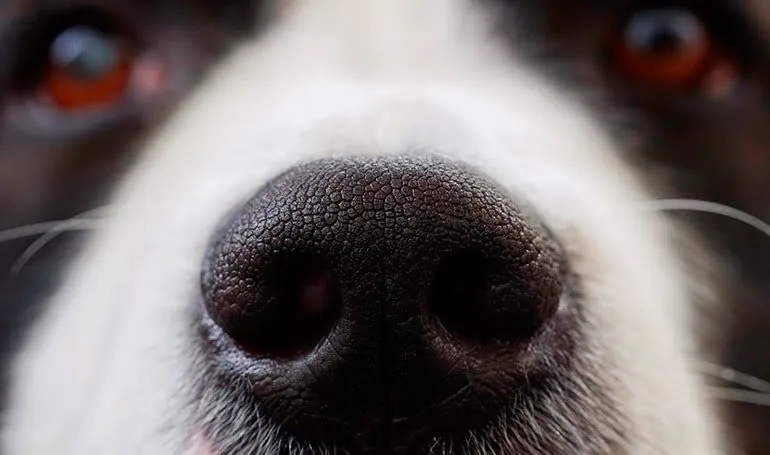
The foundation of smell lies in a dog's nasal region. What we can see from the outside are the nostrils, or nose openings. From there, you reach their respective nasal passages, which form the nasal cavity. This is entirely lined with a mucous membrane called the mucociliary blanket.
It's richly supplied with blood vessels, and it's what protects against pathogens or irritants, which are carried toward the throat to be swallowed or expelled through coughing. Also, the nasal cavity has a striking number of nerves, far more than in other animals.
Dogs, on average, have over 200 million scent receptors in their nasal folds. For comparison, humans have only 5 million. The nose's moisture helps capture scent, and on top of that, the bones forming it are thin and turbinated, full of folds. The nerves end their path at the olfactory center located in the brain.
How Does a Dog Perceive Smell?
The nerve supply and size of the olfactory center explain a dog's spectacular sense of smell. A large part of its brain is dedicated to interpreting scent. They also have a vomeronasal organ, or Jacobson's organ.
This sits on the roof of the mouth, and helps them capture sexual scent on the palate and send it to the brain, specifically to the limbic system, the part of the brain most involved in emotional behavior. A dog's sense of smell is considered around 100 times more powerful than a human's.
Can Dogs Smell Sweat?
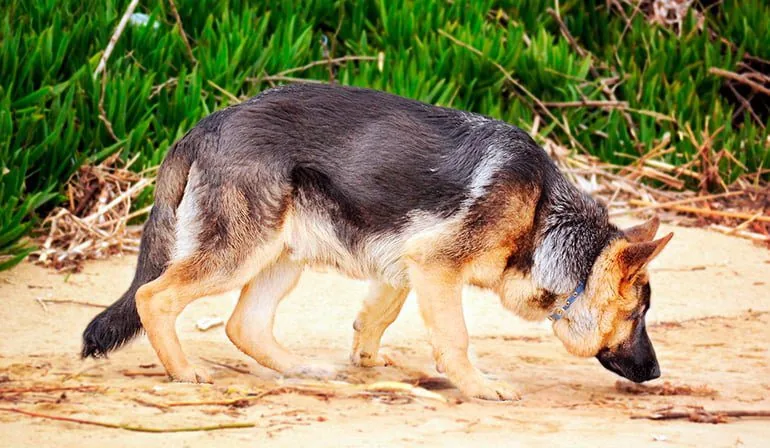
Dogs can smell the butyric acid present in human sweat. One of the studies conducted to demonstrate this is known as the pebble test. Six people were asked to hold a pebble in their hand and throw it as far as possible.
The dog was allowed to sniff one person's hand. Afterward, the animal was able to locate the pebble that person had thrown. Foot sweat is even easier for them to detect. It's known that hound-type dogs are able to follow a human trail left up to six days earlier and up to 160 km away.
A Dog's Nose Is Wonderful
Dogs' highly developed sense of smell has helped humans in many tasks. For example, hunting, which was perhaps the first collaboration established between dogs and humans thanks to their sense of smell. Another notable use is truffle hunting. Dogs are trained to detect truffles and tell their handler their exact location.
Their work in military, police, or rescue roles stands out too — for example, detecting bombs, since they can distinguish gunpowder and nitroglycerin, or drugs and every kind of illegal substance. On top of that, dogs are now being trained to smell substances the human body produces during certain illnesses.
They can detect a crisis, like an epileptic seizure or a hyperglycemic episode, before it happens. This way, the affected person can prepare to avoid risks. Although certain breeds are trained more often, like the German Shepherd or the Labrador, every dog has an excellent sense of smell and enough learning ability for this.
Olfactory Language in Dogs
Given how important smell is for dogs, it's easy to understand this is an essential element for them to communicate both with their own kind and with any other animal or human. Smell, specifically, falls under what's known as chemical communication, where scents are emitted and received.
It's worth noting that a dog's sense of smell shows special sensitivity toward scents it finds interesting. Others, like flower scents, for example, leave it indifferent.
The Dog With the Best Sense of Smell
While every dog stands out for its incredible sense of smell, one particular breed is always highlighted as the top example of this ability. It's a type of hound known as the Bloodhound or St. Hubert Hound.
Bibliography Carlson and Giffin. 2002. Dog Owner's Home Veterinary Handbook. Madrid: Editorial el Drac. Fogle, Bruce. 1995. The Encyclopedia of the Dog. London: Dorling Kindersley Limited. Morris, Desmond. 1988. Dog Watching. Barcelona: Plaza y Janés.
IMPORTANT: This article is for informational purposes only and does not constitute veterinary, nutritional or behavioural advice. Every dog is different, and only your trusted vet can advise you on its specific needs.