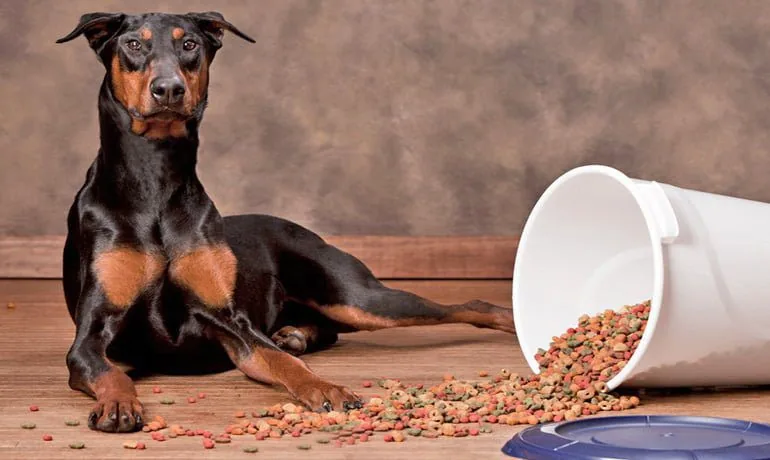
 Nutrition
How to Feed a Doberman
If you've landed here, it's because you already have a Doberman as your companion in life and you want to feed it as well as possible so it grows up and stays healthy, right? Let's get to it.
Remember that its health depends largely on the quality of its food. High-quality food will help it stay healthy and strong.
How to Feed a Doberman Puppy
It's highly advisable to let our puppy feed on its mother's milk until it weans naturally, something that will happen between two and three months of age.
At that point is when we can gradually start introducing solid food into its diet. The first few times, slightly moistened so that it's softer on those delicate milk teeth.

What's the Best Kibble for a Doberman Puppy?
We need to pick a kibble made specifically for large-breed puppies, since our little one will need a great many nutrients to develop properly.
Ideally it should be a premium kibble whose first ingredients are meat rather than meals, cereals or by-products, and one whose ingredients are also hydrolysed.
Did you know...? The hydrolysis process makes nutrients far easier to absorb, so the dog gets more out of them and is less prone to intolerances.
If you're after some good examples of products for large-breed puppies, here are a few ideas:
That said, my advice is that you assess each product's ingredients yourself and decide which one might be best for your puppy. Personally, I think all of the above are excellent options.
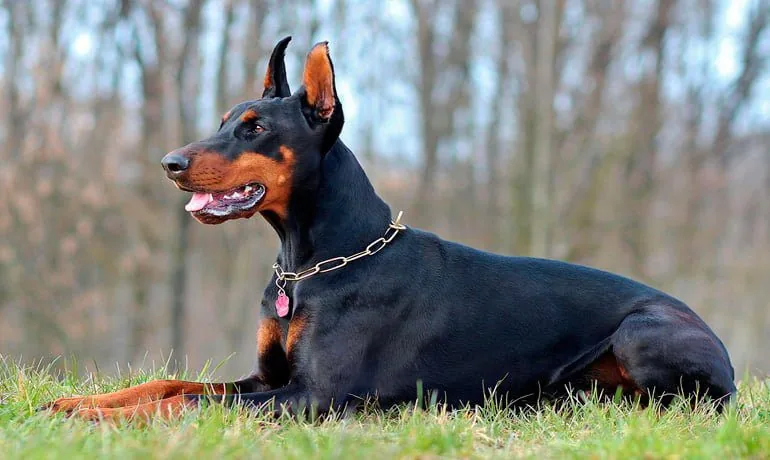
Feeding an Adult Doberman
As you'll know, food is a cornerstone of your dog's health, which means that the better its diet, the healthier it will be and the longer it will live. Food isn't everything, though — remember the recommended care for a Doberman.
Adults don't need as many nutrients as puppies in full development, but they do need plenty of energy to stay active. A kibble made with good-quality ingredients is essential.
So rule out supermarket or own-brand kibble completely, because its quality is generally very, very low. Yes, it's cheap... but there's a reason for that.
Look for a kibble with an appropriate amount of high-quality protein (between 20% and 40%) and without excessive fat, ideally below 20%.
Did you know...? Excess protein is eliminated naturally through urine and faeces.
As far as possible, avoid cereals such as maize or wheat, since dogs absorb them very poorly. Rice is probably the only cereal that, in small amounts, is acceptable.
Some examples of quality kibbles for an adult Doberman might be:
- NFNatcane Large Breed
- Orijen 6 Fresh Fish
- Acana Large Breed
- Optima nova adult mobility
And of course, if you have the chance to prepare its food yourself, don't hesitate to read up on the BARF natural diet for dogs.
How Much Should a Doberman Eat?
There's no maximum or minimum daily amount that can be recommended without knowing which kibble you're using to feed it, since some are more concentrated than others.
It's generally the manufacturer that gives a rough daily amount based on the age of our Doberman and its physical activity (whether it's an active or a laid-back dog).
And on top of those guidelines, we should always apply common sense. If we notice our Doberman losing a bit of weight, we should increase the ration; if it's putting weight on, then reduce it.
As a rough guide, these are some common amounts:
- Adult Doberman weighing 25 kilos: approx. 400 grams a day.
- Adult Doberman weighing 30 kilos: approx. 480 grams a day.
- Adult Doberman weighing 35 kilos: approx. 560 grams a day.
- Adult Doberman weighing 40 kilos: approx. 640 grams a day.
- Adult Doberman weighing 45 kilos: approx. 720 grams a day.
* Remember these are rough figures; you should check the guidance for the particular brand of kibble you use.
IMPORTANT: This article is for informational purposes only and does not constitute veterinary, nutritional or behavioural advice. Every dog is different, and only your trusted vet can advise you on its specific needs.