 Care
Care
How to Know If a Dog Has Rabies
Rabies is a viral zoonotic disease belonging to the Rhabdoviridae family, affecting the nervous system and causing fatal acute encephalitis. It affects mammals, including dogs and, of course, humans.
This disease is spread across almost the entire planet but has been eradicated in many developed countries. It can be fatal if not prevented, which is why it's so important to vaccinate our dog against it every year or two, depending on the country and region where we live.
At Soyunperro we offer you all the information needed to know, control, and prevent the rabies virus in our dog and thus prevent it from infecting us.
- You might also be interested in: Vaccination schedule for dogs.
How Is Rabies Transmitted?
Rabies is an infectious virus transmitted through the saliva of an infected animal. In other words, if a dog with rabies bites our dog, it will become infected. Transmission through ingesting feces, urine, tissue from infected animals, blood… isn't infectious.
The same happens to us humans. If a dog with rabies bites us, it will transmit the virus to us, infecting us. If this happens, we need to go to a hospital quickly.
But dogs aren't the only ones that can give us rabies — even a bat can easily infect us if its saliva comes into contact with our blood, for example by biting us (the virus doesn't pass through intact skin).
Has Rabies Been Eradicated?
In Spain and Mexico, vaccination campaigns in dogs have eradicated the disease (since 1978) except in Ceuta and Melilla. Even so, it's important to know about it since it's potentially fatal.
We should know the rabies virus can have an incubation period of up to two months, meaning a dog can have rabies but not show symptoms until two months after being infected, though they usually show up sooner.
Since it's a virus affecting the dog's nervous system, rabies symptoms are easy to distinguish, although a dog doesn't necessarily need to show all of them.
Visible Symptoms of Rabies
This virus progresses gradually, so symptoms will increase and worsen over the following days, with new symptoms characteristic of an advanced stage of the disease appearing too.
The first thing we'll notice (1-3 days) in a dog infected with rabies is:
- Behavioral changes
- Increased reflexes
- Loss of appetite
- Irritation at the bite site
- Slight increase in body temperature
Once the first few days have passed, during which we'll notice one or more of the symptoms mentioned above, we'll see new symptoms more associated with rabies appear, such as aggression.
In dogs where the disease has been developing for close to a week, we'll be able to notice these symptoms:
- Increased excitement and agitation.
- Aggression, tending to bite objects, animals, or itself
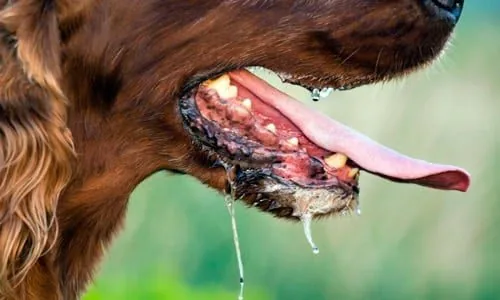
- Excessive salivation (paralysis of the muscles used to swallow saliva)
- Change in barking due to vocal cord paralysis
After a week with the virus active, symptoms start intensifying even more, moving into a fatal stage. Many animals don't reach this last stage since they die before then. However, it's important to know the symptoms of this stage:
- Generalized seizures
- Muscle incoordination
- Muscle paralysis and death (from respiratory muscle failure).
Can Rabies Be Prevented?
Unfortunately, it's currently not possible to cure rabies — there's no treatment against rabies, so if our dog catches this disease, it will end up dying or being euthanized.
However, there is something we can do to prevent our dog from catching rabies: preventing it with the rabies vaccine.
The first rabies vaccine is given when the dog is still a puppy, normally between four and five months of age. After that, a booster vaccine is legally required every year or two, depending on the region you live in.
If our dog is an adult and hasn't been vaccinated, don't worry — you can vaccinate it anyway to protect it against the rabies virus. The vaccine is effective in any non-infected dog.
Remember the rabies vaccine is mandatory in every country, it's not optional. If you don't give it, you can be fined or even have your dog taken away, so don't hesitate — vaccinate your dog.
Other forms of prevention, once we've vaccinated our dog, include avoiding areas where wild animals that could bite our dog might be, keeping our dog from mixing with unvaccinated dogs (in Spain, most are usually vaccinated), etc. The rabies vaccine is highly effective, approximately 98%, which increases to 100% after years of revaccination.
IMPORTANT: This article is for informational purposes only and does not constitute veterinary, nutritional or behavioural advice. Every dog is different, and only your trusted vet can advise you on its specific needs.