 Care
Care
How to Tell If My Dog Has an Inguinal Hernia?
Hernias are protrusions that can occur in different parts of the body. In dogs, umbilical hernia is relatively common and well known, but we can also find inguinal or perineal hernias.
Below, we'll talk about inguinal hernias. Their characteristics, what problems they can cause our dog, what treatment is most suitable, and why we need to see the vet.
What Is an Inguinal Hernia?
We call inguinal hernia the one located in the groin. A hernia, meanwhile, is a protrusion of fat or intestine through an opening remaining in the abdominal wall that should have closed during development.
Dogs can be born already with a hernia, especially in the groin or belly button, but we won't always detect it. That's why it's not unusual for the diagnosis to come once the dog is already an adult.
What Are the Symptoms of Inguinal Hernias?
In principle, the hernia doesn't need to trigger any symptoms. Externally, we'll notice it as a bulge, larger or smaller. Sometimes we don't see it but can feel it. On the other hand, when the hernia becomes complicated, we may notice symptoms such as the following:
- Vomiting.
- Loss of appetite.
- Increased urine output.
- Fever.
- Listlessness.
- Pain, which can tell us the hernia is becoming strangulated, which is an emergency.
How Is an Inguinal Hernia Diagnosed?
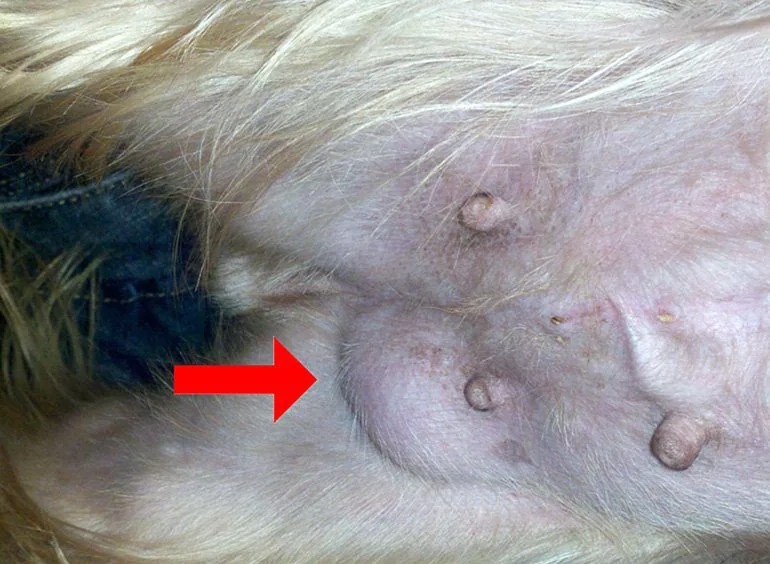
Generally, hernias are diagnosed by observing a rounded bulge in at-risk areas, in this case, the groin. The palpation the vet performs will give them information about the hernia's characteristics.
In cases with complications or where surgery is planned, an ultrasound can be done, along with bloodwork to give us information about the dog's overall condition.
Can Inguinal Hernias Be Prevented?
The truth is this type of hernia tends to be hereditary, which is why several cases can easily occur within the same family. We can't do anything to change a genetic predisposition, which is what prevents the abdominal wall from closing, but we can avoid breeding animals affected by these hernias.
Acquired inguinal hernias are those the animal isn't born with, arising after life events such as pregnancy, an impact, or obesity. These cases can indeed be prevented by neutering, controlling diet and exercise, or providing a safe environment.
Bandages on the area and other home remedies circulating online never prevent hernias from appearing, nor do they work to treat them. On the contrary, this type of remedy could even backfire.
Which Dogs Get Inguinal Hernias?
We can find this type of hernia in any dog, regardless of size. But it's been noted that some breeds have a higher tendency to develop them, such as the Pekingese, Cocker Spaniel, or Border Collie. Likewise, females suffer these hernias in a higher percentage.
What Is the Danger of Inguinal Hernias?
A portion of intestine can end up contained in a hernia. These cases can cause intestinal obstructions. Another complication of hernias is strangulation. This means the blood supply to its contents is cut off, which can cause serious damage.
If we find a hernia in our dog, we can try to push it back in by gently pressing with a finger toward the inside of the body. Of course, gently, and stopping if the dog shows discomfort. If we manage to do it, we're dealing with a reducible hernia. Otherwise, irreducible hernias are the ones at higher risk of strangling.
In addition, small, reducible hernias that don't seem serious can suddenly enlarge or even become strangulated if another factor comes into play, such as obesity or trauma.
Inguinal Hernia in Female Dogs
A female dog with an inguinal hernia carries more risks than a male. To start, her uterus can end up trapped inside the hernia. Since in some cases the hernia isn't noticed until adulthood, an unspayed female is at risk.
If she becomes pregnant, during gestation or labor, the uterus risks becoming trapped in the hernia. Uterine conditions are another factor that can end up trapping the uterus.
Treatment for an Inguinal Hernia
Surgery is recommended and is the treatment of choice for females. In males, if the hernia is small and reducible, the vet may schedule follow-up before deciding on surgery, since the hernia may close on its own.
The surgery is performed through an abdominal incision. The vet repositions the organs and sutures the damaged abdominal wall. This surgery becomes more complicated if internal damage has occurred, since it would need to be repaired before closing. The prognosis will depend on how severe these complications are, but generally, it tends to be good.
Bibliography Carlson and Giffin (2002): Manual práctico de veterinaria canina. Madrid: Editorial el Drac.
IMPORTANT: This article is for informational purposes only and does not constitute veterinary, nutritional or behavioural advice. Every dog is different, and only your trusted vet can advise you on its specific needs.