 Care
Care
How to Tell If a Dog Has a Fever
Dogs have an average body temperature suited to their organism functioning properly. A dog's normal temperature can rise, which tells us it has a fever, warning us of a possible health problem. It's a mechanism identical to what happens in humans.
There are many things that can raise our pet's temperature, some with a pathological cause and others without. At Soyunperro we'll explain how to tell if our dog has a fever and how to act.
When Does a Dog Have a Fever?
A dog's normal temperature ranges from 38.5° to 39.2°C. Puppies, however, can have a slightly higher temperature due to their faster metabolism (as well as a higher heart rate). Even so, it's worth keeping an eye on it if it rises above 39.3°C.

Causes of Fever in Dogs
It can be due to an underlying condition, such as (and this is the most common): infections, whether bacterial, viral, or, less commonly, parasitic. Other times it's due to non-pathological causes, such as heatstroke, high levels of nervousness, or simple stress can also cause it. Likewise, temperature can drop below 38.5°C in cases of prolonged cold exposure.
That's why it's important to take our dog's temperature to be sure and take the right steps. Although there are many other reasons a dog might run a fever:
- Vaccines rarely cause fever, but it's possible.
- Some drugs can cause fever, especially if they trigger a hypersensitivity reaction in the animal.
- Hypersensitivity reactions.
- In the time leading up to labor, pregnant females can experience a rise in temperature as a sign that birth is imminent.
There are more factors that can cause fever in a dog, but these are some of the most common.
How to Know if Our Dog Has a Fever?
A dog with a fever usually shows some of these symptoms. But we shouldn't rely on this completely, since many conditions produce these same signs, so what will tell us for certain whether there's a fever is taking the temperature rectally.
In cases of fever, we may observe:
- Muscle spasms or tremors.
- Strange behavior and/or listlessness.
How to Take a Dog's Temperature?
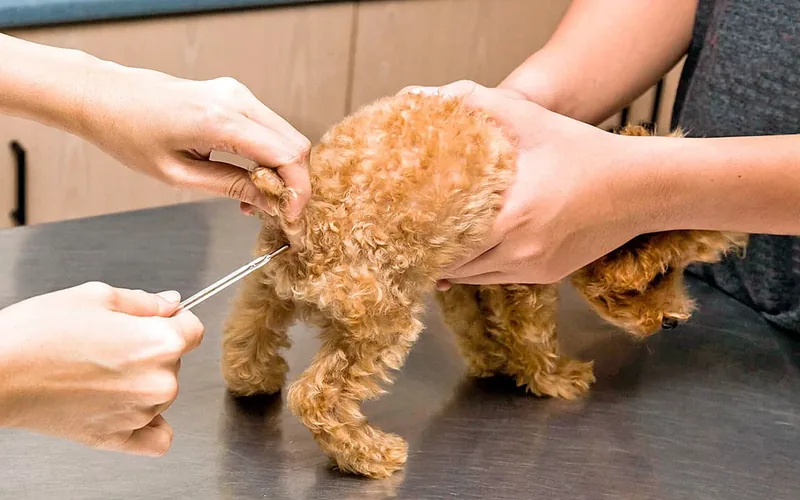
The process for taking a dog's temperature is very similar to that for humans, except that for the dog we'll insert the thermometer into the anus (rectally). It's important to have a second person help so our dog doesn't move while we take its temperature.
While one person holds the dog and keeps it relaxed, we'll gently lift its tail to insert the tip of the thermometer into its anus. For an accurate reading, it needs to go in about two centimeters, and while inserting it, angle it toward the side of the rectum to avoid contact with feces and get a good reading.
To make insertion easier, we can moisten the tip with a bit of petroleum jelly or water, so it slides in more gently. It's completely normal for the dog to feel uncomfortable and try to move, but we need to keep it steady until the thermometer shows the temperature.
Digital thermometers beep to let us know, while conventional mercury thermometers need to stay inserted for at least two minutes to measure the dog's temperature correctly. That's why we strongly recommend digital ones, and among those, the fast-reading kind (sold at pharmacies).
What to Do If Our Dog Has a Fever
First, we should assess how serious the situation is, guided by our dog's temperature taken rectally with a thermometer. A dog at 39.4°C isn't the same as one at 40°C — the prognosis will be more guarded for the latter.
If you won't feel at ease otherwise, the best thing is to go straight to the vet, or failing that, follow these guidelines:
- Puppies with fever: go to the vet urgently.
- Young dogs with fever: call or (preferably) visit the vet and ask for advice based on the temperature.
- Adult dogs at 39.5° to 40°: a high fever requiring veterinary care — go immediately. Usually, before reaching this point, the dog will have shown symptoms like listlessness or lethargy (among others) letting us know something is wrong. It's not a good idea to wait in these cases.
As you can see, fever is a sign that something isn't working properly in our dog's body — it's the body's defense mechanism against an infectious agent or some other abnormal exposure. That's why it's important to take it very seriously and see a vet in most, if not all, cases.
Home Remedies to Lower a Dog's Fever
Despite the tips we're about to give you, our recommendation is to go straight to a veterinary clinic, since the fever could be due to a bacterial infection, for example, and home remedies won't help in that case — they're only a stopgap. We'd recommend them at most for a mild fever (39.3°C).
These are:
- Leave a bowl of fresh, clean water near the dog so it can stay hydrated.
- Obviously, we shouldn't give our dog any kind of medication on our own judgment.
- Wet a towel with cold water, wring it out, and place it over our dog for a few minutes.
- Re-wet with cold water and repeat for about ten minutes. Take the temperature again.
- Place ice packs between the hind legs for about two or three minutes, then let it rest. Repeat this two or three times and take the temperature again to assess.
These home remedies can bring the fever down, but that doesn't mean the underlying problem has been solved. We need to see a vet so they can find the source of the fever and give us the right treatment.
IMPORTANT: This article is for informational purposes only and does not constitute veterinary, nutritional or behavioural advice. Every dog is different, and only your trusted vet can advise you on its specific needs.