 Training
How to Train an Adult Dog
Although it may seem a bit odd, since dogs are generally started on tricks from puppyhood, the ideal age to start proper training begins from a year old, that is, once the dog is already an adult.
It doesn't matter your dog's age — with these simple steps you'll be able to train them to do what you tell them. You simply need plenty of patience and to always stay calm — it'll take a week or a month, but you'll get there.
Before You Start Training Your Dog… Some Tips and Examples
It matters a great deal to be clear our dog picks up on our mood — that is, if they see us nervous or angry, they'll know it and get nervous too. That's why it's hugely important never to lose your calm, practise every technique with plenty of patience, and never scold, hit or glare at our dog.
If our dog does something wrong, a "No!" followed by their name and ignoring them will be enough. Physically hurting a dog indirectly teaches them aggression is normal, so they'll bite. Or you'll simply be suppressing and scaring them to the point of making them depressed.
Training an adult dog isn't the same as training a puppy, so you need to understand every technique here is meant to be applied exclusively with adult dogs. That is, dogs over twelve months old, fourteen or fifteen.

There's only one way to properly train your dog, and that's being persistent, always staying calm, and using positive reinforcement. Some dogs take one or two weeks to learn, and others take three or four months — they all learn, but each at their own pace.
Your dog learning faster or slower doesn't mean you're a better or worse trainer — they simply need their own time to learn. Dogs over eight years old generally tend to need more practice to learn.
Ideally you'd train your dog once they've burned off some energy — don't start training them right after leaving the house, since they'll only want to walk and play. Let them play, take a walk for a while, and afterwards, you can start their training session. An average of half an hour a day is enough — there's no need to push our dog too hard.
Remember the right way to give the dog a command is by their name, followed by the command. If our dog's called Tobby and we want them to sit, we'll give the command "Tobby, sit!"
Teaching Them to Relieve Themselves
Here we have two options — teaching our dog to relieve themselves inside the house but in a specific spot, such as the kitchen for example… or teaching our dog to relieve themselves outside the house, that is, at the park or on the street.
To train our dog to pee and poo outside the house, the first thing we need to do is set walking times and always stick to them. For example, we can go out for fifteen minutes in the morning for them to pee and poo (around eight or nine in the morning, once we wake up). Then another outing to pee or poo at midday (around one or two in the afternoon), a longer outing in the afternoon, where they can play, go for a walk and relieve themselves, of at least one or two hours (around seven or eight in the evening, nine if it's very hot), and one last outing before bed, for a pee, around eleven or midnight.
These are just examples of the routine we should follow every day, always at the same time. Dogs learn routines very quickly, and if they need to pee a little, they'll know to wait until their next outing to do it outside the house (as long as they know when their outing is coming up).
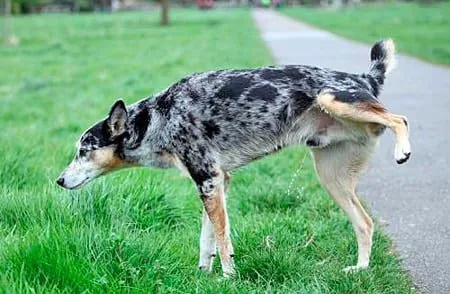
If our dog pees or poos inside the house, we shouldn't scold them, rub their nose in their urine, glare at them, or anything else. We'll simply clean it up and ignore our dog.
Even so, if our dog pees or poos outside the house, coinciding with one of the scheduled outings we need to stick to daily… we'll wait for them to finish peeing or pooing and praise them a great deal, with strokes, encouraging words, and giving them a reward. Such as a dog biscuit or a piece of sausage, for example.
This way they'll understand peeing or pooing outside the house is a great thing, and they also get a reward, whereas if they do it inside, there's no reward or praise. Within a short time they'll learn, as long as you follow these steps daily.
If we want our dog to learn to relieve themselves in a specific spot inside the house, it's best to buy absorbent pads for dogs or a training tray.
Teaching them is as simple as praising them a great deal when they pee there, giving them strokes and rewards, plenty of positive reinforcement. And, on the other hand, ignoring them when they don't do it there — there's no need to scold them, simply ignore them.
Training Them Not to Bite
If our dog bites us while playing, or bites things around the house, such as furniture or slippers… we need to teach them not to bite with these simple steps.
When our dog bites us while playing, or bites a piece of furniture or something we don't want them biting, we'll simply scold them, saying their name and a "No!"
If they stop, great. If they don't, we need to insist again, saying their name and a "No!" while giving them a small "tap" with our fingers at hip height. This is commonly called an attention tap. You can find more information here: How to correct or give your dog an attention tap.

Once they've stopped, we'll grab one of their toys or chew toys and put it in their mouth for them to bite. We can tease them a little, get them interested so they feel drawn to biting their toy, and once they do, we'll praise them a great deal. It matters to keep playing with them for a while, so they properly link that they can bite their toys, but not anything else.
This is the simplest way of teaching a dog not to bite. Even so, if your dog doesn't bite while playing, but bites out of aggression, you should see a professional trainer to help you fix this serious problem. It could even be worth using a muzzle on your dog while they haven't properly learned not to bite, as long as we're talking about aggression.
How to Train a Dog Not to Bark
To fix this hugely annoying behaviour, we need to know the reason our dog barks. There are plenty of reasons, and each has its own training technique — the most common are:
- Barking from fear or as a warning, when the dog sees a stranger approaching the house or when they get scared.
- Barking from anxiety, the most common when it comes to separation stress. That is, when the dog barks because we're leaving the house.
- Antisocial barking, which happens when the dog hasn't been properly socialised.
- Barking from boredom, also very common, since they usually spend plenty of time alone at home.
Depending on the source of the barking, one technique or another will be applied, so to fully understand every detail, we recommend reading: How to teach a dog not to bark.

On another note, there are also anti-bark collars, which give off a small vibration every time the dog barks.
Once you've identified the reason our dog barks, we simply need to follow the steps from the guide recommended above, and our dog will stop barking within a few months. This isn't something taught in two weeks — we need to be very patient and persistent.
Preventing Them From Running Off
This is one of the simplest, most practical techniques, which we can and must teach our dog without fail. A dog who comes when called is a good dog, since it'll save us plenty of problems.
If our dog runs off, or is about to cross somewhere they shouldn't, they'll come when we call if we've trained them properly. Even so, they'll ignore us and put themselves in danger if we haven't devoted time to their training.
We need to cut several pieces of sausage and keep them, which we'll use as a reward for our dog later on. The pieces should be small, no more than a centimetre in size, since we'll use plenty of them.
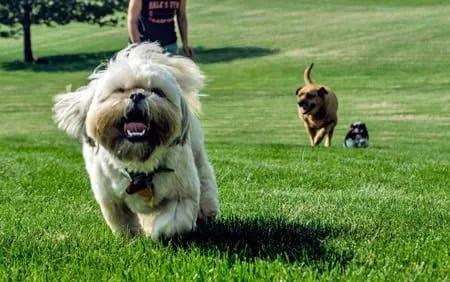
We'll go with our dog to a dog park or a fenced-off area, where there's no danger of our dog running off. There we'll let our dog off to play for a while and sniff around the area a bit.
After a few minutes we'll call them by name and immediately give the command, for example "Tobby, come here!" While giving the command, we need to show a piece of sausage in our hand, so they see it and know they can eat it if they come.
Once they come, we'll praise them a great deal and give them the piece of sausage. This is called positive reinforcement and is the best way of teaching a dog. We'll let a few seconds pass and start walking, moving a bit away from our dog, then call them again and give them another reward and praise once they come.
We need to practise this as many times as possible, always giving them a reward when they obey. After one or two months, we can give them a reward once and not the next time, though we'll always praise them.
By teaching them to come when we call, we're also teaching them not to run off. Since once they do, simply calling them will be enough for them to come to us. Even so, there are other reasons a dog runs off too, for example when female dogs are in heat or when they see a cat.
Remember persistence, calm and positive reinforcement are the trick to properly training a dog.
IMPORTANT: This article is for informational purposes only and does not constitute veterinary, nutritional or behavioural advice. Every dog is different, and only your trusted vet can advise you on its specific needs.