 Breeds
Hungarian Vizsla: Complete Breed Guide
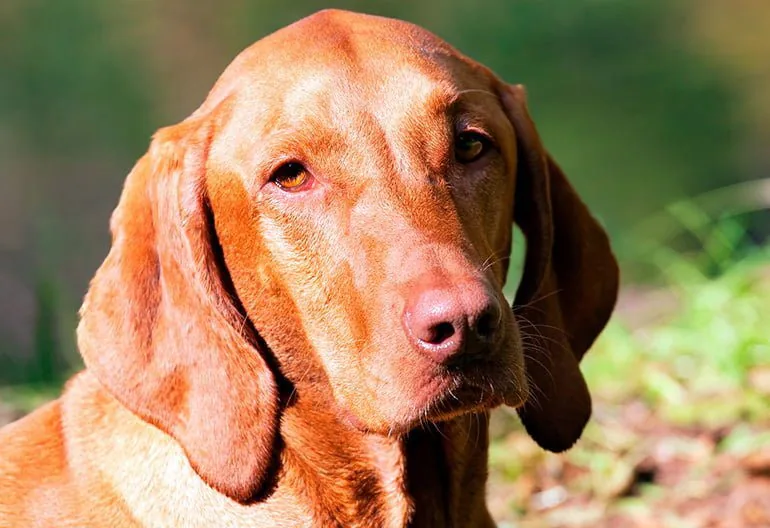
Golden-coated, muscular, with a gaze that doesn't lie: the Vizsla has been hunting the plains of Hungary for centuries, and it shows. Unlike other pointers, this dog doesn't just point at the game; he retrieves on land and in water with equal ease.
Origin and history of the Hungarian Vizsla: a medieval lineage
That dual ability goes back a long way, to a very specific medieval selection process, and it's exactly what explains both his build and the clingy temperament he has today.
The Hungarian Vizsla, known internationally simply as the Vizsla, has his roots in the plains of the Carpathian Basin, where the Magyar tribes who settled the region already kept golden-coated hunting dogs. The earliest written accounts describing a similar pointing dog appear in medieval chronicles of the Kingdom of Hungary, though the lack of systematic pedigree records makes it impossible to pin down an exact date of origin. What is known is that Hungarian nobility selected these animals for centuries for their versatility in the hunt: they had to point game, retrieve both on land and in water, and hold up through long days under the region's harsh continental climate. That selective pressure forged a dog with an athletic build, a fine nose and an extraordinary rapport with the hunter, traits still written into today's standard.
During the Ottoman occupation and the wars that ravaged Hungary, the population of these pointers dropped sharply, but local breeders preserved the genetic core on isolated estates. The real bottleneck came with the Second World War: many individuals were lost and the breed came close to extinction. In the 1950s, a handful of Hungarian breeders, along with emigrants in other European countries and the United States, launched a meticulous recovery programme, crossing the few purebred Vizslas that remained and avoiding hybridisation with other pointing breeds. The Fédération Cynologique Internationale (FCI) officially recognised the breed, and since then the Hungarian Vizsla has gone from being an almost secret national treasure — much like the Komondor — to a beloved family and competition dog worldwide.
The medieval lineage isn't just a historical curiosity: it explains the Vizsla's dual ability as both pointer and retriever. Unlike other pointing breeds that specialised in a single function, the Hungarian dog kept the versatility that medieval falconers and beaters demanded. That heritage translates today into a dog who can point a partridge with the same precision he uses to leap into a lake to retrieve a duck, an unusual combination that sets him apart from other continental pointing breeds like the German Shorthaired Pointer.
Physical characteristics of the Hungarian Vizsla
The Hungarian Vizsla follows a purebred pointer type, with a silhouette that conveys lightness and power in equal measure. Height at the withers falls between 58 and 64 cm in males and 54 to 60 cm in females, with an adult weight ranging from 22 to 30 kg. These proportions, slightly more streamlined than other working pointers, give him remarkable agility over rough terrain and a long stride that covers a lot of ground without tiring. The body is muscular but never coarse, with a deep chest that houses good lung capacity and a tucked-up belly that underlines his athletic condition.
The coat is one of his most distinctive traits: short, dense and lying close to the body, with no woolly undercoat, which helps it dry fast and cuts down on dirt build-up while hunting in wet areas. The official colour is golden or wheaten in all its shades, from lighter tones to a deep coppery red; small white markings are allowed on the chest and toes, but any shift toward dark brown or black is an eliminating fault. The skin is fine and elastic, and the nose, eyelids and lips match the coat tone, creating a very uniform overall look.
The head is noble and well-proportioned, with a moderate stop and a muzzle that narrows gradually without tapering to a point. The eyes, medium-sized and hazel, convey a lively, intelligent expression many enthusiasts describe as the “Vizsla look”: attentive, gentle and slightly inquisitive. The ears, medium-set and silky in texture, hang close to the cheeks, rounding off an expression that, without losing hunting functionality, is especially appealing to anyone looking for a companion dog with a distinguished air.
Key differences between the Vizsla and the Weimaraner
Confusion between the Hungarian Vizsla and the Weimaraner is common, especially when looking at young, light-coated individuals, but a detailed look reveals substantial differences. The most obvious is coat colour: while the Vizsla sticks to golden or wheaten, the Weimaraner shows a range of greys running from silver to mouse, with an equally short but often denser coat. Body structure also differs: the Weimaraner is larger and heavier, with males reaching 59 to 70 cm and weighing 30 to 40 kg, giving him a more imposing presence and a lower centre of gravity compared to the Hungarian dog's streamlined build.
Geographic origin marks another divide: the Weimaraner was developed at the court of Weimar (Germany) during the 19th century as a big-game hunting dog, while the Vizsla is a product of medieval Hungarian nobility geared toward small game and falconry. That historical specialisation shows up in their working style: the Hungarian Vizsla tends to point and retrieve with an innate softness, while the Weimaraner, selected to take on wild boar and deer, can show a harder edge on the game and a more pronounced independence. Temperamentally, the Vizsla is generally more sensitive and family-attached, while the Weimaraner can develop a stronger protective streak if not socialised impeccably.
Both breeds share a need for intense exercise and a predisposition to separation anxiety, but the Hungarian Vizsla tends to be more adaptable in urban settings if his activity needs are met, thanks to his smaller size and slightly more tempered reactivity. For a prospective owner torn between the two, the choice should come down to available space, prior experience with working dogs, and the type of activity planned together: the Vizsla suits active families looking for a versatile companion better, while the Weimaraner needs a firmer handler and, often, more square metres.
Hungarian Vizsla temperament and personality
With the Vizsla there's something that sooner or later catches everyone off guard: his need to be glued to you. Literally. He follows his person from room to room, seeks physical contact at any hour, and if left alone too long without gradual preparation, can develop separation anxiety. It isn't a whim; for generations this dog was bred to work alongside the hunter in constant communication, and that emotional dependence comes built in. At home it translates into an animal who rarely wanders off and joins in, with genuine enthusiasm, whatever the family is doing.
Is he a good dog to have at home? It depends. He needs daily exercise and someone present most of the time. If you're out eight hours a day and looking for a dog who'll manage on his own in the garden, this is where things change, because the Vizsla isn't built for that. When his environment suits him, he's tremendously sociable with children, other dogs and cats, as long as socialisation happened early. Aggression is notably absent in well-bred individuals; faced with a tense situation, he'd rather step away than get into conflict, which makes him thoroughly manageable for a first-time owner keen to learn about dog training.
He learns fast. Very fast, and training built on positive reinforcement gets the most out of him. Coercive methods or endless repetition shut him down. His sensitivity to tone of voice and body language throws off anyone who isn't expecting it, and a harsh correction can leave him rattled for days. That same emotional sensitivity, in return, builds a connection with the owner that's hard to find in other breeds. Day to day he's cheerful, curious and quite the clown, with that knack for reading the mood of whoever's around him and adjusting his energy to match — as long as his physical and mental needs are covered.
Care and exercise a Hungarian Vizsla needs
Physical maintenance for the Hungarian Vizsla is simple as far as coat goes: a weekly brush with a rubber grooming glove is enough to remove dead hair and spread the skin's natural oils, since the lack of undercoat keeps shedding at very manageable levels indoors. Baths should be occasional, only when the dog is visibly dirty, using gentle shampoos that won't disrupt the skin barrier. Floppy ears need regular checking to prevent moisture build-up and ear infections, especially in dogs who swim often, and nail trimming needs to be regular if natural wear on hard surfaces isn't enough.
The real challenge is meeting his energy demands: an adult Vizsla needs a minimum of 1-2 hours of daily exercise, but that figure should be read as quality activity, not a simple lead walk. Trotting alongside a bike, canicross sessions, controlled swimming or scent work in natural areas are options that drain both the physical and, above all, the mental tank. Without that outlet, the dog builds up tension that can turn into destructive behaviour, excessive vocalisation or hypervigilance. Puppies and adolescents need more careful management: exercise should be frequent but low-impact to protect growing joints, combining short walks with regulated tug games and self-control exercises.
Diet needs to match the breed's high metabolic rate, especially in working or competing individuals. High-end kibble formulated for active dogs, split into two daily meals, is usually enough, but body condition needs monitoring since the Vizsla naturally tends to stay lean, and even mild excess weight punishes his joints. Hydration is another critical point: during intense exercise in hot climates, like summers in inland Spain, fresh water should be offered every twenty or thirty minutes, and the middle of the day avoided to prevent heatstroke, something his short coat and working drive make him vulnerable to.
Urban adaptation in Spain
Many people in Spanish cities have long been asking themselves the same question: can a Vizsla live in a flat? Almost everything depends on what the owner is willing to do outside the home. With several outings adding up to one or two hours of real activity a day — including some free-running time in a fenced or quiet space — the Hungarian Vizsla can manage perfectly well in an apartment. The breed has a contained size and a temperament trait that helps a lot indoors. Once he's back home after a walk, he sticks to his owner like a shadow, seeks out the sofa or a warm corner, and doesn't pace around the flat looking for something to do if he's already burned off energy outside.
Living in a flat with a Vizsla has two problem areas worth knowing about. The first is barking. If the dog gets bored, or if he has a window within reach and watches people and bikes go by all day, he can get pretty noisy. Teaching him from puppyhood that staying quiet pays off, and not leaving him stationed at the window for hours when nobody's home, makes a huge difference. The other thing complicating flat life is climate. In summer, the asphalt in Madrid, Seville or the Ebro valley gets scorching, so walks need to move to early morning and late afternoon, with grass or dirt sought out to avoid burning his pads, and water always brought along. Cold also calls for caution. The Vizsla's short coat offers fairly little warmth, and in cities with frequent frosts, a senior or lightweight individual will appreciate wearing something during the harshest months.
There's also plenty that can be done indoors. Toys that make him think, a good scent session or a round of training are what's called for on days when the weather doesn't cooperate and long outings aren't an option. Once he's genuinely burned off energy, he can lie down for hours without bothering anyone. A flat doesn't condemn anyone to a sedentary life. If the owner takes the dog running, hiking or on long walks, the Hungarian Vizsla can be just as happy on the sixth floor of a Barcelona building as on a farmhouse surrounded by fields.
Common Hungarian Vizsla health conditions
Like any breed, the Hungarian Vizsla shows predispositions to certain conditions worth knowing before bringing a puppy into the family. One of the most specific is immune-mediated polymyositis, a muscular disorder presenting with inflammation of the chewing and pharyngeal muscles, causing dysphagia, muscle wasting and pain. The immune-mediated cause of this disease has shown a beneficial clinical response to immunosuppressive therapy ‘Association of an MHC class II haplotype with increased risk of…’ (2013). While the prevalence isn't alarming, the severity of symptoms means any owner should watch for signs like difficulty swallowing, excessive drooling or loss of muscle mass in the head, and seek immediate veterinary assessment.
Another relevant condition is primary closed-angle glaucoma, linked to an anatomical abnormality called pectinate ligament dysplasia. This abnormality is significantly associated with the development of glaucoma, which is why gonioscopy screening is recommended in the Hungarian Vizsla to identify at-risk dogs before clinical symptoms appear ‘Pectinate ligament dysplasia in the Border Collie, Hungarian Vizsla and Golden…’ (2017). Gonioscopy is a simple test that visualises the iridocorneal angle and should be part of every Vizsla's regular eye exam, especially if intended for breeding. Early detection can be the difference between controlled medical management and irreversible vision loss.
Hip dysplasia is another concern present in the breed, shared with many medium-large dogs. Although no specific prevalence figures exist for the Hungarian Vizsla in Spain, the biomechanics of his hip — with a femoral head fitting into a socket that needs to be deep — makes him susceptible when genetic and environmental factors coincide. Idiopathic epilepsy and certain skin allergies also show up fairly often in practice, so regular clinical follow-up and pet health insurance can be sensible investments for anyone deciding to share their life with a Vizsla.
Preventing hip dysplasia: findings from the 2023 ESVCE study
Hip dysplasia has a significant hereditary component, but that doesn't mean there's no room to manoeuvre. The 2023 ESVCE study puts numbers to something serious breeders have applied for years: assessing breeding stock with official X-rays and only mating those that pass reduces transmission of the joint laxity behind the problem. Anyone looking for a Vizsla puppy does well to ask for both parents' hip certificates from the first contact with the breeder. If they don't have them or dodge the question, keep looking.
The first year is critical. Hungarian Vizslas grow at a pace their joints can barely keep up with, and the growth plates stay open well into canine adolescence. The 2023 ESVCE study documents that controlling nutrition during this phase — without overfeeding or creating calcium or phosphorus deficiencies — and avoiding high-impact exercise reduces the clinical expression of dysplasia even in dogs who already carry a genetic predisposition. Repeated jumping, unsupervised stairs and running on asphalt can wait. What does fit well in these months are walks on dirt or grass, scent games and supervised swimming.
Then there's weight. A Vizsla carrying extra kilos loads his hips with extra force on every step, wearing down cartilage at a rate that can bring on symptoms that might otherwise never have appeared. The 2023 ESVCE study confirms that all three variables together — genetic selection, well-managed growth and weight control throughout adult life — significantly reduce cases of dysplasia with real clinical impact. That leaves the owner with three concrete levers: buying with health guarantees, following a growth plan supervised by the vet, and keeping the dog lean and muscled. Few, but effective.
Properly understanding what a Hungarian Vizsla is before bringing one home is what separates a relationship that works from one that becomes a problem for both sides. Anyone seriously considering a Vizsla should look for breeders who apply the recommended health screenings and, before committing to any puppy, spend time with adult dogs in everyday situations. Only that way can you know whether this breed's energy and need for closeness genuinely fit your own pace of life.
IMPORTANT: This article is for informational purposes only and does not constitute veterinary, nutritional or behavioural advice. Every dog is different, and only your trusted vet can advise you on its specific needs.