 Care
Care
My Dog Sleeps With Its Tongue Out. What Does That Mean?
If we watch our dog, we'll notice it spends a good part of its time, except for walk and meal times, sleeping or, at least, in a resting position.
Among the various postures it takes, there's one that can catch our attention or even worry us: your dog falls asleep with its tongue out. Below, we explain why this happens.
Your Dog and Its Sleep
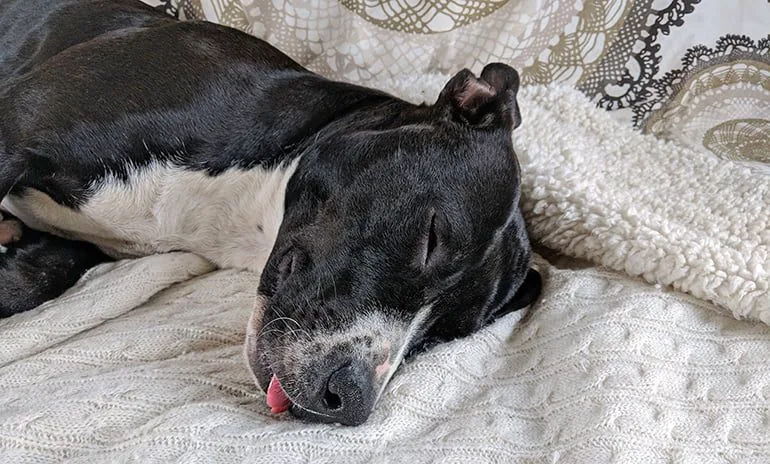
Generally, a dog sleeping with its tongue out does so because it's completely relaxed. Its muscles relax so much that its mouth falls slightly open and its tongue peeks out, becoming visible. This can happen in any sleeping position, though it's more common to see when it's lying on its side or fully stretched out.
This posture also tells us it's calm and comfortable. In other words, it's a good sign. Since dogs are able to fall into a deep sleep at any time of day, we might see them sleeping with their tongue out both during the day and at night.
We shouldn't bother them or do anything to tuck the tongue back into the mouth. It'll do so on its own once it wakes up or changes position. Keep in mind it's essential to give your dog comfortable, sheltered spots to sleep and let it do so uninterrupted. Lack of sleep affects its wellbeing.
The Problems of Brachycephalic Dogs
Although every dog could end up sticking out its tongue while sleeping, the truth is this is a much more common occurrence in those with a short muzzle — the brachycephalic breeds.
These breeds are precisely characterized by a wide skull, a short muzzle, and a flattened nose. They're very well-known, popular breeds, like Bulldogs, Boxers, Pekingese, or Pugs. They usually have respiratory issues and snore.
The Sleep Cycle in Dogs
Sometimes sticking out the tongue is part of a broader set of movements linked to a specific sleep phase, known as REM, short for Rapid Eye Movement. During this deep sleep phase, which lasts a few minutes, brain activity spikes, breathing speeds up, and heart rate increases.
We'll notice the dog moving. Its legs will especially stand out, as if it were running. Different body parts, like the ears, eyes, or mouth, twitch or spasm slightly. The eyes and mouth may open, and the dog, fully asleep, may make various sounds like whimpering, barking, or howling.
It may also stick out its tongue in this state. This is a physiological sleep phase. It doesn't indicate any illness, and, of course, we don't need to intervene. Normally it'll stop within a few minutes and the dog will keep sleeping. Other times it'll wake up, perhaps a bit startled. Within seconds, it'll get its bearings.
The Important Role of a Dog's Tongue
A dog's tongue isn't just important for eating or interacting with its surroundings. Sticking out its tongue helps it regulate its temperature. Dogs lack the abundance of sweat glands humans have — in dogs, these are only found in the paw pads.
That's why they're not enough to lower body temperature when exposed to high temperatures. To cool off, dogs rely on the panting mechanism, fully opening their mouth and sticking out their tongue completely. This way, warm air evaporates from its surface, lowering the temperature.
On another note, exploring their surroundings with the tongue exposes it to damage from foreign objects. Bone fragments, plant pieces, splinters, and so on are some of the things dogs can come into contact with, injuring the tongue. An injury can keep it hanging out of the mouth. The dog will also paw at itself, drool, or lick its lips nonstop.
When to See a Vet
Sleeping with the tongue out isn't concerning, but if the dog, once awake, can't manage to tuck its tongue back into its mouth, you should see a vet. For example, if you spot a foreign object you can't remove. Also, swelling of the tongue could prevent it from fully retracting into the mouth.
This is rare, but it could happen, for example, after a bee, wasp, or spider bite. The bite area will swell, and the dog will feel pain. Also, the swelling can spread to the rest of the face and even the neck. Keep in mind that if there's more than one sting, the dog could go into shock from toxin absorption.
Another serious allergic reaction is anaphylactic shock. In this case, you need to see a vet. On another note, tongue out combined with other signs like intense panting, reddened gums, excessive drooling, or vomiting can indicate heatstroke. This is an emergency requiring immediate veterinary attention.
Bibliography Carlson and Giffin. 2002. Dog Owner's Home Veterinary Handbook. Madrid: Editorial el Drac.
IMPORTANT: This article is for informational purposes only and does not constitute veterinary, nutritional or behavioural advice. Every dog is different, and only your trusted vet can advise you on its specific needs.