 Care
Care
My Dog Eats Everything — Pica Syndrome?
Pica is the name given to the syndrome characterized by eating all kinds of non-food materials. It's considered an eating behavior disorder and can have various causes, both physical and psychological.
The name comes from Pica pica, the scientific name for the magpie. This bird is known for stealing all sorts of objects, which it hoards in its nest. If we notice this behavior in our dog, we should consult the vet. Let's take a detailed look at what this condition involves.
What Does a Dog With Pica Eat?
Dogs with pica can still eat a normal diet, meaning they'll eat whatever menu we've chosen to offer them. But in addition, they'll swallow or lick, more or less compulsively, materials like dirt, chalk, plaster, paint, wood, cigarettes, or paper of all kinds.
What Causes Pica?
It's common to assume that if we see a dog eating paint or a similar substance, it's due to a nutritional deficiency. But nowadays, it's actually quite rare for a dog to have gaps in its diet. Even the lowest-cost dog food lines usually meet minimum requirements for dogs of all ages.
That's why, although a problem with nutrient processing called malabsorption could exist, there are other causes, both physical and psychological, that the vet needs to assess in this situation.
Let's take a detailed look at some of the possible causes of pica:
Malabsorption Syndrome
These dogs will eat normally, but since their body isn't able to properly absorb nutrients, they'll always seem hungry. They eat everything in an attempt to get nourishment. They also suffer from diarrhea and weight loss. There are several causes of malabsorption.
These are linked to problems in the small intestine or pancreas. Reaching a diagnosis requires analyzing stool samples or performing intestinal biopsies. Treatment depends on which underlying disease triggered it.
Stress
Stress can be any circumstance that causes the dog distress. For example, boredom or frustration are at the root of behaviors we could consider disruptive. In general, any circumstance that prevents the dog from expressing its natural behaviors will produce what we know as stress.
Not letting it get enough exercise, keeping it confined to small spaces, tied up, without socialization, or alone for many hours are situations that lead a dog to develop destructive and self-destructive behaviors, among which pica can appear.
These behaviors, once the vet has ruled out a physical cause, are treated by ethologists. These specialists in canine behavior study the dog's routine and introduce the changes needed to improve its wellbeing.
Cognitive Dysfunction Syndrome
This syndrome has been compared to Alzheimer's in humans. As with us, in dogs it's also related to aging. What we'll notice is that the dog becomes disoriented, its sleep pattern changes, it hides, it seems not to recognize family members, it urinates indoors, shows repetitive stereotyped behaviors, etc.
Pica can also be found among these changes. Since these are older dogs, the vet needs to run tests to rule out that the symptoms are due to physical problems before attributing them to cognitive dysfunction. There's no cure, but quality of life can be improved.
Pica in Puppies
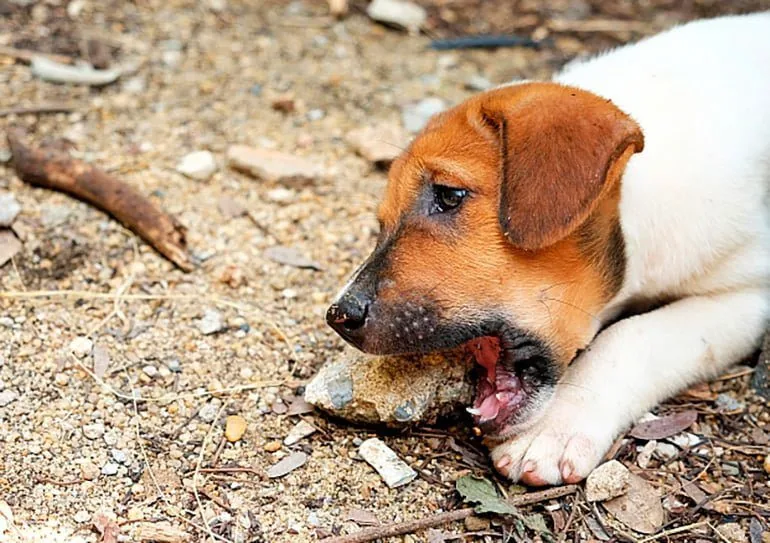
During the growth stage, dogs are characterized by exploratory behaviors. Since they don't have hands, the mouth becomes a key tool for touching, picking up, and handling objects.
That's why it's not unusual for puppies, in their eagerness to discover the world, to end up eating all sorts of substances. But this behavior should stop once they leave this stage behind.
Dangers of Pica
When a dog swallows non-digestible substances, it risks intestinal obstruction, along with milder gastrointestinal discomfort. This mainly includes vomiting, diarrhea, or constipation, depending on the materials eaten. It can also pick up digestive parasites.
In addition, if the dog eats lead, it can suffer serious poisoning. Lead is found in some paints, linoleum, plaster, batteries, some plumbing materials, solder, putty, etc.
Poisoning results from prolonged contact. Symptoms include vomiting, seizures, lack of coordination, constant barking, nervousness, weakness, or blindness. This is a veterinary emergency.
Is There a Treatment for Pica?
If we notice a case like the one described, we should see a vet. This professional, through examining the dog and building its medical history, will look for or rule out a physical cause. Treatment will depend on this.
Attempts will be made to identify parasites in the stool, foreign bodies through X-rays, or systemic diseases through bloodwork. If the dog turns out to be completely healthy, the problem may have a psychological origin.
If so, having an ethologist or a canine behavior specialist involved can give us guidance for resolving the disorder. This will most likely involve modifying the dog's living conditions. In addition, we need to do everything possible to keep it from accessing the substances it finds appealing to eat.
Bibliography Carlson and Giffin. 2002. Manual práctico de veterinaria canina. Madrid. Editorial el Drac.
IMPORTANT: This article is for informational purposes only and does not constitute veterinary, nutritional or behavioural advice. Every dog is different, and only your trusted vet can advise you on its specific needs.