 Breeds
Rhodesian Ridgeback
Native to South Africa and mischievous in behavior yet highly intelligent and loyal, the Rhodesian Ridgeback is a dog that will win you over at first sight.
Excellent as a companion dog, hunting partner, or watchdog thanks to its large size, it can also become your best friend. Want to know everything about the breed?
Characteristics of the Rhodesian Ridgeback
- Height at the withers: About 70 cm in males and 60 cm in females
- Body weight: Up to 40 kilos in males and 35 kilos in females
- Coat type: Short, in a reddish or light brown color
- Life expectancy: Around 12 years
- Temperament: Active, loyal, watchful, intelligent, stubborn, powerful
- Health: Prone to "dermoid sinus" (a congenital skin condition)
Where Does the Breed Come From?
It was European settlers arriving in southern Africa, in the interior of the Cape of Good Hope, in the 16th century who encountered a people — the Khoikhoi — who used a semi-domesticated dog to protect their livestock.
Farmers later improved the breed so it could be used as a hunting dog in unexplored African lands. They needed dogs that could flush out big game as well as protect their farms from human intruders and wild animals during the night.
They also needed a dog that could withstand the hardships of life in the African bush, able to survive drastic temperature swings (from the heat of the day to the freezing temperatures of night), and capable of going twenty-four hours without water.
They also needed it to have a short coat to avoid picking up ticks from the bush. On top of that, the dog also had to be a companion and protector for the farmer's wife and children. They were looking for the perfect specimen.
By the 19th century, Europeans had imported a wide variety of dogs to this part of Africa. Given the extreme climate, water scarcity, and arid terrain, it became clear that these imported dogs couldn't handle certain tasks.
Breeders noticed that, unlike the imported breeds they were trying to work with, native dogs were fully adapted and barely panted, so they took the best traits from each breed and created a super-dog they came to call the "lion dog."

What Is the Rhodesian Ridgeback Like?
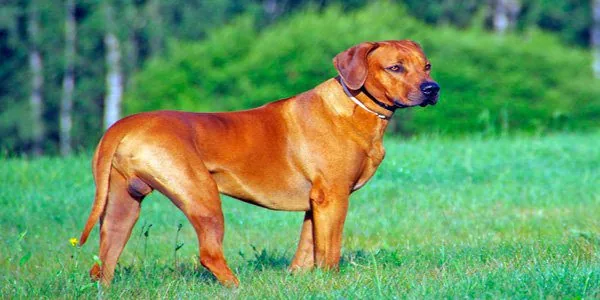
This is a dog with an impressive presence: muscular, agile, strong, and active, with a symmetrical, well-balanced build. At a glance it has an athletic stature and shape, able to cover long distances at a good pace. It carries itself with elegant agility and solidity without looking bulky.
Of course, as the breed's very name suggests, the first thing that will catch your eye about a Rhodesian Ridgeback is the distinctive ridge running along its back.
The ridge is formed by hair growing in the opposite direction to the rest of the coat. It typically starts just behind the shoulders and runs down to just before the hips. At the point where the ridge begins there are two identical crowns (whorls) directly opposite each other.
The ridge must be clearly defined and symmetrical, narrowing toward the hips. The length of the crown should not exceed 1/3 of the total length of the ridge.
A good average width for the ridge is 5 cm. That said, not every puppy is born with a ridge, since some may have more than two crowns, fewer than two, or asymmetrical ones. It can also be short or long (though the latter is very rare) or irregular in shape.
Its coat is short, dense, sleek, and glossy, without being woolly or silky. Color usually ranges from light wheaten to red wheaten or red fawn, as accepted by the breed standard. White is officially permitted on the chest and toes, but excessive white on the belly or over the toes is undesirable.
Breed Morphology
The breed standard states that males should stand around 63 to 70 cm at the withers and weigh between 36 and 41 kg. Females, as with most breeds, are a little smaller. They measure between 61 and 66 cm in height and weigh between 32 and 36.5 kg.
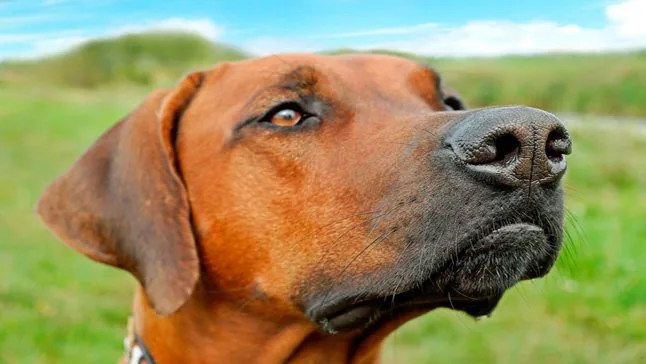
The head is of good length. It has a flat skull, fairly wide and well defined. The muzzle is long and powerful, with correctly fitted lips and strong jaws built for hunting heavy game.
The nose tends to be brown or black, usually depending on coat color. The eyes are round and expressive, in a color that always harmonizes with the coat.
As for the ears, they're set fairly high but medium in size, ending in a rounded tip and lying close to the head with a very slight, natural fold.
Looking at the body, it appears powerful, with straight, strong front legs, correct bone structure, and elbows held close to the body, which makes for a highly resilient animal. The neck shows no dewlap and flows down into a chest that isn't overly wide, being instead fairly deep and low-set. The ribs are moderately sprung beneath a powerful back that supports a strong, muscular loin. The tail is thick at the base but tapers toward the tip, which curves slightly upward.This morphology matches the standard accepted and recognized by the Real Sociedad Canina de España (RSCE), which classifies it among the scenthound, tracking-type, and related breeds.
Rhodesian Ridgeback Temperament
The Rhodesian Ridgeback is a loyal, intelligent, and independent dog, which makes it somewhat aloof with strangers without ever being aggressive.
It has a calm, dignified, gentle, and stable temperament, preferring to ignore rather than confront. Its character is strong, and it loves protecting its family.
Although as a puppy it comes across as a highly active dog, once it matures it becomes an extremely calm dog. So calm, in fact, that it can give the impression of a big, lazy hound, even though it usually carries a somewhat imposing look.
Since this dog was bred to be, among other things, a good protector of families, we're looking at an extremely tolerant, excellent companion, one that enjoys the company of other dogs, as long as too many males aren't gathered together, which could lead to dominance fights.
These dogs can get along well with cats if raised together. Because of its hunting roots, it doesn't tend to get along with very small animals, which it may view as prey.
It's a patient dog, especially with children, for whom it has a particular soft spot, although given its size and strength it's wise to stay alert while it plays with them to prevent any accidents.
They make excellent guard dogs and family protectors, but they need to know who's in charge. They're loyal and affectionate with their owner but reserved with strangers, though they rarely bark. Ridgebacks are always on alert for anything out of the ordinary.
Living Together and Training
Since it needs to be trained from puppyhood, getting one isn't recommended for people without experience or first-time owners. As with all breeds, it's important to teach it to socialize as early as possible to avoid behavioral problems down the line.
The Rhodesian trains easily, so its trainability is above average. This breed responds well to training based on positive reinforcement (using rewards).
Given their natural guarding instincts, Ridgebacks shouldn't be trained as protection dogs. Their natural protective instinct should instead be channeled through obedience training to keep it under control.
What Is Its Health Like?
Under the standard, the Rhodesian's ridge is considered an essential trait, which has traditionally led breeders to cull puppies that don't display it.
This requirement, however, can carry health consequences, since it has been shown that the mutation responsible for the ridge also predisposes the dog to a condition called "dermoid sinus."
It's generally a healthy, athletic dog. But, like all breeds, it can suffer from other conditions:
- Hip dysplasia: Genetic selection is one of the best ways to reduce its incidence, though good nutrition and moderate exercise are also crucial, helping prevent dysplasia in adulthood.
- Elbow dysplasia: Like hip dysplasia, this is a degenerative disorder affecting the joint.
- Hemophilia: A hereditary disorder that causes poor blood clotting.
IMPORTANT: This article is for informational purposes only and does not constitute veterinary, nutritional or behavioural advice. Every dog is different, and only your trusted vet can advise you on its specific needs.