 Breeds
Differences Between the Rottweiler and the Doberman
The differences between the Rottweiler and the Doberman are hard to spot at a glance if you don't know the key points that set them apart. Although both breeds are similar, there are several details that make it easy to tell them apart, such as build — heavier and sturdier in one of the two breeds — and variations in coat and nose color.
Want to know all the secrets to telling these breeds apart? Become an expert and don't miss the information SoyUnPerro has put together for you. Let's take a look!
Characteristics of the Rottweiler
The Rottweiler is an ancient breed, already known during the height of the Roman Empire for its bearing and powerful muscles. Its size ranges from medium to large; males stand between 63 and 68 centimeters at the withers, while females reach between 58 and 63 centimeters.
The head is medium-sized, with a prominent black nose. The muzzle is straight, the dog has firm black lips, and the breed has a scissor bite. The eyes are almond-shaped with a dark brown iris, while the ears are triangular and set high.
The Rottweiler has an outer coat and an undercoat. Both the inner and outer coats are coarse and thick. The breed's colors are black with tan markings on the face, neck, chest, and legs.
The Rottweiler's temperament is friendly toward its owners and other people when well socialized, though it can be possessive and rough if it doesn't get training from puppyhood. It's a good guard dog and loves physical activity. Daily, varied exercise is recommended to keep it from getting bored.
 Rottweiler
Characteristics of the Doberman
The Doberman is a dog native to Germany, where it was used for hunting. Its body is medium-sized and muscular, standing out for its agile, proud bearing. Males stand between 68 and 72 centimeters at the withers, while females reach 63 to 68 centimeters.
The Doberman's head is wedge-shaped, with a wide nose that can be brown or black. The muzzle is elongated with a scissor bite; the lips are black or brown. The eyes are oval-shaped, with a black or brown iris, depending on coat shade. The ears are set at the sides of the skull and hang close to the cheeks.
The Doberman has a short, smooth, dense coat, appearing in two color varieties: solid black, or dark brown with reddish markings on the face, throat, chest, legs, and thighs.
This breed is alert and protective, excelling as a guard dog. It loves exercising with its owners, since it's an active, playful companion.
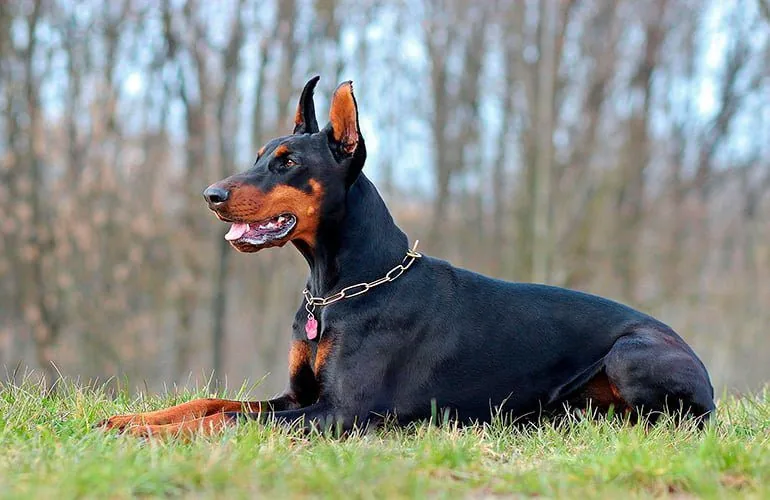 Doberman
How to Tell a Rottweiler and a Doberman Apart
As you've seen, both breeds share similarities in appearance and personality. Even so, there are several details that help tell the Rottweiler and the Doberman apart:
- Height: the Doberman is taller than the Rottweiler by several centimeters, even taller than those Rottweilers classified as large.
- Body: the Rottweiler is a sturdier dog, with a look that's even a bit heavy and imposing; the Doberman, meanwhile, stands out for its sleek body shape.
- Eyes: the Rottweiler's eyes are almond-shaped with a dark brown iris, while the Doberman's are oval-shaped and the color varies depending on coat shade, either brown or black.
- Coat color and texture: both dogs have smooth, thick coats, but the color varies: Rottweilers have dark coats with tan patches, while the Doberman, in addition to those shades, can also have a solid black coat.
- Head shape: the Rottweiler's head is shorter and sturdier, while the Doberman has an elongated, fine skull. Head shape is an important trait for telling them apart at a glance.
- Lip droop: both breeds have firm, pigmented lips; however, the Rottweiler's lips look a bit more drooping than those seen on the Doberman's muzzle.
- Stop shape: the fronto-nasal stop is mild in the Doberman, while this feature is more pronounced on the Rottweiler's head.
- Nose shape and color: both dogs have wide noses, but the color varies: it can be black or brown in the Doberman, matching the coat color, but it's always black in the Rottweiler.
- Trotting gait: the Rottweiler has a rugged look and trots when moving, often appearing a bit labored; the Doberman, on the other hand, is known for its elegant, agile bearing.
IMPORTANT: This article is for informational purposes only and does not constitute veterinary, nutritional or behavioural advice. Every dog is different, and only your trusted vet can advise you on its specific needs.