 Breeds
Samoyed
White as freshly fallen snow, with an expression that seems to smile at life itself, the Samoyed is far more than a dazzlingly beautiful dog. Forged in the frozen Siberian steppes alongside nomadic tribes, this tireless companion keeps intact a sociable, hardy, deeply loyal soul. Stepping into its world means discovering a breed that doesn't just dazzle with its polar coat, but wins hearts with a warmth to match.
The Look and Proportions of the Samoyed
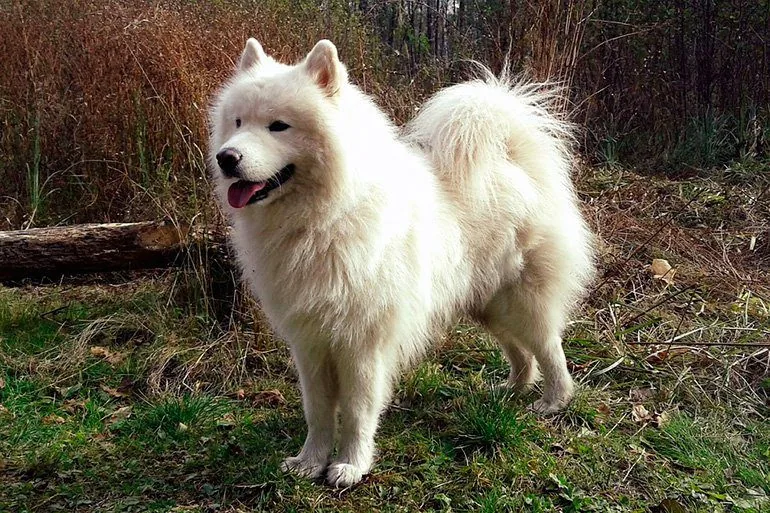
The Samoyed is a medium-sized, compact, muscular dog, built for endurance rather than pure speed. Under the official American Kennel Club (AKC) standard, males reach a height at the withers of 53 to 60 cm and a weight of 20 to 30 kg, while females fall between 48 and 53 cm and weigh 16 to 23 kg. Its silhouette, both elegant and powerful, conveys a unique combination of strength and agility.
The breed's most iconic trait is its double coat: a dense, soft, woolly undercoat and a longer, coarser outer coat that repels dirt and moisture. This coat comes in pure white, cream, or white with biscuit tones, providing exceptional insulation. The small, triangular, always-erect ears, along with the tail curled over the back, round out an unmistakable silhouette. Its life expectancy runs between 12 and 14 years, notable for a dog of its size.
Born Among Nomads of the Ice
The Samoyed's history dates back more than 3,000 years in the tundras of Siberia, between the White Sea and the Yenisei River. The nomadic Samoyed peoples didn't see them as mere working animals, but as essential survival companions. They watched over reindeer, warned of danger, and pulled sleds loaded with entire families when the ice demanded it.
That extreme cohabitation forged a hardy, intelligent, deeply cooperative dog. They slept alongside their owners to share warmth, a habit that explains the exceptionally close bond they still maintain with people today. In the late 19th century, explorers and fur traders brought the first dogs to England, where the breed began its westward expansion without losing an ounce of its Arctic essence.
A Temperament That Spreads Joy
The Samoyed's temperament is defined by contagious joy and overflowing sociability. It's an extremely family-oriented, affectionate dog that needs to feel like an active part of the household and takes part enthusiastically in any everyday activity. Its playful nature makes it an ideal companion for children and adults alike, always up for a new game or an outdoor run.
It has sharp intelligence, but it comes paired with a mischievous, independent streak that can surprise first-time owners. It loves to explore, and if it finds a way out, it won't hesitate to set off on an adventure. Some dogs can show a dominant streak, which is why early, ongoing socialization from puppyhood is essential for balancing its temperament and ensuring harmonious relationships with other dogs and people.
Secrets Only the Samoyed Holds
Beyond its Nordic beauty, this breed holds some fascinating quirks. Its world-famous "smile" — the corners of its mouth curving upward — isn't just an adorable trait, but an evolutionary trick that prevents saliva from freezing in extreme cold, keeping its face free of icicles.
On the genetic front, the breed has been the subject of relevant research. A scientific study from the Hospital for Sick Children used immunohistochemical techniques and electron microscopy to analyze extrarenal basement membranes in dogs affected by Samoyed hereditary glomerulopathy, shedding light on how this genetic disease alters fundamental structures beyond the kidney. This finding helped researchers better understand a unique condition specific to the breed.
Care and Health for the Polar White Dog
The Samoyed generally enjoys robust health, but has a predisposition to certain conditions. The most characteristic is hereditary glomerulopathy, a genetic kidney disease that can show up in young dogs. Cases of hip dysplasia, eye problems like cataracts or progressive retinal atrophy, and hypothyroidism are also seen. Regular vet check-ups and responsible monitoring are essential allies.
As for daily care, this dog needs intense daily exercise to channel its energy: runs, pulling games, or activities that stimulate its draft instinct are ideal. Its coat needs frequent brushing, especially during its two annual seasonal coat blows, when the amount of loose hair is considerable. It should never be shaved, since the double coat protects it from both cold and heat. Ongoing socialization and positive reinforcement will keep its lively, affectionate temperament balanced.
IMPORTANT: This article is for informational purposes only and does not constitute veterinary, nutritional or behavioural advice. Every dog is different, and only your trusted vet can advise you on its specific needs.