 Breeds
Spanish Alano: The Noble Catch Dog You Should Know
The Spanish Alano, an Iberian catch-dog breed with medieval roots, came to the brink of disappearing until he was officially recognised in 2004 following a breeding programme built around functional individuals. This article covers his history, standard and the keys to his temperament.
History and origins of the Spanish Alano
The name says it all: it comes from the Alans, nomads of Iranian origin who crossed into Europe during the Early Middle Ages with their catch dogs, animals bred for big-game hunting and war. Settling in Hispania, they crossbred with native mastiffs until shaping the type we recognise today. Few breeds on the Peninsula carry that pedigree, and the same could be said of the Spanish/Portuguese Water Dog. In the Middle Ages and Renaissance the Alano was key to hunting large ungulates — wild boar, deer — because his prey drive and powerful bite let him hold the animal down without releasing until the hunter arrived. A dog designed for one very specific job.
The evolution of hunting techniques and the arrival of firearms gradually pushed the Alano toward other roles. In the 17th and 18th centuries he became a regular figure in bullfighting spectacles, tasked with gripping fighting bulls, a job that demanded nerves of steel and extraordinary stamina. He also worked as a guardian of livestock and estates, where his protective character and loyalty to his owner made him especially valuable. The banning of dogs in bullfighting events and the transformation of rural life pushed the breed to the margins until it was left with almost no representatives by the first half of the 20th century.
The comeback started from the fringes. In the 1980s a handful of enthusiasts and breeders combed remote parts of Castile and León, Extremadura and Andalusia in search of functional individuals still being used to work fighting cattle. Selection criteria were based on ability, not looks. That foundation was the starting point for a breeding programme that ended in 2004 with official recognition by Spain's Real Sociedad Canina. Today the Alano is classified as a catch dog and retains intact what has always defined him. Courage, hardiness, unconditional devotion to whoever handles him.
Official Spanish Alano standard: measurements, weight and comparison with other breeds
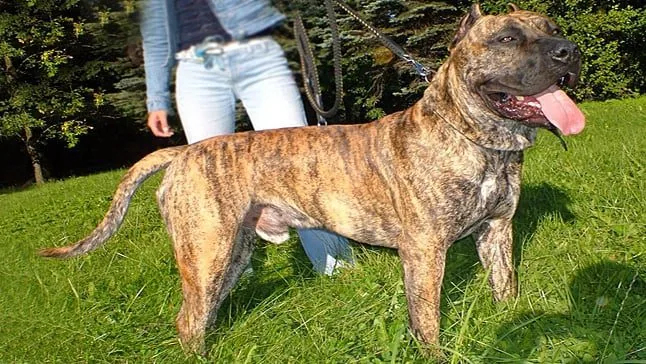
We're talking about a medium-large molosser, solid bone structure and musculature that makes clear what this dog was bred for. Males stand between 58 and 63 centimetres at the withers, weighing 30 to 40 kilos; females fall between 55 and 60 centimetres and 25 to 35 kilos. Within the group of Spanish catch-dog molossers, these measurements put him in a fairly precise middle ground: lighter and more agile than the Dogo Canario — which runs around or above 50 kilos — and considerably smaller than the Spanish Mastiff, which in many individuals exceeds 70 kilograms. That athletic build translates into real endurance and speed over short distances, two essential qualities when his job was chasing down and holding big game.
The head grabs attention right away. A wide, somewhat convex skull, a defined stop without going to extremes, and a muzzle in a 2:3 ratio to the skull. The bite is scissor or pincer. A black mask shows up fairly often and contrasts well with the coat, which allows fawn, brindle, black and combinations of these, always short, dense and lying close to the body. The ears present a dilemma today that didn't exist decades ago: where cropping is banned, they hang naturally at the sides of the skull; in more traditional working individuals, they appear cropped. The tail, thick at the base and tapering toward the tip, has a slightly curved carriage that gives the whole dog character.
There are obvious functional parallels with the Italian Cane Corso or the American Pit Bull Terrier, but that's where the resemblance ends. The Cane Corso has spent decades under selection that prioritises looks, and it shows in the type. The Alano goes the opposite way. A more primitive phenotype, greater colour variability, less morphologically polished. Serious breeders know this and cultivate it deliberately, because what's being preserved is a functional, healthy dog, without the exaggerations that in other breeds end up compromising the animal's breathing or physical structure.
The Spanish Alano has a temperament that surprises anyone arriving with preconceptions. Stable, confident, loyal to the bone. He's not the dog who lunges without thinking — he watches, weighs things up, and only then acts. With his own people he shows a tolerance that throws more than a few off guard, children included, though that doesn't mean interactions with little ones should go unsupervised by an adult. The claim that this breed is naturally aggressive has no basis: a catch dog who attacked without control would be useless in the field, and the people who selected these animals over centuries knew that perfectly well. What he does have, in abundance, is prey drive and a determination that can be misread if the dog lacks work, socialisation and a handler who knows what they're doing.
Spanish Alano temperament and character
In Spain he's included in the annex of breeds classified as potentially dangerous, with everything that entails: an administrative licence, liability insurance, lead and muzzle in public spaces. That classification comes from his physical potential and his heritage as a catch dog, not from being an unbalanced animal. Watch out for this, because the distinction matters. A well-handled Alano is a different story entirely.
As a family dog, the bond he forms is intense. He wants to be in the middle of everything, take part, tag along. Protective behaviour shows up on its own, with no training needed, and that's exactly the catch: it needs channelling before it turns into overprotectiveness. With children he's grown up around, his patience is real and notable, but his size alone is reason enough not to leave them together unsupervised.
An Alano needs a purpose. Real daily exercise, not a twenty-minute walk, and someone who sets clear boundaries without unnecessary heavy-handedness. In experienced hands, this breed's nobility and devotion to his human pack are hard to match among Spanish working dogs.
Life with other dogs and pets
The Alano has a very pronounced prey drive and a tendency to dominate others of the same sex, especially between males. That shapes, quite significantly, how he gets on with other dogs under the same roof. Individuals socialised from puppyhood with good-tempered dogs usually manage reasonably well; interactions between males are another story, requiring constant supervision. Fights over resources, hierarchy, whatever the trigger. Neutering can help lower hormonal tension, evaluated together with the vet, but without serious socialisation work behind it, it works no miracles.
With small animals — cats, rabbits, birds — things change quite a bit. The Alano comes from centuries of selection to chase, catch and hold, and that motor pattern can trigger at any creature that moves fast or bolts. It doesn't matter that they've lived together since puppyhood. Some learn to tell the family cat apart from potential prey, yes, but trusting that blindly is a mistake. Introductions need to be gradual, with physical barriers and total control at all times, and even then the margin of risk doesn't disappear. That's why many experienced owners simply choose not to mix: no small animals in the house, or genuine physical separation whenever nobody's supervising.
In a rural setting he can live alongside livestock if habituated from puppyhood, but his reaction to moving animals demands expert handling. He's a catch dog, and although some individuals learn to respect the cattle they work with, the instinct can surface at an unexpected moment. Watch out for this: ongoing socialisation protocol, reliable obedience at a distance, and a muzzle in public spaces and on walks, as required by the regulations for potentially dangerous breeds. No shortcuts.
The Spanish Greyhound, the Spanish Alano and other breeds with a strong prey drive aren't socialised the same way as a Labrador. They need a phased plan, with concrete goals at each stage, teaching them to manage their own impulses when something triggering appears.
4-phase socialisation protocol for dogs with a high prey drive
From three to twelve weeks, the puppy is in full imprinting mode. Everything he experiences now gets burned into memory. That's why this window needs to be filled with as wide a range of experiences as possible: people of different ages, city and countryside noises, floors that move or creak, and above all contact with well-adjusted adult dogs who teach him to communicate properly. Every one of those encounters needs to end well, whether with high-value food or play, because the goal is building an emotional memory that later acts as a counterweight to wariness.
Between three and six months comes the trickiest work. The puppy starts paying attention to cyclists, runners and small animals, and the goal is to stop those stimuli from triggering him. The technique is systematic desensitisation: exposing the dog at distances where he still doesn't react, rewarding calm and, especially, rewarding looking at you instead of staying fixated on the stimulus. This is also the time to introduce the muzzle. Watch out for this: it's done calmly and with food, no rush, until the dog associates it with something good. In parallel, tug-of-war games start with one fixed rule: the dog releases on command. That gives the instinct an outlet and strengthens the bond.
From six to twelve months the puppy enters adolescence and impulsivity rises. Here the focus is on self-control. Waiting before going through a door, staying still until given the signal to eat, stopping mid-run at a command. These are seemingly simple exercises that gradually build an internal brake. Sessions with a lure — a rag or hide tied to a rope — are also added, where the dog learns to switch on and calm down on the handler's cue. For catch-dog breeds, this work is very effective because it channels exactly what the dog needs to do. Encounters with other dogs remain necessary, but need closer supervision as sexual maturity starts adding noise.
From one year on, the protocol doesn't end, it changes shape. It's no longer about teaching new things but about maintaining what's been learned and generalising it to more distracting places. Outings move to more complex environments, reinforcement becomes intermittent so responses stay solid even without a reward every time. The muzzle in public spaces stays on, both to comply with the law and as basic prevention. An adult Alano who stops being exposed to stimuli can regress behaviourally, and that regression is hard to win back. Consistency here isn't optional.
Spanish Alano training and education
Training the Spanish Alano needs to rest on the principles of positive reinforcement and consistency, avoiding punishment-based or confrontational methods, which in this breed can produce distrust or defensive responses. This is an intelligent dog with a notable capacity to learn, but also with a strong independence of judgement: he doesn't execute commands mechanically — he weighs the usefulness of what's being asked. The handler therefore needs to build a cooperative relationship where the dog finds intrinsic motivation to collaborate, using rewards he genuinely values — food, tug play or access to something he wants — and proposing short, dynamic sessions free of monotony.
Basic obedience — sit, stay, heel, recall — should be established from the first months, but the real challenge with a catch dog is achieving reliability under high arousal. An Alano who responds perfectly in the living room can ignore recall if he's fixated on something moving. To overcome this limitation, training needs to progress gradually from controlled environments to distraction-filled spaces, and recall should always be paired with a top-value reward, never with a negative experience like the end of the walk. Work with a whistle or visual signals can be an effective complement for grabbing attention at a distance.
One fundamental piece is bite inhibition, which needs working on during puppyhood, teaching the dog to gauge his mouth pressure during play. In an adult dog this size, a poorly controlled bite, even in a playful context, can have serious consequences. On top of this, the Alano benefits enormously from dog sports like mondioring, tracking or agility, which channel his physical and mental energy and strengthen the bond with the handler. These disciplines let the dog express his innate motor patterns within a structured framework, reducing the odds of unwanted behaviours surfacing in daily life.
The Spanish Alano eats differently depending on the stage of life he's in, and understanding that can be the difference between a healthy animal and one with chronic problems. There's something more urgent than fine-tuning the kibble's protein content: gastric dilatation-volvulus, an emergency that in deep-chested breeds like this one can kill within hours. A UK study documented gastric torsion as a cause of death in 65 of 165 purebreds analysed, with at least one episode recorded in 48 of 169 breeds ‘Mortality and morbidity due to gastric dilatation-volvulus syndrome in pedigree dogs…’ (2010). The feeding plan needs to be built with that always in mind.
Feeding by life stage: nutritional plan and preventing bloat
Up to 12 months, the puppy needs kibble designed for large breeds, with controlled calcium and phosphorus levels. Growing too fast wrecks the joints. Three or four meals a day, small portions, and no running right after eating. A minimum two-hour gap before any intense exercise.
From 12–18 months things change: the goal shifts to sustaining muscle and keeping up with the activity a dog who needs 60 to 90 minutes of real daily movement demands. A diet with 25-30% animal protein and 15-18% fat usually works well, though every animal has its own metabolism and workload. Here the trick against bloat is simple to explain and easy to forget: two meals a day, anti-gulping bowls if the dog wolfs food without pausing to breathe, and water in small amounts before and after meals, never gulped down all at once. Watch out with raised feeders: the evidence on whether they help or worsen bloat is mixed, so they're not the fix they appear to be. An analysis of 88,635 dogs identified ten hereditary conditions more common in purebreds than in mixed breeds, gastric torsion among them ‘Ten inherited disorders in purebred dogs by functional breed groupings’ (2015). The Alano falls into that risk group.
Recognising an episode in time saves lives. A swollen abdomen, unsuccessful attempts to vomit, a dog who won't settle: go straight to the vet clinic. Every minute counts. Past 7-8 years, the dog enters a stage where the body needs fewer calories but more joint support, and adding omega-3s and joint supplements makes a real difference long term. The anti-bloat guidelines, however, never retire. They stay in place for life.
Spanish Alano health and diseases
Breeding the Alano has always prioritised performance over extreme morphology, and that has direct consequences for his health. Fewer serious hereditary diseases than in other, more specialised molosser breeds. Life expectancy runs around 10 to 12 years, typical for a dog this size. Even so, there are breed-specific conditions every owner should know about before they show up.
Hip and elbow dysplasia top the list. These are orthopaedic problems with a genetic component, but environment matters too. A puppy who gains weight too fast or exercises intensely before he's fully developed carries more risk. Choosing a breeder who X-rays their breeding stock makes a real difference long term. Entropion also shows up in some individuals. The eyelid rolls inward and rubs against the cornea; when the irritation is persistent, surgery is needed.
Atopic dermatitis is another front to watch. Chronic itching, red skin, infections that keep coming back. There are no specific studies on its prevalence in the Alano, but it's documented in short-haired breeds and can be triggered by both environmental allergens and diet. Managing it means identifying the trigger, hypoallergenic shampoos and, if the response isn't enough, immunomodulators under veterinary supervision. Gastric torsion has its own section under diet; here it's enough to note that the symptoms need to be recognised fast, because time is what you have.
At least one annual vet check-up catches problems that at first glance go unnoticed. Aortic stenosis is a good example. It's a hereditary heart condition that can go years with no signs before suddenly leading to collapse. Working from the start with a breeder who health-tests their breeding stock and operates under Spain's Real Sociedad Canina standards considerably reduces this kind of risk. For anyone considering an Alano, the logical step is contacting the breed's official club, visiting several breeders and observing adult dogs in person. Health certifications and pedigree aren't optional paperwork.
IMPORTANT: This article is for informational purposes only and does not constitute veterinary, nutritional or behavioural advice. Every dog is different, and only your trusted vet can advise you on its specific needs.