 Care
Care
Causes of a Swollen Belly in Dogs
Our dog's belly can swell up for various reasons. Their physical characteristics and age are factors that help guide the diagnosis, since there isn't just one single cause. So, how serious the condition is can also vary.
Regular internal deworming and quality food are the basics for preventing our dog's belly from swelling. Let's take a detailed look at the main causes that can lead to this type of swelling.
Why does my dog have a swollen belly?
There are several causes that can lead to our dog's abdomen swelling. It's important to note the circumstances it happened under and whether there are other symptoms, so we can tell the vet and help them reach a diagnosis. The most common causes are:
- Intestinal parasites.
- Diet-related issues.
- Gas.
- Intestinal obstruction.
- Gastric dilatation-volvulus (bloat).
- Ascites.
- Pregnancy.
My puppy has a swollen belly
It's not unusual for puppies to have a swollen abdomen. The most common cause of this sign is internal parasites. Different types of worms are more common in younger dogs due to several factors — some can catch them directly from their mother, others from contact with contaminated surfaces or infested feces.
What's more, their immature immune system still can't manage them. Intestinal parasites can also cause other symptoms such as diarrhea, vomiting, poor coat condition, malnutrition, or anemia. But puppies can also have a swollen belly from poor feeding practices, especially the smallest puppies.
If, for example, when starting them on solid food we prepare a mash of kibble and water that's too hot, their belly will swell. With orphaned nursing puppies that need to be fed formula made for dogs, we need to strictly follow the recommended amounts to avoid digestive problems, which can be serious.
My dog's stomach makes a lot of noise and they have gas
This problem can affect dogs of any age. By gas, we mean gas buildup in the digestive system. Borborygmi are the sounds that can be heard coming from the abdomen. Both phenomena can have different causes.
It's common for a dog to wolf down their food, which means they swallow large amounts of air. It can also be due to eating highly fermentable foods. But there are causes that are more complex to resolve, such as malabsorption syndromes. In this last case, a vet visit is essential.
Intestinal obstruction in dogs
Sometimes the belly swells because something is blocking the digestive tract. Foreign objects, intussusception (when a segment of intestine telescopes into another), tumors, hernias, etc. can cause a blockage. The obstruction can be partial or complete.
Other symptoms this causes are vomiting or abdominal pain. It can be diagnosed with an X-ray. The blockage needs to be relieved as soon as possible to prevent serious complications such as intestinal strangulation.
Gastric dilatation-volvulus (bloat) in dogs
This is a serious condition affecting large dogs more, precisely due to their body shape. As the name suggests, what happens is that the stomach dilates enormously, and in some more severe cases, it twists on its own long axis.
First, the stomach fills with gas and fluids the dog can't get rid of. If the stomach twists, it becomes essentially sealed off. What's more, blood supply is compromised, resulting in tissue death in the affected area.
This is a very serious condition requiring prompt veterinary care. It tends to happen when the dog suddenly eats or drinks large amounts, or when they do so right after intense physical activity.
Ascites in dogs
Ascites is the term for fluid buildup in the abdomen. There are various causes that can explain it, such as heart, liver, or kidney problems. Ascites is more common in older dogs.
It's usually accompanied by other symptoms, depending on the cause. These notably include exercise intolerance, coughing, vomiting, yellowish mucous membranes, loss of appetite, or weight loss. The vet needs to run various tests to reach a diagnosis.
Signs of pregnancy in a female dog
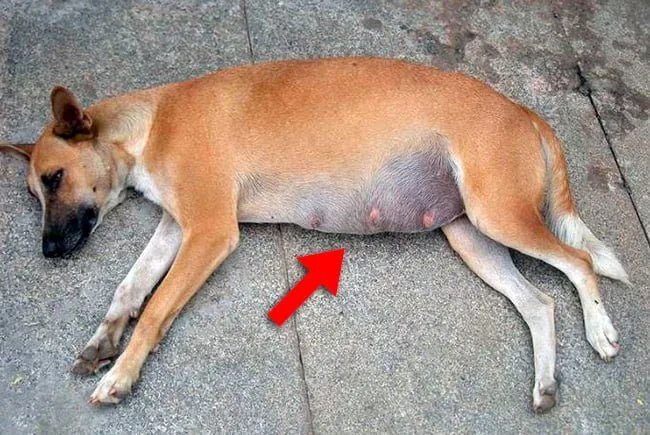
Lastly, we should mention pregnancy, since for some owners both the heat cycle and mating can go unnoticed. They may only notice abdominal swelling in the final weeks of pregnancy, which usually lasts about two months.
Keep in mind that female dogs can start their heat cycle as early as six months old, and in some cases we might not notice the heat at all. Having an intact female — that is, not spayed — means a risk of pregnancy at every heat cycle, which happens twice a year.
What should I do if my dog has a swollen belly?
The most important thing is to observe the dog's overall condition and check for other symptoms. If, for example, it coincides with an episode of overeating, the dog should improve within a few hours.
But if there are other symptoms, or it's a puppy, a dog already diagnosed with another condition, or an older dog, you should check with the vet. Remember that problems like gastric dilatation-volvulus can be fatal within hours.
Can abdominal bloating in dogs be prevented?
Keeping the following measures in mind can help prevent, as much as possible, gastrointestinal problems that can cause your dog's belly to swell:
- Deworm and vaccinate following the schedule set by the vet.
- Give quality food, following the manufacturer's instructions for preparation and portions.
- Keep a safe environment where the dog can't swallow dangerous substances.
- Don't give them large amounts of food or water right after intense exercise.
- Have your dog checked once a year starting at age seven.
- Neuter/spay them to prevent unwanted pregnancies.
Bibliography Carlson and Giffin. 2002. Manual práctico de veterinaria canina. Madrid. Editorial el Drac.
IMPORTANT: This article is for informational purposes only and does not constitute veterinary, nutritional or behavioural advice. Every dog is different, and only your trusted vet can advise you on its specific needs.