 Breeds
Toy Poodle: Complete Guide and Essential Care
The Toy Poodle is much more than a small dog with a delicate look: his curly coat, which needs brushing at least every 2-3 days, makes him an option for anyone looking to minimise shedding at home, and his sharp intelligence calls for early socialisation to avoid behavioural problems.
Physical characteristics and colours of the Toy Poodle
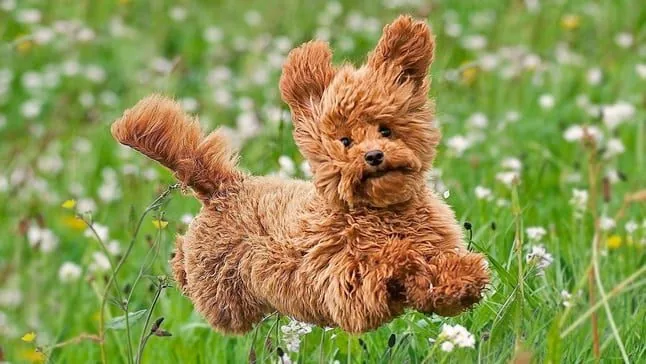
The toy is the smallest Poodle variety there is. The Fédération Cynologique Internationale sets his weight between 2 and 3 kilos, with a maximum height of 28 centimetres at the withers. A square body, fine bones without looking fragile, and that lively gaze that's practically his hallmark. The head follows a straight line with a barely noticeable stop, and the ears fall close to the cheeks, covered in that dense, wavy hair finishing off his whole silhouette.
The coat is what draws the most attention in this breed. Curly or corded, with a woolly texture and no undercoat, it grows continuously for much longer than in other breeds, and dead hair doesn't fall to the floor — it stays trapped within the curl. That's why it barely dirties the house and why many people with allergies choose him, though watch out: no dog is 100% hypoallergenic. That same density in the curl that traps dander and allergens is also what makes regular combing and clipping essential, since otherwise tangles show up sooner than you'd expect.
Colours accepted by the standard include black, white, brown, grey, apricot and red, among others. In shows, solid-coloured individuals are the most highly valued, though diluted shades like silver or cream have their own following. Nose, lip and eyelid pigmentation should match the coat, and any white patch on a dark coat counts as a fault. Colour doesn't change the animal's temperament or health, but it can hint at breeding lines, something worth checking when looking for a puppy.
Toy Poodle temperament and behaviour
Few small dogs combine as much intelligence with as much sensitivity. The Toy Poodle reads the emotional state of those around him with an ease that can be disconcerting, and that same quality makes him highly responsive to positive training. The problem shows up in households with an unstable atmosphere or rules that change depending on the day's mood. He picks up on it, it builds up, and he ends up responding with insecurity or avoiding situations that never used to bother him.
Socialisation in the first weeks changes everything. A puppy exposed to noises, strangers, other animals and varied environments usually grows into a balanced adult. One who hasn't gone through that tends toward shyness or overreacting to things another dog wouldn't even notice. Aggression isn't his thing, but his size puts him at an easy disadvantage, and without the tools to handle that feeling, barking ends up being the only language he knows how to use. Excessive barking has more to do with what he wasn't taught than with any innate breed trait.
From puppyhood it's also worth working on his ability to be left alone. This dog bonds strongly with his family, and if that attachment isn't managed, solitude becomes a genuine trigger. Short outings, coming back without making a fuss, and keeping predictable routines help just as much as daily physical exercise. With that groundwork done, that same attached, sensitive temperament becomes the very trait that makes this breed special. Calm, affectionate, adaptable to almost any situation.
Toy, Miniature and the "mini toy" that doesn't exist: what the official standard says
Four varieties, four size ranges. That's what the FCI has on record for the Poodle. The toy doesn't exceed 28 centimetres at the withers, with an ideal weight of 2 to 3 kilos; the miniature covers 28 to 35 centimetres and 3 to 5 kilos. Then come the medium (35-45 cm, 5-8 kg) and the standard, reaching up to 60 centimetres and 12 kilos. Build, proportions, temperament — the standard is identical across all varieties. What changes is height, and in the smallest individuals a somewhat finer bone structure can sometimes be seen. Nothing more.
The "mini toy" or "teacup" doesn't appear in any official document from any kennel federation. None. It's a marketing hook, full stop. Behind that label are usually dogs smaller than the standard's minimum, obtained by systematically breeding from the runtiest puppies in each litter, or through even more questionable practices that put the health of mothers and puppies at risk. Watch out for what follows: severe bone fragility, recurring hypoglycaemia, open fontanelles, compromised immunity. These aren't isolated cases. They're the usual consequences of pushing miniaturisation past what the animal's biology can bear.
If what you're after is a small companion Poodle, the official toy already marks the reasonable limit. Past that size, the breed's biology stops keeping up. When a breeder advertises "micro toy", "mini toy" or "teacup", they're sending up warning signs worth heeding. An individual within the standard, with parents backed by verifiable health tests, is what makes sense to choose — not a size the breed can't sustain without a cost.
Health and hereditary diseases: patellar luxation and eye problems
Patellar luxation is one of the most common orthopaedic conditions in the Toy Poodle. It happens when the kneecap shifts out of its trochlear groove, usually medially, due to a combination of anatomical factors like a shallow groove and abnormal alignment of the extensor mechanism. The risk of developing it is significantly higher in small dogs than in large ones, and it may be more common in females than males; Toy Poodles are among the predisposed breeds, along with the Papillon. Clinical signs range from an intermittent skip during walking to persistent lameness requiring surgical correction. Vet palpation diagnoses the degree of luxation, and while moderate exercise helps maintain supporting muscle, only surgery can resolve advanced cases.
On the eye front, progressive rod-cone degeneration (PRCD) is a silent threat. It's a hereditary, autosomal recessive disorder with mid-to-late onset, caused by the c.5G>A substitution in the PRCD gene, leading to progressive loss of photoreceptors ‘Real-time PCR genotyping assay for canine progressive rod-cone degeneration and…’ (2015). The first symptoms are usually difficulty seeing in low light, progressing to total blindness over the years. Being a recessively inherited disease, a dog can be a carrier without developing it, which is why genetic tests are the only reliable tool for identifying at-risk breeding stock and preventing transmission to offspring.
Beyond these two conditions, the Toy Poodle shares with other miniature breeds like the Miniature Pinscher a predisposition to fractures in the distal radius and ulna. Fractures occurring in the distal radius and ulna in toy breeds like the Miniature Schnauzer present distinctive challenges for vets, requiring specialised treatment approaches based mainly on stabilisation with reduced-size plates and screws ‘Elucidation of the radius and ulna fracture mechanisms in toy poodle…’ (2024). These injuries usually happen from jumps off heights that would be inconsequential for a larger dog, like a sofa or a bed. Prevention means controlling access to elevated surfaces and maintaining a body weight that doesn't overload bone structures already fairly delicate. Other conditions worth watching include Legg-Calvé-Perthes disease, tracheal collapse and dental problems stemming from crowding in a small jaw.
How to spot a Toy Poodle breeder who does things right
The vaccination record is the bare minimum. A breeder who works thoughtfully will put on the table the parents' DNA test results — especially the ones ruling out the mutation responsible for PRCD — eye certificates and a patellar luxation assessment. Without that, you're buying blind. The pedigree needs to be in order, the breeder should belong to a recognised breed club, and if they make any excuse to avoid letting you visit the facility and meet the mother, you already have the answer you needed.
In Spain, a puppy from a breeder meeting all this criteria has a price that varies quite a bit depending on the bloodline, how rare the colour is and the breeder's reputation. It isn't cheap. But the vet expenses you save when the dog doesn't carry hereditary conditions far outweigh that initial investment, not counting what it's like watching a sick animal at home.
The terms "mini toy" or "teacup" don't appear in any recognised breed standard, and when a breeder uses them, it's usually a sign something's off. The same goes for anyone handing over puppies under eight weeks old or dodging any question about health. There, the priorities are clear, and they aren't the dog's.
Why the Toy Poodle needs both mind and body active
The Toy Poodle is clever. More than he looks. He has the cognitive capacity of a working dog, which means rethinking what it means to care for him properly. Giving him just one daily walk doesn't cover his needs. His mind needs keeping occupied: scent searches, puzzles, short positive-training sessions, changes of scenery. When that's missing, things shift: barking for no apparent reason starts up, objects get destroyed, and the dog shows an anxiety that never needed to be there.
Caring for him properly involves more fronts than it seems. Lead walks need to let him stop and sniff, because that's how he reads the world. Games should be interactive, not just about movement. Regular grooming prevents skin problems, and the mouth needs regular cleaning — in small-headed breeds, periodontal disease sets in easily and goes unnoticed for a long time. Vet check-ups should focus on the joints and eyes, since that's where this breed has the most chance of developing problems. Body and mind, on equal footing.
With maturity come more options. Agility adapted to his size or hoopers are activities he can thoroughly enjoy, provided a professional sets the pace and adjusts demands to what his body can handle. He can live perfectly well in a flat if he gets his daily walks and has something to occupy his mind.
Toy Poodle grooming and coat trimming
The Toy Poodle's hair doesn't shed. That's the first thing to understand. Being curly, dead hair stays trapped within the curls instead of falling out, and if you don't remove it regularly it ends up forming compact tangles that pull on the skin. Two or three days is the maximum you can go between brushings before the problem starts. To do it properly you need a blunt-tipped metal-pin brush, backed up with a steel comb for the trickier areas: armpits, groin and behind the ears. A well-aired, tangle-free coat also protects the skin from moisture-related dermatitis, which shows up more often than you'd think with this coat type.
Taking the Toy Poodle to the groomer every four to six weeks is basic maintenance, full stop. There's plenty of variety in styles. The lion clip — with the hindquarters shaved and abundant hair on the head and front — has centuries of history behind it and remains a favourite in dog shows. For everyday life, many owners prefer the puppy clip, which leaves an even length and makes home brushing considerably easier, or some shorter sporty variant. Whatever style is chosen, a hygienic trim around the perianal and genital area is non-negotiable. Without it, dirt builds up with very specific consequences. Full grooming also means cleaning the ears with specific solutions, trimming the nails every three or four weeks, and bathing the dog with gentle shampoos that respect his skin's pH, roughly once a month, unless he's gotten filthy before then.
After a good grooming session, where the dog sleeps matters more than it seems. The Toy Poodle needs to sleep indoors, always, with a comfortable bed in a quiet corner but with human activity nearby. His person's bedroom is usually the best option. Sensing the social group's presence while sleeping greatly reduces the chances of developing separation anxiety. A cold, noisy or overly isolated corner can generate insecurity, and that ends up translating into behavioural problems during the day. Bed placement affects the dog's temperament. It's as direct as that.
Where a Toy Poodle should sleep
The Toy Poodle has a coat with no undercoat, little body fat and just a few kilos of weight. That combination makes him very sensitive to temperature changes and draughts. Sleeping outdoors is out of the question, even with a kennel and well-arranged blankets. His body isn't equipped to handle that thermal stress. On top of that comes the social dimension, because this dog needs to be close to the people he lives with. Separating him at night goes against something fairly basic in how he functions.
Inside the bedroom of the person he's most bonded with, the most practical option is leaving him a specific bed or a travel crate with the door open. The crate, if worked with from the start using positive reinforcement, ends up becoming his own personal den, the corner he goes to when he wants peace. It's most appreciated as a puppy, since it helps with house training and prevents nighttime accidents; as an adult, it still serves as a personal retreat. If choosing a bed, go for one with some thickness, raised edges he can rest his head against while falling asleep, and set away from direct draughts.
Routine does more for a Toy Poodle's rest than any designer bed. Keeping the last walk of the day at roughly the same time, and not letting bedtime vary too much from one day to the next, stabilises his sleep cycles and reduces night-time waking, both the anxious kind and the purely physical kind. When a dog genuinely rests, it shows the next day. He handles frustration better, doesn't overreact to every stimulus, and learns more easily.
When a Toy Poodle sleeps nearby, with controlled temperature and stable schedules, the change in his everyday behaviour is visible. Checking today how yours is sleeping, and adjusting whatever's needed if the space doesn't meet those criteria, is one of the highest-return changes any owner can make.
IMPORTANT: This article is for informational purposes only and does not constitute veterinary, nutritional or behavioural advice. Every dog is different, and only your trusted vet can advise you on its specific needs.