 Care
Care
Types of Cancer in Dogs and Their Characteristics
There are many types of cancer in dogs that are easy to spot, while others are hidden at first glance and require specific veterinary tests to detect. We'll explain the most common types of cancer in dogs and their characteristics.
Keep in mind that even if your dog shows the same symptoms you read about in this article, various veterinary tests are absolutely necessary to confirm whether it's actually cancer.
Skin cancer
Skin cancer is one of the most common cancers in dogs, since they spend long hours exposed to the sun's harmful effects. We all know dogs love lying down, relaxing, and sleeping in the sun, soaking up its warmth. This is also because sunlight lets them gather vitamin A in their coat, which they later absorb by licking it (they don't absorb it through the skin).
The sun is getting stronger and more harmful on our planet, which is why it's a good idea to use sunscreen before spending time in it. Dogs don't use any kind of sun protection, and although their skin is almost entirely covered by their fur, sometimes this isn't enough to prevent prolonged, harmful exposure.
Skin irritation, hair loss, skin rashes, or small lumps can be the first symptoms of skin cancer. If we notice any of these cancer symptoms, we should see a vet right away and run the necessary tests.
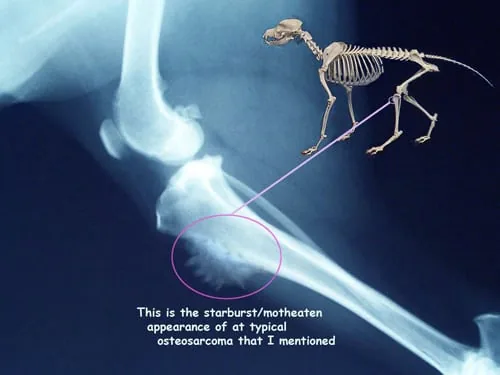
Bone cancer
Unfortunately, this type of cancer is invisible to the naked eye — there's nothing we can spot on the surface of the dog that would signal bone cancer.
This makes it much harder to catch early, when it first starts, so it's usually detected too late. It's also a fairly aggressive type of cancer, which progresses very quickly and can end a dog's life within a few months, even while undergoing cancer treatment.
Larger dogs are the ones most likely to develop it — many studies confirm this type of cancer is mainly linked to poor-quality diet. Low-quality dog kibble sometimes contains excess fluoride, which is a leading cause of bone cancer.
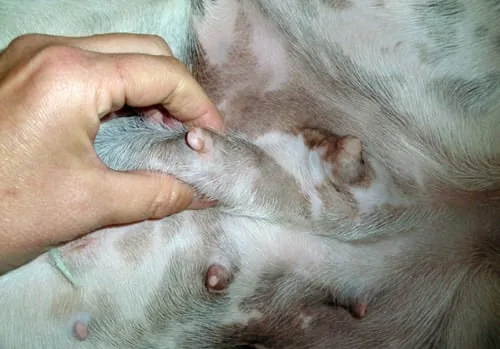
Breast cancer
This is without a doubt the most widespread type of cancer among female dogs, which can avoid it with a simple full spay while young. If we don't plan on our female dog having puppies, it's best to spay her at a vet clinic.
This way, we can prevent breast cancer with more than an eighty percent chance of success. A female dog doesn't necessarily have to have given birth to develop breast cancer, but the actual root causes remain unknown.
Among the different types of cancer, breast cancer is very easy to spot, since it shows up as lumps or sores on our dog's mammary glands. If this happens, we should see a vet to run tests and get a definitive diagnosis.
Examples of tumor presentations
Below we'll go over the most common presentation of the tumors dogs most frequently develop. This doesn't mean that whenever we find, say, a wart, it's malignant cancer. But we should still check with the vet.
Cutaneous papilloma
This looks like a wart appearing on the skin anywhere on the body, on the paw pads, or behind the claws. More common in older dogs. These are benign, and it's not even always necessary to remove them.
Lipoma
A rounded lump with a soft, doughy texture. It usually grows slowly. More common in overweight females. These are typically benign. They're removed if they interfere with the dog's quality of life.
Histiocytoma
Its appearance resembles a button. A small, hairless raised bump forms, which can appear anywhere on the body. It tends to grow quickly. It affects young dogs more, between one and three years old. Many disappear on their own.
Sebaceous adenoma
Forms in the sebaceous glands. It's often seen on the eyelids or limbs. Can be single or multiple. It's a soft, lobulated lump on a kind of stalk.
The surface is hairless and can also ulcerate. It mainly affects older dogs. It's more common in Boston Terriers and Cocker Spaniels around 9-10 years old. Most are benign.
Mast cell tumor
Although its appearance varies a lot, the typical form is a multinodular, reddened, hairless, ulcerated lump. These tumors are common. They affect brachycephalic breeds more, from around nine years old onward.
They appear on the trunk, perineum, lower abdomen, prepuce, and hind legs. Another symptom of mast cell tumors is gastroduodenal ulcers. There are as many malignant cases as benign ones.
Squamous cell carcinoma
Its appearance varies. It can look like a hard, flat, grayish ulcer, a hardened red patch, or a lump resembling a cauliflower. With or without hair loss. Since it's caused by UV radiation, it appears in areas with little pigmentation.
Melanoma
Produces a brown or black nodule in heavily pigmented areas of skin such as the eyelids, lips, or limbs. Seen more often in breeds like the Scottish Terrier, Boston Terrier, or Cocker Spaniel. Those in the mouth or under the nails are usually malignant.
Lymphoma
Enlarged lymph nodes are found in the groin, armpit, neck, or chest. The dog stops eating, loses weight, and becomes listless. The liver and spleen also enlarge.
When it affects the chest, pleural effusion can occur, causing breathing complications. If the skin is affected, nodules or itchy areas appear. In cases of intestinal lymphoma, the dog suffers vomiting and diarrhea. There's also anemia, and calcium levels are elevated.
Osteosarcoma
Can show up as limping followed by swelling in a leg, or a mass that can be felt in the area. Besides the front and hind legs, it's also found in the ribs and jaw.
It's more common from eight years old onward, and in giant or large breeds such as the Saint Bernard, Newfoundland, Boxer, Irish Setter, or Great Dane. It tends to be very aggressive and metastasize to the lungs.
Chondrosarcoma
Usually affects the ribs, nose, and pelvis. A large, hard swelling can be detected. More common in dogs over six years old, and unfortunately tends to be malignant and spread to the lungs.
Testicular tumor
More common in dogs with retained testicles in the groin or abdominal cavity. A mass would be noticeable in that area. If the testicle isn't retained, it will appear larger than the healthy one. It'll be hardened and show an irregular, nodular surface.
What's more, some of these tumors produce estrogen. This causes the dog to develop female-like traits, such as enlarged mammary glands, symmetric bilateral hair loss, or a drooping prepuce. The average age of onset is ten, but it can be detected from as early as six.
Transmissible venereal tumor
Can be solitary or multiple, cauliflower-shaped or nodular, single or multiple, on a stalk. Sometimes they ulcerate. They occur in the vagina and vulva in females and on the penis in males. In both, they can also be found in the perineum, face, mouth, nose, or legs.
Vaginal tumor
Warning signs include vaginal discharge or bleeding, a mass protruding from the vulva, more frequent urination, or repeated licking of the area. Larger ones can deform the perineal area and, if severe enough, obstruct the birth canal. More common in intact females around ten years old.
Ovarian tumor
These usually don't cause symptoms, but sometimes swelling in the abdominal cavity, ascites, hyperestrogenism, abnormal heat cycles, an enlarged vulva, or oilier skin and coat can be noticed.
Mammary tumor
Felt as a lump, generally in the larger mammary glands. It can be more or less large and have well-defined or poorly defined edges. The skin sometimes ulcerates and bleeds. These are very common in unspayed female dogs over six years old. They can be malignant and spread very quickly.
Leukemia
Symptoms are non-specific, which makes diagnosis harder. Fever, weight loss, loss of appetite, anemia, or pale mucous membranes appear. It's more common in middle-aged dogs.
Bibliography Carlson and Giffin. 2002. Manual práctico de veterinaria canina. Madrid. Editorial el Drac.
IMPORTANT: This article is for informational purposes only and does not constitute veterinary, nutritional or behavioural advice. Every dog is different, and only your trusted vet can advise you on its specific needs.