 Care
Care
What Do Black Gums Mean in Dogs?
Dogs' gums give us very important information about their overall health. Changes to their usual color point to the presence of different conditions. That's why it's a good idea to pay attention to them.
Most dogs, except for certain breeds like the Chow Chow, have pink gums, since black gums can have a meaning related to their health. Let's look at what causes this odd dark coloring.
What Does the Color of a Dog's Gums Mean?
Most dogs normally have gums of a pinkish tone. We can see them just by lifting the lip, and it's a good idea to make this check regularly to catch health problems early.
When a dog is sick, its gums can give us extra information about its condition. Numerous conditions affect their color. These are the colors we'll most often detect:
- Whitish: pale mucous membranes can be due to a decrease in red blood cell count. Examples of this coloring occur in anemia or bleeding.
- Yellowish: the yellow tone in the gums is usually linked to elevated bilirubin, or the destruction of red blood cells, which releases bilirubin. It can be seen in both liver disease and hemolytic anemias caused by conditions such as babesia. This is also called jaundice.
- Bright red: vivid red mucous membranes can occur when blood pools in the area. For example, during heatstroke, blood rushes to the mouth to try to lower body temperature. It also happens in cases of poisoning, such as from carbon monoxide.
- Bluish or purplish: this tone is linked to an oxygen deficiency. The dog's breathing isn't efficient, so it fails to meet its vital needs. It appears in heart problems, drowning, etc. It's also called cyanosis.
- Dotted: small red dots on the gums are called petechiae. These are microhemorrhages and can be seen, for example, in clotting problems such as DIC (disseminated intravascular coagulation) or liver failure.
- Black or grayish: this coloring, if uniform throughout the mouth, points to a very serious failure in the dog's body. It indicates collapse, meaning an emergency requiring immediate veterinary care for hospitalization and stabilization. The dog's life is seriously at risk. The prognosis is guarded.
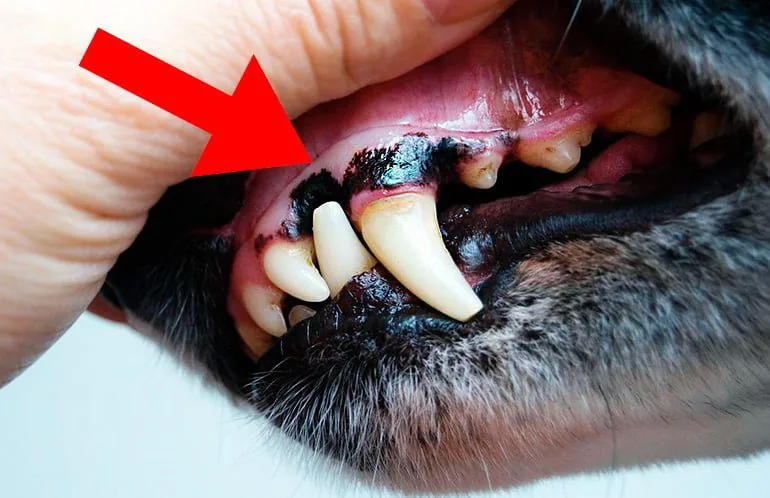
Spots in a Dog's Mouth
But sometimes, the dog doesn't have entirely black gums or show collapse, and we only detect the color change in some areas. These cases can be due to a normal coloring, since dogs have pigments that darken different areas, including the tongue and gums.
But other times, especially when the darkening occurs around the teeth or suddenly once the dog is already an adult, it's pointing to a dental problem. The most widespread is periodontal disease. This is linked to poor hygiene, an unsuitable diet, and also genetic factors.
What Is Periodontal Disease in Dogs?
This disease starts with a buildup of dental plaque that, over time, ends up forming the well-known tartar. This deposits between the tooth and the gum, causing them to separate, becoming a source of infection. The affected teeth eventually loosen and fall out.
The dog may have pain, excess drooling, swollen and red gums that bleed at the slightest contact, pus, bad breath or halitosis, etc. It's necessary to see the vet so they can start treatment. Several teeth will likely need to be extracted, and an ultrasonic cleaning of the mouth performed.
This is done after giving the dog general anesthesia. It involves removing all the tartar and polishing the teeth. Afterward, we'll need to implement hygiene routines at home, such as daily tooth brushing with a brush and toothpaste specially formulated for dogs. The ultrasonic cleaning will likely need to be repeated periodically.
Mouth Tumors in Dogs
Growths can appear on dogs' gums that sometimes have a blackish coloring, such as melanomas. This is a type of cancer, more common in older dogs, that, when it grows in the mouth, carries a poor prognosis.
Unfortunately, it's usually malignant and spreads through metastasis to nearby lymph nodes, lungs, and generally any other organ. The vet will need to assess each case. Depending on its characteristics, it can be surgically removed or different drug treatments tried.
Dogs With Dark Gums
Finally, it's worth noting that some well-known breeds like the Chow Chow naturally and characteristically have a bluish-black gum tone, without this being any kind of disease at all. Besides the gums, the roof of the mouth, tongue, and lips also show this dark coloring due to a buildup of pigments.
Bibliography Carlson and Giffin. 2002. Manual práctico de veterinaria canina. Madrid. Editorial el Drac.
IMPORTANT: This article is for informational purposes only and does not constitute veterinary, nutritional or behavioural advice. Every dog is different, and only your trusted vet can advise you on its specific needs.