 Care
Care
Why Does My Dog Eat Paper? Causes
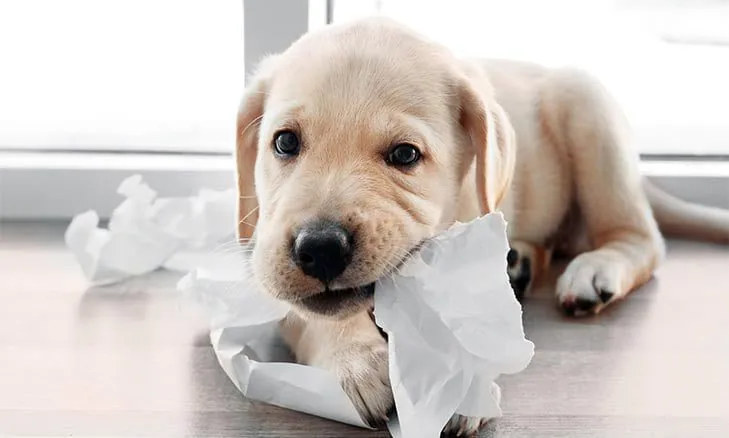
It's not unusual for a dog to swallow paper, especially if it's soaked in some food residue. But it's also not unusual for it to swallow it during an episode of destructive behavior. This last case is more common in puppies, in their exploratory eagerness.
A one-off event isn't concerning, but if we notice our dog eating paper continuously or combining it with other non-edible objects such as rocks, wall paint, or dirt, then we do need to worry.
Does My Dog Like Eating Paper?
First, it's worth stressing the importance of telling apart the one-off act of eating paper, which we could call incidental, from the behavior that involves eating paper almost compulsively.
In the first case, the dog may eat paper accidentally, for example, if its intention is to eat what's soaked into it. Muffin wrappers are a very typical example, but it will also be interested in anything else stained with oil, grease, sauce, etc. It doesn't want to eat the paper itself — it's after what its nose has detected on it.
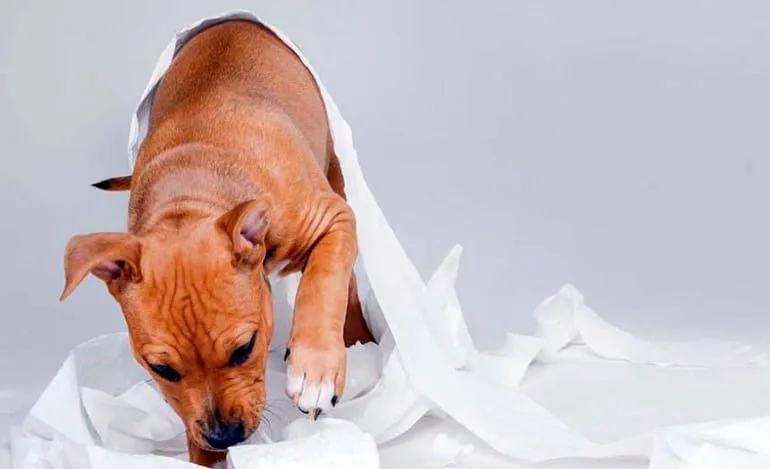
A very different case is that of a dog that eats paper, such as kitchen paper or toilet paper. It seeks it out and swallows it directly, not because it smells like food. This is the situation that can be linked to a health or behavioral problem.
The Pica Disorder
Pica syndrome is the name given to eating non-food materials. This includes all sorts of substances. So, a dog can eat paper, but also any other material such as plaster, rocks, dirt, hair, clothing, etc. — basically anything you can think of. Eating one's own feces or those of other animals is known as coprophagia.
It's a dangerous habit, since it can have health consequences, such as perforations, intestinal obstructions, digestive disorders, poisoning, malnutrition, etc. Different causes are pointed to that can explain why a dog would take to swallowing this type of material, and these are both physical and psychological.
The Dog Eats Paper From Stress
Dogs need physical and mental stimulation. This means we can't keep our dog locked up at home or in a yard, tied up, or with no contact with anyone. A dog whose basic needs in this regard aren't met will express it through behavioral changes. In other words, it redirects its pent-up energy.
It may direct it toward this activity or toward any other less advisable one, such as destructiveness or excessive barking. This gives it a certain relief. And it's this relief that acts as reinforcement, so the behavior repeats and continues. Eating paper or any other substance within reach is, in these dogs, a sign of stress.
If it's a puppy, the ingestion may be part of typical exploration of its surroundings, which includes trying, licking, or eating different objects. It's not unusual for it to destroy and swallow the newspaper we leave on the floor for it to relieve itself on. Even in this case, if it's not a one-off event, we need to assess its living conditions and change its routines.
Eating Paper From Separation Anxiety
We mention this disorder separately given how often it unfortunately shows up in dogs. In this case, eating paper can appear as secondary to destructiveness, which is one of the frequent symptoms in this problem. Others are barking, howling, whining, or urinating and defecating indoors.
These behaviors happen while the dog is left alone at home. When it has company, its behavior can be completely normal. Separation anxiety has a solution, but it requires time, patience, and putting it in the hands of professionals.
Addiction to Eating Paper From Illness
Sometimes there are conditions that come with a very pronounced increase in appetite, causing the dog not only to eat its usual ration but to swallow absolutely everything it finds.
For example, with diabetes, the dog can't get enough energy, so it keeps eating. The same happens if there's a nutrient absorption problem. Even if the dog eats well, it will never feel its needs are met. We need to see the vet to diagnose and treat this.
How to Prevent a Dog From Eating Paper
Ethologists are the professionals who can help you treat psychological problems, although it's always a good idea to rule out physical causes first. That's the vet's job. In other words, the first step is always to see a vet clinic for a general exam. The vet will also ask about its routines.
This refers to what the dog eats, how much, what its daily routine looks like, etc. If the professional's conclusion is that it's healthy, it can then be treated as a behavioral problem. On the other hand, if the ingestion is happening in a puppy exploring its surroundings, we can control the problem by offering suitable, interesting toys, such as ones that dispense food.
We'll also increase attention, play, and exercise, and provide socialization and training. If you catch it eating paper, don't scold it. Offer an alternative toy or call it over and reward it in that moment. This way it'll know which behavior you want it to repeat. Also, make sure you leave it in a safe environment.
Bibliography Carlson and Giffin. 2002. Manual práctico de veterinaria canina. Madrid. Editorial el Drac. Morris, Desmond. 1988. Observe a su perro. Barcelona. Plaza & Janés.
IMPORTANT: This article is for informational purposes only and does not constitute veterinary, nutritional or behavioural advice. Every dog is different, and only your trusted vet can advise you on its specific needs.